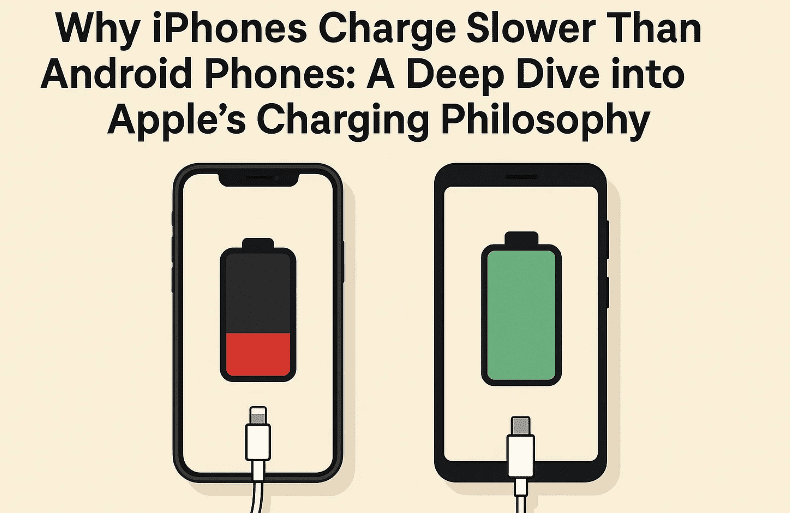
Have you ever plugged in your iPhone and wondered why it takes so long to charge compared to some Android phones that go from 0 to 100% in under 30 minutes? In recent years, Android manufacturers have boasted charging speeds of 100W, 120W, or even 240W, while Apple seems stuck at a much slower pace.
At first glance, it might look like Apple is behind the curve. But as with most Apple decisions, there’s a philosophy behind it—balancing speed, safety, and long-term battery health. In this article, we’ll explore the evolution of iPhone charging, explain why Apple has chosen a more conservative approach, and answer whether iPhones will ever catch up to the blazing-fast speeds of Android rivals.
The Early Days: 5W Charging on iPhone (2007–2011)
When Apple launched the very first iPhone in 2007, it came with the same 5W charger used for iPods at the time. Charging a phone from empty to full would take hours, but users didn’t complain. Back then, people usually charged their devices overnight and weren’t expecting “super-fast charging” like we do today.
Apple continued this tradition through the iPhone 3G, 3GS, iPhone 4, and 4S, sticking with the 5W standard. At the time, it was simple, safe, and reliable.
The Lightning Port Era (2012–2016)
In 2012, Apple introduced the Lightning connector with the iPhone 5. It was reversible, compact, and more durable than the old 30-pin dock connector. Many expected Apple to also bump up charging speeds with this new port.
But surprisingly, Apple stuck with 5W charging. Even though the new connector promised a faster digital future, Apple did not prioritize charging speed.
With the iPhone 6 and iPhone 7 series, Apple quietly allowed faster charging—but only if you used a 12W iPad charger. This wasn’t advertised as an official feature, but savvy users discovered that plugging their iPhones into an iPad adapter reduced charging time significantly. You could call it “unofficial fast charging.”
The First Steps into Fast Charging (2017–2019)
Things started to change in 2017 with the iPhone 8, iPhone 8 Plus, and iPhone X. For the first time, Apple officially introduced fast charging through USB-C Power Delivery (PD).
- iPhones could now charge up to 18W.
- Apple promised 50% charge in just 30 minutes—a huge leap from before.
But here’s the catch: Apple didn’t include the required accessories. To use this feature, you needed to buy both:
- A USB-C to Lightning cable (sold separately).
- An 18W USB-C adapter (also sold separately).
At the same time, these iPhones supported Qi wireless charging at up to 7.5W, marking Apple’s entry into wireless power.
The iPhone 11 Series: A Small but Important Change
The iPhone 11 (2019) stuck to the same formula: fast charging up to 18W, but only if you bought the accessories separately.





However, Apple finally made a consumer-friendly move: the iPhone 11 Pro and iPhone 11 Pro Max came with an 18W charger included in the box. For the first time, Apple users could experience fast charging without extra purchases.
It felt like Apple was catching up. But as we’ll see, this momentum didn’t last long.
The iPhone 12 Revolution: No Charger in the Box
In 2020, Apple made one of its most controversial decisions with the iPhone 12 series. For the first time, iPhones did not include a power adapter in the box. Apple argued this move was environmentally friendly, reducing electronic waste.
Instead, the iPhone 12 came only with a USB-C to Lightning cable. If you wanted fast charging, you had to buy a 20W adapter separately.
Here’s what the iPhone 12 offered:
- Wired charging up to 20W (50% in ~30 minutes).
- Wireless MagSafe charging up to 15W.
This marked the beginning of Apple’s push toward wireless charging and accessory-based ecosystems.
MagSafe and the Wireless Charging Shift
While the lack of a charger in the box frustrated some, the real innovation in the iPhone 12 lineup was MagSafe.
- MagSafe used magnets to perfectly align your iPhone with the wireless charger.
- It delivered up to 15W wireless charging, faster than traditional Qi chargers.
- It also enabled a new wave of accessories—wallets, stands, car mounts, and more.
This wasn’t just about speed; it was about transforming how users interacted with their phones. MagSafe became a core part of Apple’s ecosystem.
iPhone 13 & 14: Slow Improvements Behind the Scenes
Apple didn’t change much with the iPhone 13 (2021) and iPhone 14 (2022) series on paper. Official specs still listed:
- 20W wired charging.
- 15W MagSafe charging.
However, independent tests revealed that the iPhone 14 Pro Max could actually hit speeds of up to 27W under the right conditions—even though Apple never advertised this.
But there’s a catch: once the battery reaches around 50%, Apple intentionally slows down charging speeds. This prevents heat buildup and protects the battery’s long-term health.
The USB-C Transition: iPhone 15 and Beyond
A major shift came in 2023 with the iPhone 15 lineup. Apple finally replaced the Lightning port with USB-C, aligning with EU regulations and the broader industry trend.
But before you get too excited—charging speeds didn’t change much.
- Standard iPhone 15 and 15 Plus models: still capped at 20W.
- iPhone 15 Pro and Pro Max: up to 27W under ideal conditions.
So while the connector changed, the charging philosophy stayed the same.
iPhone 16 Pro Models: Pushing the Limits Slightly Higher
With the iPhone 16 Pro and Pro Max (2024), Apple made small progress:
- Peak charging speeds now reach 27–30W during the early charging phase.
- In some cases, speeds can spike slightly higher for short bursts.
- Standard iPhone 16 models remain capped at 20W.
This shows Apple is willing to improve gradually but still avoids joining the ultra-fast charging race that Android brands compete in.
Why Apple Doesn’t Compete in the Fast Charging Race
At this point, you might be asking: If Android phones can safely hit 100W or even 240W, why doesn’t Apple match them?
The answer comes down to battery longevity and safety. Apple prioritizes:
- Battery health over years of use – iPhones are designed to last 3–5 years without severe battery degradation.
- Heat management – high wattage charging generates heat, which accelerates wear.
- Consistency – Apple wants every iPhone to perform reliably, rather than chasing spec-sheet records.
In short, Apple believes that “slow and steady” is better for the average consumer, even if it looks outdated next to Android’s numbers.
Android vs. iPhone Charging: A Quick Comparison Table
| Feature | iPhone 16 Pro Max (2024) | Android Flagship (e.g., Xiaomi, Realme, Oppo) |
|---|---|---|
| Maximum Wired Speed | ~30W | 100W – 240W |
| Wireless Charging Speed | 15W (MagSafe) | 50W – 120W (proprietary) |
| Time to 50% Battery | ~30 minutes | 10–15 minutes |
| Time to Full Charge | ~90 minutes | 20–30 minutes |
| Focus | Battery longevity | Fastest possible charging |
FAQs About iPhone Charging
Q1: Why does my iPhone slow down charging after 50%?
Apple deliberately reduces charging speed after 50% to prevent overheating and extend battery lifespan.
Q2: Can I use a higher-watt charger for faster results?
Yes, but only up to a point. Even if you plug in a 60W charger, your iPhone will only draw a maximum of ~27–30W.
Q3: Does MagSafe reduce battery health?
MagSafe generates more heat than wired charging, which can slightly impact long-term health. But Apple manages this with strict thermal controls.
Q4: Why doesn’t Apple advertise 27W charging for Pro models?
Apple prefers to underpromise and overdeliver. Officially listing 20W keeps expectations realistic, while advanced users discover the hidden performance.
Q5: Will Apple ever adopt 100W charging?
Unlikely in the near future. Apple’s focus remains on safety, battery longevity, and ecosystem integration rather than competing in wattage numbers.
Final Thoughts: Slow but Steady Wins the Race?
Apple’s approach to charging can feel frustrating if you compare it directly with Android’s rapid advancements. But the truth is, Apple isn’t trying to win the “charging speed war.” Instead, they’re playing the long game—prioritizing battery health, user safety, and product reliability.
So yes, your iPhone might take longer to charge. But chances are, its battery will last longer after years of daily use compared to some Android phones that undergo more stress from extreme charging speeds.
The real question is: Do you prefer speed at all costs, or long-term stability? Apple has clearly chosen the latter.
✅ Disclaimer: This article is based on Apple’s official documentation, product specifications, and independent charging tests. Actual charging performance may vary depending on conditions, accessories used, and battery health.
Tags: iPhone charging, Apple fast charging, MagSafe, USB-C iPhone, iPhone battery health, iPhone vs Android charging, iPhone 16 Pro charging
Hashtags: #iPhone #FastCharging #MagSafe #Apple #USB-C #BatteryHealth #iPhone16