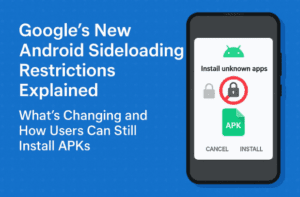
For years, one of Android’s biggest advantages over Apple’s iOS has been freedom. You could install apps from anywhere — whether through the Google Play Store, a third-party marketplace like F-Droid, or even directly from a developer’s website using a simple APK file. That openness became part of Android’s identity.
But Google’s newly announced app verification rules are about to change that story. Starting in the next few years, developers will need to register with Google and verify their identity — even if they never publish their apps on the Play Store. Apps that don’t meet these requirements simply won’t run on most Android devices.
On the surface, Google frames this as a security measure to fight malware, but the consequences go much deeper. This shift could:
- Limit how easily users can sideload apps.
- Force independent developers into Google’s system.
- Give governments more leverage to pressure Google into blocking apps.
- Bring Android closer to Apple’s “walled garden” ecosystem.
So, is Android slowly losing the very thing that made it different? In this article, we’ll break down Google’s upcoming verification rules, explain the timeline, explore what it means for developers and users, and consider whether Android is truly on the path to becoming iOS.

In this article, we’ll break down what Google’s policy means, why they’re introducing it, the timeline for rollout, how it affects developers, what users can do to prepare, and the broader implications for privacy and freedom.
🔒 What Is Changing in Android App Verification
Until now, anyone could:
- Download an APK file from a website.
- Tap it, approve installation, and run it.
That freedom is about to shrink.
Google is introducing mandatory developer verification. This means:
- Any developer who wants their app to run on Android (even outside the Play Store) must register with Google.
- Apps without verification will simply not work on most Android devices.
Essentially, sideloading without Google’s approval will no longer be possible on mainstream Android phones.
🛡️ Why Google Is Enforcing Developer Verification
Google’s official reasoning is security.
- Sideloaded apps are a common vector for malware.
- Malicious apps can easily trick users by imitating popular apps or hiding spyware.
- In 2023, Google added stricter verification within the Play Store and reported a sharp decline in malware incidents.
So, their logic is: if verification improved Play Store safety, why not extend it to all sideloaded apps?







But this solution comes with huge consequences:
- Developers must hand over personal data and government ID.
- Google gains control over apps that never touch its Play Store.
- Governments could pressure Google to block apps for political reasons.
This raises the question: is this about security, or about control?
📅 Timeline: When the New Rules Roll Out
Google is rolling this out gradually:
- October 2025 – Testing begins in select markets.
- September 2026 – Launch in specific high-risk regions (likely where malware is more common).
- 2027 – Planned global rollout, requiring all developers worldwide to verify.
So while the full impact may feel distant, the clock is ticking.
👨💻 What Developers Will Have to Do
For developers, the new rules mean:
- Register in Google’s Developer Console – even if you never plan to publish on the Play Store.
- Provide KYC (Know Your Customer) details – including:
- Full legal name.
- Residential or organizational address.
- Contact email.
- Government-issued ID.
- Submit app signing keys and package name to Google.
This last part is especially controversial. The app signing key is a developer’s most sensitive credential. It proves ownership of an app. Handing it over to Google could feel like surrendering independence, especially for developers deliberately avoiding the Play Store.
👉 Example: Projects like Signal Messenger offer APKs directly from their websites. Under the new system, even Signal would need to register with Google for those APKs to remain usable.
👥 How This Impacts Users
From the user perspective, the changes are even more concerning:
- No more easy sideloading – APKs from developer websites may stop working unless verified.
- Greater censorship risk – Apps Google or governments dislike could be blocked entirely.
- Loss of freedom – Android, once praised for openness compared to iOS, edges closer to Apple’s walled garden.
This isn’t just about niche apps. Think about:
- VPNs built to bypass censorship.
- Open-source tools distributed outside the Play Store.
- Beta apps shared directly by indie developers.
All of these could be at risk.
⚖️ Security vs Freedom: The Trade-Off
At its core, this debate is about security vs openness.
- Pro-Google Argument: Sideloading is the biggest source of Android malware. Verification reduces risks, just as it did in the Play Store.
- Counterpoint: Even if security improves, users lose freedom. Every computer operating system (Windows, Linux, macOS) allows downloading apps from the internet. Why should phones be different?
Many believe this is less about protecting users and more about protecting Google’s ecosystem dominance.
🛍️ Third-Party App Stores and F-Droid
What about alternative stores like F-Droid?
Here’s the nuance:
- This new rule applies only to devices with Google Play Services installed.
- On most mainstream Android devices (Pixel, Samsung, Motorola, etc.), Play Services is deeply integrated.
- On custom ROMs (e.g., LineageOS without Play Services), apps from F-Droid would still work.
So while power users may bypass the restriction, the average Android owner who just uses the phone out of the box will feel the effects.
📊 Comparison of App Installation Models on Android
| Feature / Requirement | Google Play Store Apps (Current) | Sideloaded Apps (Now) | Sideloaded Apps (Future – after Google’s Verification) | Third-Party Stores (e.g., F-Droid) |
|---|---|---|---|---|
| Developer Registration | Mandatory via Google Developer Console | Not required | Mandatory via Google Developer Console (even outside Play Store) | Depends on store policy (F-Droid curates open-source apps without KYC) |
| KYC / Identity Verification | Yes (legal name, ID, organization details) | No | Yes (government ID, legal info required) | No, unless future rules extend indirectly |
| App Signing Keys | Submitted to Google for validation | Held only by developer | Must be shared with Google during verification | Managed by developers directly |
| Distribution Control | Google has full control (approval required) | User decides what to install | Google decides what runs (apps must be verified) | Store-specific; outside Google Play Services, not affected |
| Security Filtering | Google Play Protect + app reviews | User discretion, Play Protect scans if enabled | Apps blocked if not verified, even if user wants them | Depends on ROM – usually allowed unless Google Play Services present |
| User Freedom | Restricted to Play Store rules | Full freedom to install any APK | Reduced — only verified APKs run | Full freedom if using a ROM without Google Play Services |
| Malware Risk | Low (but not zero) | Higher (due to unverified APKs) | Reduced (verification aims to lower it) | Depends on curation; F-Droid usually safe due to open-source model |
| Global Availability | Everywhere Google Play exists | Anywhere APK is shared | Gradual rollout (full by ~2027) | Only where users choose to install F-Droid/custom ROMs |
🛠️ Possible Workarounds for Users
There are still some strategies users can consider:
- Install F-Droid now – If you already have apps installed before the new rules, Google is unlikely to retroactively remove them.
- Use custom ROMs – Systems like GrapheneOS or LineageOS without Google Play Services won’t be subject to these checks.
- Explore microG – A replacement for Google Play Services used by privacy-focused communities.
- Pressure developers to verify – Some open-source devs may reluctantly register to keep their apps usable.
👉 Important: There’s still uncertainty. Google hasn’t explained what “unverified apps won’t work” technically means. Will there be bypasses? Will older Android versions be unaffected? Only time will tell.
⚔️ Wider Context: Epic Games, Lawsuits, and Control
The timing of Google’s policy is suspicious.
- Epic Games sued Google over antitrust violations, arguing that third-party app stores should have more freedom.
- Courts have pressured Google to reduce control over Play Store distribution.
- At the same time, Google introduces a verification requirement that ironically increases their control over all apps, Play Store or not.
This could be seen as Google’s attempt to regain power just as regulators and lawsuits try to take it away.
🔮 Signs of Android Moving Towards iOS-Like Restrictions
This isn’t an isolated change. Recent trends show Android slowly closing its doors:
- Samsung disabling bootloader unlocking in many regions.
- Google AOSP (Android Open Source Project) now developed more privately.
- Increasing integration of Google Play Services into the core of Android.
Taken together, this paints a picture: Android is no longer the wide-open system it used to be.
❓ Frequently Asked Questions (FAQs)
Q1. Will sideloading completely disappear?
Not entirely. On custom ROMs or devices without Google Play Services, sideloading should remain possible. But for most mainstream users, unverified APKs will stop working.
Q2. What happens to apps like Signal that offer APKs outside the Play Store?
They will need to verify with Google. Otherwise, their direct downloads won’t work on most Android phones.
Q3. Is this update retroactive? Will existing sideloaded apps stop working?
Unlikely. Google has never forcibly uninstalled apps. However, future updates may block launching unverified apps.
Q4. What about developers who don’t want to register with Google?
Their apps won’t run on standard Android phones with Google Play Services. This could push developers towards alternative platforms or ROMs.
Q5. When will this affect me as a user?
The first tests start in late 2025, but widespread enforcement is planned for 2027.
🏁 Conclusion
Google’s upcoming verification rules mark a turning point for Android. What was once the world’s most open mainstream mobile OS is steadily moving towards Apple’s restrictive model.
For developers, it means registering with Google, handing over sensitive information, and losing independence. For users, it means less freedom to install apps of their choice.
While the promise of increased security is valid, the cost may be too high — especially for communities that rely on sideloading for innovation, censorship circumvention, or independence from big tech.
If you value Android’s openness, now is the time to explore alternatives: install F-Droid, learn about custom ROMs, and support developers who push back against unnecessary restrictions.
⚠️ Disclaimer
This article is for informational purposes only. Policies described are based on early reports and Google’s announcements as of 2025. Timelines and technical details may change. Always check the official Android Developers website for the latest updates.
Tags
android sideloading changes, google play verification, android developer kyc, f-droid apps, android vs ios restrictions, app signing keys google, android user freedom, android security policies
Hashtags
#Android #Google #Sideloading #AppVerification #Privacy #Developers #FOSS #FDroid #MobileSecurity #TechNews