For more than a decade, Android has stood for freedom — a mobile operating system that allowed anyone to build, install, and share apps without gatekeepers. It wasn’t just a marketing line; it was a promise. You could take your phone, unlock it, and install anything you wanted — from your own experiments to apps that never made it to Google Play.
But that promise is now hanging by a thread.
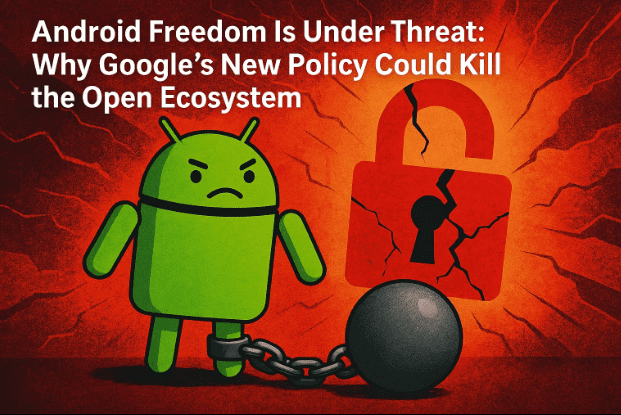
A new Google policy is threatening to shut down the very foundation of Android’s openness — third-party app installations and independent app stores like F-Droid.
This isn’t just a technical change. It’s a shift in digital rights, ownership, and sovereignty.
Let’s dive in and understand what’s happening, why it matters, and what every Android user — including you — can still do about it.
🧠 What’s Actually Happening?
In 2025, Google began enforcing new developer verification requirements for Android apps.
On paper, it sounds harmless: “verify who you are before publishing apps.”
But under the hood, this change affects every single developer, even those who never publish on the Play Store.
Developers — including those who distribute apps through F-Droid or their own websites — must now:
- Pay a mandatory fee to Google.
- Submit government-issued identification.
- Share private signing keys (cryptographic fingerprints used to verify app authenticity).
- Provide a complete list of current and future app identifiers.
That means if you’re an independent developer or part of an alternative app ecosystem, you’re now forced to register with Google — even if you never planned to use their store or services.
In other words:
To develop for Android, you now need Google’s permission.
This completely undermines the core idea of Android’s open nature.
⚠️ Why Is This So Dangerous?
This move effectively gives Google full control over what software can exist on Android devices.
Let’s break down why this is such a big deal:




1️⃣ It Kills Independent App Stores
F-Droid, the most respected open-source app store, has already warned that this policy could “kill them.”
F-Droid thrives on developer independence — allowing free, privacy-friendly apps without ads, trackers, or surveillance.
But with Google’s new policy, every developer publishing on F-Droid would still need Google’s approval and ID verification.
That defeats the entire point of having an independent app ecosystem.
2️⃣ It Compromises Developer Privacy
By requiring developers to submit personal IDs and private keys, Google gains unprecedented control and insight into everyone building apps — even its competitors.
Imagine being forced to give your passport and house keys to a rival company, just to exist in the same market.
3️⃣ It Weakens Global Digital Sovereignty
Countries that value open digital systems — like India, France, and Brazil — now face a sovereignty problem.
Why?
Because if all app installations must go through Google, governments lose control over what their citizens can or cannot install.
If Google removes an app under political pressure — as it has done before — people lose access entirely.
Real-World Example:
In Russia, Google once removed a voting app after government demands.
In China, VPN apps have been repeatedly delisted.
And when sideloading is banned, there’s no way for users to reinstall them independently.
The result?
A world where corporations — not citizens — decide what you’re allowed to run on your own device.
📵 “You Don’t Actually Own Your Device”
This is the harsh truth many Android users are waking up to.
If these restrictions go live globally, you will no longer own your phone in any meaningful sense.
You’ll only be allowed to install what Google authorizes — similar to Apple’s App Store model.
That means:
- No experimental apps.
- No custom versions of popular software.
- No local community tools or privacy-friendly replacements.
Your phone becomes a locked ecosystem — a walled garden disguised as freedom.
🧩 Why This Affects Everyone (Not Just Android Users)
Even if you’re an iPhone user, this matters.
Here’s why:
If Google — historically the “open” alternative — adopts Apple’s walled-garden model, then both major mobile ecosystems become closed.
And once both giants agree that “one app store for all” is the norm, there’s no competitive pressure to remain open.
That’s dangerous not only for innovation but also for freedom of choice.
The mobile internet becomes controlled by two gatekeepers instead of a global community of developers.
🌍 How This Threatens Global Democracy
Let’s step back for a moment.
Smartphones are no longer just phones — they’re our connection to information, news, and activism.
If app access is restricted, governments can easily pressure Google or Apple to censor apps that expose corruption, support protests, or enable privacy.
When there’s no way to install apps outside the official store, freedom of speech and expression suffer.
So this isn’t just a technical battle — it’s a question of civil liberty.
A country that allows only government-approved or corporation-approved apps effectively limits the free flow of ideas.
That’s why the Keep Android Open movement isn’t about developers or geeks — it’s about democracy itself.
🏛️ The “Keep Android Open” Initiative
Thankfully, not everyone is silent.
A new global campaign — KeepAndroidOpen.org — is actively working to raise awareness and pressure regulators worldwide.
Their message is simple:
Android must remain open to everyone — not just Google-approved developers.
Let’s explore what they’re asking us to do.
✉️ Step 1: Contact Regulators in Your Country
The most effective thing you can do is send a short email to your regional tech or digital regulator.
You can find country-specific contacts directly on the Keep Android Open website for regions like:
- European Union
- United States
- India
- Brazil, Singapore, Thailand, Indonesia
- Australia, Japan, South Korea, Canada, UK, and many more
The process takes less than 10 minutes:
- Choose your country.
- Write an email in your official national language.
- Explain that Google’s new Android verification violates open software principles.
- Request a written acknowledgement.
- Forward any response to victory@keepandroidopen.org for documentation.
It may sound small, but a coordinated flood of citizen messages does influence lawmakers.
Europe’s Digital Markets Act (DMA), for example, took years of public pressure to pass — and this new Google policy might even violate it.
So your voice truly matters.
🛠️ Step 2: Use and Support Alternative App Stores
If you haven’t already, install F-Droid.
It’s a free, open-source app store built entirely on community trust.
Using F-Droid isn’t just about convenience — it’s about sending a message:
We want app diversity, not corporate monopoly.
Other independent stores like Aurora Store, Obtainium, and Neo Store also allow open access to software without Play Store restrictions.
🧾 Step 3: Sign the Open Letter and Petition
If you represent an organization, you can co-sign the open letter to Google, hosted securely on CryptPad.
You’ll need to email your:
- Name
- Title
- Organization affiliation
- Statement of intent to sign
If you’re an individual, you can also sign the Change.org petition supporting this cause.
At the time of writing, over 13,000 people have already signed — and growing.
🧑💻 Step 4: Developers — Take a Stand
If you’re a developer, here’s how you can help protect the ecosystem:
- Do NOT enroll in Google’s new “Developer Identity Verification” or “Early Access” programs.
- Respond politely to any invitation, listing your privacy concerns.
- Share awareness in developer groups, Reddit, or forums.
- Add the open-source FreeDroid WARN library in your app to alert users about this policy.
Remember: silence equals compliance. If enough developers refuse participation, Google will face regulatory scrutiny.
📢 Step 5: Spread Awareness Online
Even if you’re not a developer, your influence counts.
Here’s what you can do:
- Write or share posts on social media with #KeepAndroidOpen.
- Comment constructively on discussions where misinformation is spreading.
- Translate campaign messages into your local language.
- Encourage people to visit keepandroidopen.org.
The movement depends on visibility. The more people talk about it, the harder it becomes to ignore.
🧩 Step 6: Contribute to the Cause
If you’re familiar with privacy or open-source communities, you can also help by:
- Editing or improving the Keep Android Open website.
- Adding regional regulator links not yet listed.
- Supporting open-source developers on Liberapay or Patreon.
Every small action builds toward collective resistance.
💬 Q&A: Common Questions About the Android Freedom Issue
Q1. Isn’t Google just improving security?
Security is important, yes — but this policy isn’t just about malware. It’s about forcing all developers (even those outside Play Store) to surrender their identities and keys. That’s about control, not protection.
Q2. Why can’t we just trust Google?
Because no single company should decide what’s allowed on billions of devices. Power must be decentralized.
Q3. What about iOS users — how does this affect them?
If Android becomes just as closed as iOS, Apple gets free justification to tighten its own restrictions further. Both ecosystems would lock users in permanently.
Q4. Is sideloading really that important?
Yes. Sideloading (installing apps directly via APKs) ensures user autonomy. Without it, you can’t install apps that are blocked, censored, or region-locked.
Q5. Will regulators actually care?
They will — if we tell them. Laws like the DMA and India’s Digital Competition Act exist to stop such monopolistic behavior. Regulators often act only after receiving enough complaints.
🔒 Why This Is a Battle for Device Ownership
At the heart of this issue lies a philosophical question:
When you buy a smartphone, do you truly own it?
In the desktop world, you can install anything you like — Windows, macOS, or Linux.
But on your phone, your “ownership” is conditional.
If Android loses sideloading and third-party stores, your phone effectively becomes rented hardware — controlled by remote policy updates, not your personal choice.
And that’s not freedom. That’s dependency.
🧭 The Broader Picture: Open vs Closed Ecosystems
Let’s put this into context:
| Platform | App Freedom | Developer Verification | Alternative Stores |
|---|---|---|---|
| Android (Old) | Full sideloading | Optional | F-Droid, Aurora, etc. |
| Android (New Policy) | Restricted | Mandatory Google ID & fee | Heavily limited |
| iOS | None | Mandatory Apple ID | None |
| Windows/Linux | Unlimited | Optional | Unlimited |
See the problem?
Android used to be the only major open mobile OS.
This policy eliminates the last stronghold of user freedom in the smartphone world.
🔥 The Fight for Open Android Isn’t Over
It’s not too late.
Movements like #KeepAndroidOpen have already drawn attention from privacy organizations, open-source advocates, and digital rights groups across Europe and Asia.
Even if you do just one of these today — emailing your regulator, installing F-Droid, or signing the petition — you’ll contribute to a larger wave that defends freedom for everyone.
The Android ecosystem was built on community innovation — not corporate monopoly.
And keeping it open is our collective responsibility.
⚠️ Disclaimer
This article is for educational and informational purposes. It encourages lawful activism and public awareness regarding digital rights and open-source software. Always comply with your country’s regulations when communicating with authorities or modifying your device.
#KeepAndroidOpen #AndroidFreedom #FOSS #DigitalRights #Privacy #FDroid #TechLore #GooglePolicy #MobileFreedom