Do you remember the early days of 4G in India? Every time we recharged our mobile plan, we had to carefully calculate: “Will my 1GB or 1.5GB last the whole day?” Watching YouTube or playing PUBG meant constantly worrying about running out of data.
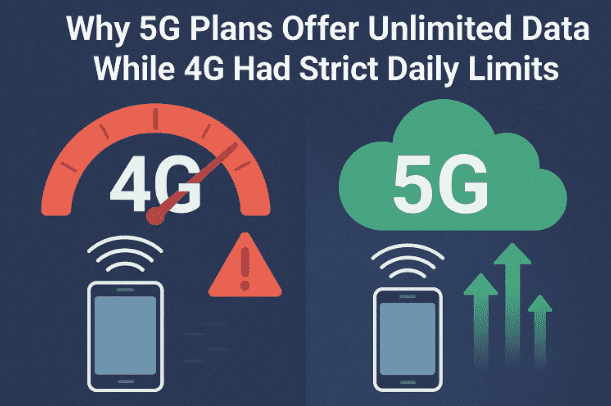
Now things look completely different. Telecom companies are advertising “Unlimited 5G Data”, encouraging users to consume as much as they want. But this raises an interesting question: Why was 4G data always limited, while 5G suddenly feels unlimited?
Let’s break this mystery down step by step.
1. The Data Revolution That Started with 4G
When 4G launched in India, it triggered a digital revolution. Reliance Jio entered the market, slashed internet prices, and millions of people suddenly had affordable access to high-speed data.
For the first time, people were streaming YouTube daily, making endless WhatsApp calls, and gaming online without worrying about 2G/3G buffering.
But this explosion of users created a big challenge.
- Millions of new connections meant every 4G tower was overloaded.
- Internet speeds slowed down drastically in crowded areas.
- Companies had to limit daily usage to prevent the entire network from collapsing.
That’s when data caps like “1GB/day” or “1.5GB/day” became the norm.
2. What is Spectrum? The Internet Highway Explained
To truly understand the difference between 4G and 5G, we need to understand spectrum.
Think of spectrum as a highway for internet data:
- Just like highways have lanes (2-lane, 4-lane, 8-lane roads), spectrum has frequency bands.
- Each telecom company buys specific bands from the government through auctions.
- These bands define how many devices can connect and how much data can pass through without congestion.
In 4G, companies mostly operated in the 1800 MHz to 2300 MHz bands. This was like having a narrow road with too much traffic.
In 5G, companies gained access to 3300 MHz mid-band and even 26 GHz mmWave spectrum. These are super-high-capacity expressways, allowing millions of devices to pass through smoothly.






💡 Analogy: Imagine a village with a small canal providing water to everyone. People drink from it, wash utensils, bathe, and animals drink too. The canal gets overloaded, and water pressure drops. Now imagine replacing that with a huge dam-fed canal — suddenly, there’s plenty of water for everyone. That’s the difference between 4G and 5G spectrum capacity.
3. Why 4G Had Data Limits
Telecom companies didn’t impose daily limits on 4G data because they enjoyed restricting customers. They had no choice.
Here’s why:
- Limited spectrum (narrow lanes): Fewer frequency bands meant less bandwidth.
- Too many users: Millions of people joined at once, creating a jam.
- Fear of network collapse: If everyone streamed unlimited video, speeds would drop to 2G-like levels.
- Sustainability: Companies had to ration data, offering per-day caps like 1GB or 1.5GB.
This was the only way to keep the system fair — otherwise, heavy users would hog all the resources.
4. Why 5G Can Offer Unlimited Data
Now let’s flip the game. With 5G, the situation is completely different.
- Much larger spectrum bands: 3300 MHz mid-band and 26 GHz mmWave offer huge bandwidth.
- Higher efficiency: 5G technology can handle more devices per tower.
- Super speed: Faster data transfer means even heavy users don’t clog the system.
- Low adoption (for now): Not everyone has a 5G phone yet, so networks are under less pressure.
To simplify:
- 4G = a single-lane road with traffic jams.
- 5G = a multi-lane expressway where traffic flows smoothly.
This capacity gives telecom companies confidence to offer “Unlimited Data” — at least for now.
5. The Catch: Fair Usage Policy in “Unlimited” Plans
Before you celebrate, there’s an important twist.
“Unlimited data” in telecom plans is not truly unlimited. Most companies include a Fair Usage Policy (FUP).
- You may get high-speed data up to a certain GB limit.
- After crossing that limit, your speed drops (sometimes to 1 Mbps or less).
- This ensures that a few users don’t hog the entire network.
So yes, you can technically keep using data endlessly, but your experience may slow down after a point.
6. The Marketing Strategy Behind Unlimited 5G
There’s also a strong business angle.
Telecom companies know that unlimited plans attract customers. The word “unlimited” creates excitement, even if there are hidden conditions.
- In 4G: Companies needed to monetize every GB, so they introduced daily limits.
- In 5G: Companies need customers to adopt the new technology quickly. By offering unlimited data, they push people to upgrade to 5G phones and plans.
It’s both a technical advantage and a marketing strategy.
7. Will 5G Always Remain Unlimited?
This is the million-dollar question.
Right now, unlimited 5G is possible because:
- Not everyone has switched to 5G.
- Spectrum availability is higher.
- Companies want rapid adoption.
But in the future, as millions more users shift to 5G, congestion may return. If that happens, companies might reintroduce limits, just like they did with 4G.
So, unlimited 5G may not last forever. It depends on:
- How efficiently networks expand.
- How many people adopt 5G.
- How much spectrum companies buy in future auctions.
8. Frequently Asked Questions
Q1. Why did 4G networks feel congested while 3G didn’t?
Because 3G adoption was slower and data usage lighter. 4G’s low pricing led to a sudden surge in demand, overwhelming towers.
Q2. Is 5G really unlimited for all users?
Not exactly. Plans usually include a Fair Usage Policy, which lowers your speed after a certain data cap.
Q3. Why do companies spend billions on spectrum auctions?
Because spectrum is like renting road space. The more lanes they buy, the more users and data they can handle.
Q4. Will 6G also be unlimited?
Possibly, but history suggests limits may return when networks get overloaded. Every generation starts “open” and tightens later.
Q5. Does unlimited 5G affect battery life?
Yes. Higher speeds can encourage heavier usage (streaming, downloads), which drains batteries faster.
9. Final Thoughts
So now you know why 4G had strict daily caps while 5G is being marketed as unlimited.
- 4G = limited spectrum, high congestion → daily caps.
- 5G = wide spectrum, higher efficiency → unlimited plans (with FUP).
But remember — this “unlimited” phase may not last forever. As adoption grows, telecom companies might bring back limits to manage load.
For now, enjoy the benefits of 5G, but keep in mind that “unlimited” always comes with fine print.
⚠️ Disclaimer
Telecom plans, spectrum allocations, and policies vary across regions and operators. Always check the terms and conditions of your specific plan before assuming truly unlimited usage.
Tags
5G in India, Unlimited Data Plans, 4G vs 5G, Telecom Spectrum, Fair Usage Policy, Mobile Data Limits, 5G Internet Speed, Telecom Strategy
Hashtags
#5G #UnlimitedData #Telecom #InternetSpeed #4Gvs5G #MobilePlans #DigitalIndia