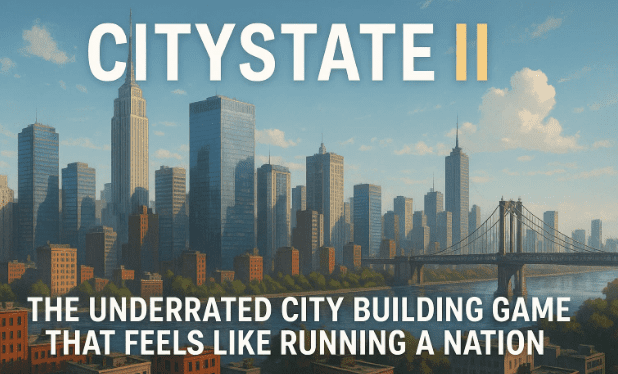
City-building games have always had a special place in the hearts of strategy and simulation fans. From classics like SimCity to modern favorites such as Cities: Skylines, the genre has grown into something much bigger than just placing houses and roads. Yet, hidden beneath the radar of many players is a game that takes this concept to the next level—Citystate II.
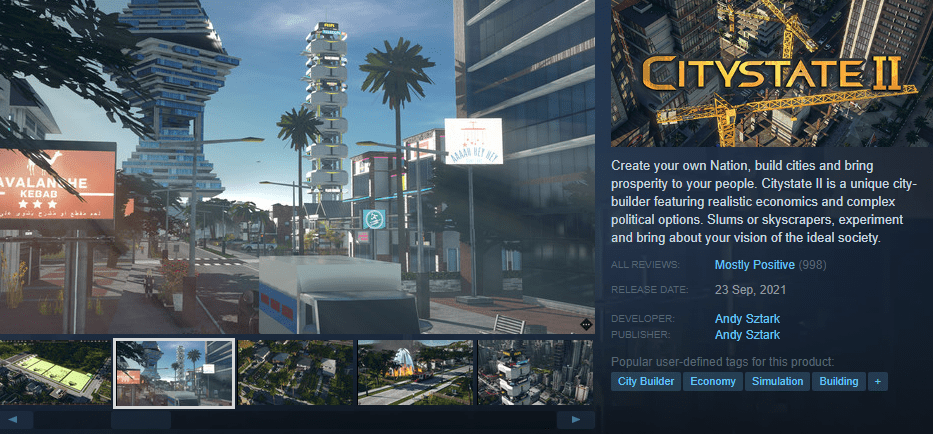
This isn’t just a city builder—it’s a nation simulator. You’re not only constructing roads and skyscrapers; you’re drafting laws, adjusting taxes, setting immigration policies, managing inflation, and even printing money if the situation demands it. Surprisingly, despite its depth, Citystate II is often overlooked compared to bigger titles.
In this article, we’ll take a deep dive into how Citystate II works, why it stands out, and how you can start playing it effectively.
👉 Official website: Citystate II on Steam
1. What Makes Citystate II Unique
Unlike most city builders, Citystate II treats your city not just as a settlement but as part of a larger nation simulation.
- You can enact laws around patents, copyrights, and civil rights.
- Adjusting border policies determines which demographics immigrate into your nation.
- Printing money is possible, but it comes at the cost of inflation.
- Political parties exist, and their approval influences how smoothly you can govern.
- Cities aren’t isolated—they are part of your country’s economy, meaning you can build and manage multiple interconnected urban centers.
This makes Citystate II far more complex and realistic compared to games like Cities: Skylines 2.
2. Starting Your First City
Let’s walk through the very beginning of gameplay, where you’re tasked with establishing your first settlement.
Before constructing anything, you must purchase land from the government. A typical starting plot costs around 200,000 credits. With limited funds, planning carefully from the start is essential.
Once the land is bought and the city is named, you’re dropped onto the map. The next step is setting up the road network. Gravel roads are the cheapest, but they may become overcrowded quickly. Many players choose to begin with larger, upgradeable roads to future-proof traffic management.
From here, a grid layout is a safe and simple choice to begin zoning.
3. Zoning Explained – Low, Medium, High Density
Zoning in Citystate II is different from other city builders. You have three main categories:










- Low Density → Small houses and shops, useful for suburbs and early stages.
- Medium Density → Mid-sized apartments and commercial blocks.
- High Density → Towers, skyscrapers, and large industrial complexes.
Unlike SimCity or Cities: Skylines, you don’t need to “unlock” high density through milestones—you can use it right away.
However, density here doesn’t mean population immediately. Instead, it refers to the potential growth cap. For example:
- A low-density plot might grow into a small townhouse.
- A high-density plot starts small but has the ability to evolve into skyscrapers later.
4. Utilities and Basic Services
Naturally, your citizens won’t live happily without water and electricity.
- Water: Early game usually starts with a water tower, which covers basic needs.
- Electricity: A solar farm is cheap and eco-friendly, though its output may struggle to keep up with rapid expansion.
These two are essential because without them, complaints will flood in and buildings won’t upgrade.
5. The Social Ladder System
One of Citystate II’s most fascinating mechanics is the social ladder.
Citizens are divided into:
- Lower Class
- Middle Class
- Upper Class
Your policies, education, inflation levels, and taxation affect whether people can “climb” into higher social groups. This isn’t just cosmetic—it directly impacts workforce quality, economy stability, and approval ratings.
For instance:
- Lower inflation + better education → More middle-class citizens.
- Lower taxes on the wealthy → Growth in the upper class.
6. Employment, Industry, and Economy
Without jobs, your city collapses. Industry comes in two main forms:
- Basic Industry – Farming, mining, and low-level factories.
- Manufacturing/Advanced Industry – High-tech production and cleaner industrial zones that require high land value.
Employment balance is crucial. If unemployment rises, stability falls and political unrest grows. If jobs are too few, you can temporarily assign “fictitious jobs” at government buildings until the private sector catches up.
7. Government Buildings and Legislation
Early in the game, you unlock Government Headquarters, where legislation can be enacted.
Examples include:
- Mandatory Entrepreneurship Program – Boosts innovation and lowers unemployment.
- Unemployment Policies – Helps reduce poverty but may cost heavily.
- Commerce & Social Affairs Departments – Unlock deeper policies such as gambling bans, pension laws, and pollution taxes.
Unlike other city builders, these decisions have real consequences on approval ratings, economy, and social class balance.
8. Taxes, Inflation, and Currency
Taxes are not just sliders for money—they’re deeply tied to approval, social mobility, and inflation.
- Lower taxes → Higher approval, easier class mobility.
- Higher taxes → More revenue but risks unrest.
You can also print money. While tempting in a financial crisis, this raises inflation. To control inflation, you’ll need to:
- Boost exports through farming, mining, and industry.
- Maintain a positive trade balance.
- Strengthen your currency reserves.
This adds a layer of realism rarely seen in other city builders.
9. Immigration and Border Policy
At around 2,000 population, you unlock the Department of Immigration. This lets you manage:
- Open or closed borders.
- Which countries citizens may immigrate from.
- Whether you want low-income workers or wealthy skilled migrants.
For example, allowing immigration from developing countries may rapidly increase population, but it can also expand low-income housing demand. Balancing this with education and job creation is essential.
10. Education, Healthcare, and Stability
Schools, hospitals, and libraries play a bigger role than simple “happiness” buildings.
- Elementary Schools can be upgraded with more teachers for higher capacity.
- High Schools and Universities are crucial for producing a skilled workforce.
- Hospitals reduce mortality and improve approval, but require heavy investment.
Meanwhile, stability (a hidden mechanic) drops if unemployment, poverty, or civil unrest grows. A stable government allows you to pass laws freely.
11. Transportation and Traffic Solutions
Traffic quickly becomes an issue as your population rises. Solutions include:
- Bus Stations → Affordable mass transit early on.
- Airports → Improve trade, tourism, and reduce isolation penalties.
- Road Upgrades → Wider avenues reduce congestion.
Since car usage is dominant, balancing public transport early makes your city more sustainable.
12. Advanced Industry and Manufacturing
Once land values rise, advanced manufacturing zones can be placed. These industries are cleaner and more profitable, but they require:
- High education levels.
- High land value.
- Low inflation.
This creates a natural progression from rural farming towns into high-tech urban hubs.
13. Religion, Social Policies, and Approval
Religion is another unique factor. Building churches increases religious influence, which in turn shapes voter preference toward conservative policies.
You can then pass laws that affect gambling, social rights, and civic freedoms. For example:
- Banning casinos → Stability boost but lower tourism.
- Expanding pensions → Higher approval but costly.
14. Managing Land Value
Land value isn’t just cosmetic—it determines which industries spawn.
Ways to increase land value:
- Build parks, plazas, and sports courts.
- Improve infrastructure like schools and hospitals nearby.
- Keep pollution low by zoning industry further away.
This directly influences your ability to attract upper-class citizens and advanced manufacturing.
15. Scaling Toward 25,000+ Population
The early target is 2,000 citizens, but later milestones like 25,000 unlock the Department of Commerce. At this stage, the challenge shifts from survival to economic fine-tuning.
- Expand residential areas carefully to prevent slums.
- Focus on exports to stabilize inflation.
- Balance middle and upper-class growth for stronger industry.
16. Military, Police, and Security
Your citizens won’t feel safe without law enforcement. Build and upgrade:
- Police Stations → Lower crime.
- Fire Stations → Reduce disaster risk.
- Libraries & Community Buildings → Indirectly improve approval and reduce unrest.
17. Resource Extraction and Trade Balance
Mining and oil drilling are possible if resources exist in your land plots. Each resource boosts exports, reduces trade deficits, and provides stability to your economy.
Combined with farming, these industries are your primary tool for keeping inflation low.
18. Driving & Helicopter Mode – Exploring the City
Beyond management, Citystate II lets you step into the streets with driving mode. You can:
- Drive a car through your city like in an open-world game.
- Fly a helicopter and view urban growth from above.
This feature adds immersion and lets you experience the city from a resident’s perspective.
19. FAQ: Common Player Questions
Q: Is Citystate II harder than Cities: Skylines?
A: Yes, it leans heavily on political and economic simulation, making it more complex but also more rewarding.
Q: Can I play multiple cities at once?
A: Yes. Cities exist within your nation and can trade or transfer funds between each other.
Q: How do I prevent slums from forming?
A: Improve land value with parks, schools, and infrastructure. Also, adjust immigration policies.
Q: What’s the best way to reduce inflation?
A: Increase exports through farming, mining, or manufacturing, and avoid printing too much money.
20. Final Thoughts
Citystate II is not just a city builder—it’s a nation simulator disguised as one. Every decision, from zoning land to banning casinos, has ripple effects across your economy and society. It blends the best of urban planning with deep economic and political mechanics rarely seen in the genre.
If you’ve grown bored of simple city builders and want a real challenge that tests your strategic thinking, Citystate II might be the hidden gem you’ve been searching for.
👉 Try it yourself here: Citystate II on Steam
Disclaimer
This article is for educational and informational purposes only. All game features described are based on publicly available information and gameplay experience. Always check the official website or Steam page for the latest updates, patches, and system requirements.
Tags: citystate ii, city building games, strategy simulation, cities skylines alternative, economy simulation, urban planning games
Hashtags: #CitystateII #CityBuilding #SimulationGames #StrategyGames #UrbanPlanning