For over a decade, cloud gaming has promised to free players from expensive GPUs and hardware upgrades. The idea was simple — instead of running a game locally on your PC or console, you stream it directly from a powerful machine in the cloud. In theory, this should turn any laptop, TV, or tablet into a high-end gaming rig.
But the reality hasn’t always lived up to the dream. Latency, compression, and connection drops have long been the enemies of cloud gaming. Most gamers still believed nothing could match the feel of playing on local hardware — until now.
In 2025, NVIDIA claims to have changed the game entirely with its Blackwell 5080 Super Pods, the backbone of its upgraded GeForce Now Ultimate tier. This isn’t just another incremental update — it’s a complete redefinition of what’s technically possible for real-time cloud gaming.
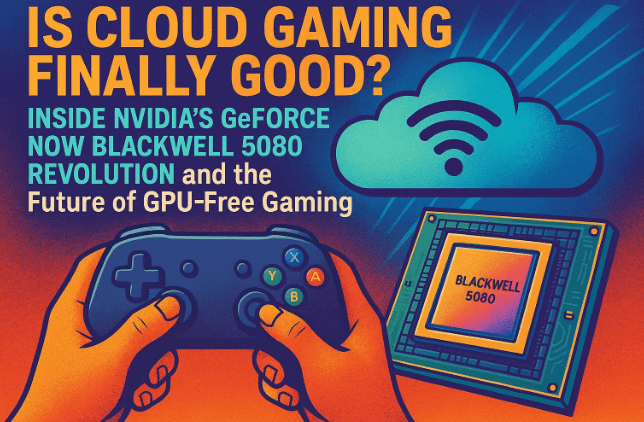
So, is cloud gaming finally good? Let’s dive deep into how NVIDIA’s latest system works, what real-world tests reveal, and whether it can truly compete with having your own GPU.
1️⃣ The Cloud Gaming Dream — and Why It Struggled for So Long
Before we jump into NVIDIA’s latest innovation, it’s worth recalling why cloud gaming struggled in the first place. The concept sounds perfect — play anywhere, no need for upgrades, instant access to the best GPUs. Yet, for years, it was mostly a disappointment.
Early services like Google Stadia, PlayStation Now, and even early versions of GeForce Now faced the same trio of problems:
- Input latency: Every keystroke and mouse movement had to travel to a data center, process there, and return as video. Even a 50-millisecond delay could make fast games feel sluggish.
- Compression artifacts: The streamed video, especially in action games, often looked blurry or pixelated, particularly in darker scenes or with rapid camera movement.
- Internet dependency: Lose your connection for even a few seconds, and your entire game froze.
These issues made it clear that the technology needed serious evolution — not just better hardware, but smarter data handling, encoding, and networking.
And that’s where NVIDIA’s Blackwell 5080 upgrade enters the scene.
2️⃣ What Makes NVIDIA’s Blackwell 5080 Super Pods Special
When NVIDIA announced that its new Blackwell GPU architecture was being used to power the latest GeForce Now Ultimate tier, many gamers raised an eyebrow. Could cloud GPUs really deliver the same responsiveness and fidelity as local ones?
To understand why this matters, let’s first see what’s actually inside these Super Pods.
Each Super Pod is essentially a massive data center rack equipped with RTX 5080-class GPUs, custom low-latency encoders, and ultra-fast NVLink interconnects. These systems are designed not just for rendering frames but also for compressing, encoding, and transmitting them with almost no delay.





NVIDIA claims these new servers can now stream games at:
- Up to 5K resolution or 4K 120 FPS,
- Or even 1080p at 360 FPS in competitive mode.
That’s a monumental leap. Four years ago, GeForce Now maxed out at 4K 60 FPS, and even that required a fiber-grade connection. Now, it’s offering PC-level fluidity — at least on paper.
3️⃣ How It Actually Works — From Input to Image
It’s easy to forget just how many technical steps occur between your mouse click and the image on your screen in a cloud gaming session. Let’s simplify this process:
- Input Transmission: Your mouse, keyboard, or controller input is sent instantly over the internet to NVIDIA’s nearest data center.
- Virtual Machine Setup: Each user is allocated a virtual gaming PC running Windows 11 with access to an RTX 5080-class GPU, 8 CPU cores, and up to 57 GB of RAM.
- Game Execution: The game runs on this VM — just like on your own PC — but the rendered frames never leave the server as pixels.
- Compression & Encoding: The output frames are compressed using NVIDIA’s low-latency video codec (NVENC) before being transmitted back to your device.
- Streaming to Display: The encoded video stream reaches your screen, and the process repeats in milliseconds.
This round-trip happens hundreds of times per second. The Blackwell encoder is what makes the magic possible — it’s designed for near-instantaneous compression with minimal quality loss.
NVIDIA also uses adaptive bitrates and region-based optimizations, dynamically adjusting the video quality to keep latency low even on imperfect connections.
4️⃣ Real-World Testing — Does It Actually Feel Like Local Gaming?
Let’s move to the fun part — the testing.
To evaluate whether NVIDIA’s promises hold true, a series of games were tested across genres — Indiana Jones and the Great Circle, Borderlands 4, and Apex Legends — comparing GeForce Now’s 5080 tier against local RTX 5080 hardware.
The results tell a fascinating story.
🕹️ Visual Fidelity and Compression
At first glance, the games look fantastic. 4K 120Hz gameplay feels smooth and visually clean — far sharper than earlier generations of GeForce Now. However, when you look closely, subtle compression artifacts appear, especially in darker or high-motion scenes (like light rays in fog or explosions).
For example:
- Indiana Jones looked stunning and responsive, though minor blockiness appeared during rapid camera pans.
- Borderlands 4, with its stylized art, was nearly flawless — the comic-book textures hid compression beautifully.
- Apex Legends, the real test of latency, showed smooth performance at 1080p 360Hz mode, with latency under 25 milliseconds total — only about 15ms higher than local play.
That’s an incredible feat considering the data travels hundreds of kilometers round-trip.
⚡ Latency — The Make-or-Break Metric
Latency is what separates a “fun demo” from a truly playable experience.
Using NVIDIA’s own LDAT (Latency Display Analysis Tool) — a hardware device that measures input-to-display delay — the following results were recorded:
| Mode | Average Latency | Experience |
|---|---|---|
| Local RTX 5080 (4K 120Hz) | ~20ms | Instant response |
| GeForce Now (4K 120Hz Balanced) | ~35–40ms | Slight delay, very playable |
| GeForce Now (1080p 360Hz Competitive) | ~25ms | Feels nearly local |
| GeForce Now (Cinematic 4K mode) | ~45–50ms | Noticeable lag on mouse input |
In real-world use, these numbers are astonishingly good. Most players wouldn’t notice any delay while using a controller — even in shooters.
Latency once killed cloud gaming. Today, it’s down to imperceptible levels for 95% of users.
🧩 Stability and Bugs
However, no system is perfect. During testing, some bugs appeared, like Steam profile sync issues and loading freezes when switching modes. These aren’t major dealbreakers, but they remind us that this is still a complex orchestration of virtual machines and remote streaming.
NVIDIA’s servers run Windows 11 for compatibility, and every session starts on a fresh instance — meaning unless you pay extra for persistent storage, you must reinstall games or sync cloud saves each session.
It’s a small but important trade-off between convenience and control.
5️⃣ Why Performance Matters More Than Ever
Gaming is no longer just about pretty graphics — it’s about responsiveness, frame pacing, and frame generation. NVIDIA knows this, and it’s why they built competitive mode (1080p 360Hz) specifically for esports and fast-paced titles.
In practice, this mode does something brilliant — it reduces video bitrate, sharpness, and resolution, all to gain near-local latency.
For example:
- Apex Legends felt surprisingly crisp at 360Hz streaming.
- The latency gap between local and cloud dropped to only 15ms.
- Even professional testers struggled to tell them apart without measurement tools.
So while cinematic gamers may crave perfect sharpness, competitive players now have a legitimate alternative that doesn’t require a $2000 gaming PC.
6️⃣ The Economics of GPU-Free Gaming
Let’s take a quick detour to the economics.
At $20/month for GeForce Now Ultimate, you’d pay roughly $1,000 over five years — equivalent to buying an RTX 5080 outright.
So, financially speaking, it’s a draw. But the difference lies in maintenance:
- No hardware upgrades.
- No driver conflicts.
- No power bills for a 500W GPU.
- No need for a powerful PC at all.
The catch? You don’t own your setup. NVIDIA can raise prices, remove features, or lock certain performance modes behind new tiers. And of course — if your internet drops, your entire “PC” vanishes.
That’s the philosophical trade-off of cloud computing: convenience vs control.
7️⃣ Technical Deep Dive — How Blackwell Makes It Possible
The heart of GeForce Now’s leap is NVIDIA’s Blackwell GPU architecture — the same one powering data centers and future AI workloads.
Here’s what’s happening under the hood:
- Dedicated AI tensor cores predict frame sequences to pre-render parts of the stream.
- Next-gen NVENC encoder compresses frames with lower latency and higher bit depth.
- NVLink 5 interconnect allows ultra-fast data sharing between GPUs inside the same rack.
- Smart scaling automatically shifts encoding priorities between visual fidelity and responsiveness depending on your connection speed.
These aren’t just buzzwords — they are the technical reasons why you can now play a ray-traced, 120FPS 4K title over the internet with smoothness unimaginable in 2020.
8️⃣ The Verdict — Is Cloud Gaming Finally Good?
After years of skepticism, the answer is yes — but with caveats.
Cloud gaming in 2025 is not a gimmick anymore. NVIDIA’s Blackwell-powered GeForce Now Ultimate delivers:
- 4K 120Hz visuals
- 360Hz esports modes
- Latencies as low as 25ms
- Hardware-level ray tracing and DLSS 3.5
- Compatibility with Steam, Xbox Game Pass, and Epic
For players with fiber internet and stable connections, this is genuinely a replacement for local gaming.
But if you live in a rural area, depend on Wi-Fi, or have data caps — it’s still not for you. Cloud gaming demands consistency, and the internet infrastructure isn’t equal everywhere.
Still, the fact that we can even ask “is cloud gaming good?” and not laugh at the question — that’s progress.
💬 Frequently Asked Questions (FAQ)
Q1. What do you need to run GeForce Now Ultimate?
You only need a stable internet connection (50 Mbps or higher recommended), a compatible device, and an NVIDIA account. Visit GeForce Now’s official site for system requirements.
Q2. Can you play offline with GeForce Now?
No. Since the games run entirely on NVIDIA’s servers, the service requires a constant internet connection.
Q3. How much latency does cloud gaming add compared to local hardware?
Typically 15–25ms for competitive mode and 35–40ms for 4K cinematic mode — virtually unnoticeable with a controller.
Q4. What happens if NVIDIA raises prices or ends support?
You lose access unless you maintain a subscription. This is one of the biggest long-term downsides versus owning a GPU.
Q5. Does GeForce Now support all Steam or Game Pass titles?
Most major games are supported, but licensing limitations mean a few titles remain unavailable. NVIDIA’s library continues to expand monthly.
⚠️ Disclaimer
The performance data mentioned in this article is based on independent and public test results conducted on NVIDIA GeForce Now Ultimate with Blackwell 5080 Super Pods. Actual latency and image quality depend heavily on your connection speed, network routing, and geographic proximity to NVIDIA’s data centers.
For official specs and updates, visit NVIDIA GeForce Now.
🧩 Final Thoughts
NVIDIA’s latest cloud gaming platform isn’t just a technical marvel — it’s a vision of the future. For gamers with high-speed internet, the Blackwell-powered GeForce Now finally delivers the performance that cloud gaming always promised but never achieved.
It doesn’t just feel “acceptable.” It feels real. And that changes everything.
Still, the golden rule remains — you’re only as good as your connection. Until global internet reliability improves, local GPUs aren’t obsolete yet. But for many, the dream of gaming anywhere, instantly, on any screen… has finally arrived.
#NVIDIA #GeForceNow #CloudGaming #Blackwell #RTX5080 #GamingTech #StreamingPC #DLSS #dtptips #PerformanceGaming