Every once in a long while, a video game comes along that doesn’t just entertain—it redefines what a genre can be. Baldur’s Gate 3 is one such game. Developed by Larian Studios, it sets a new high watermark for role-playing adventures inspired by tabletop classics like Dungeons & Dragons (D&D).
It’s not just another RPG with swords, sorcery, and turn-based combat. It’s a carefully crafted, story-driven epic that blends freedom of choice, cinematic storytelling, and tactical gameplay into something truly special. After spending well over 130 hours in its world, I can confidently say that Baldur’s Gate 3 isn’t just a game—it’s an experience that will stay with you long after the credits roll.
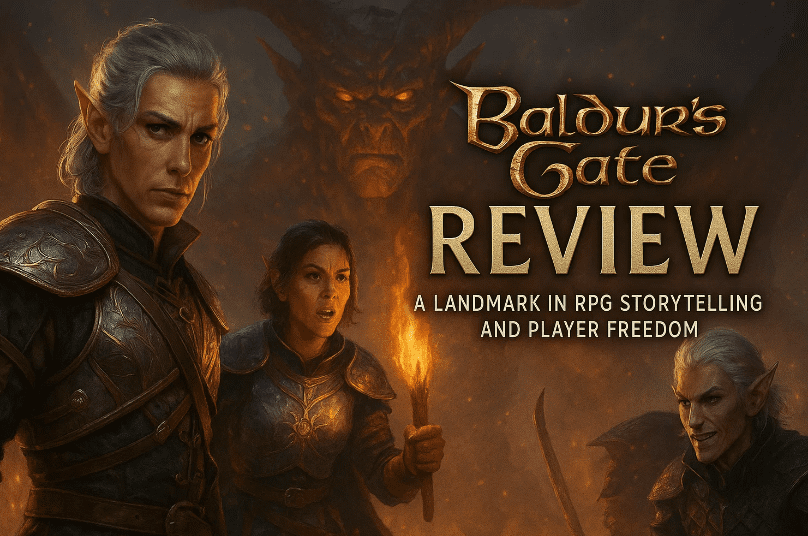
In this article, we’ll dive into every aspect of Baldur’s Gate 3: from its narrative depth and character design to the intricacies of its combat system, exploration, and technical achievements. We’ll also cover some common questions new players might have and highlight why this game is already being hailed as one of the best RPGs ever made.
📖 A Story That Demands Choices
Before diving into mechanics, let’s talk about the heart of any RPG—the story. Baldur’s Gate 3 takes place in the Forgotten Realms, one of the most iconic D&D universes. From the very beginning, you’re thrust into a desperate struggle: your character has been infected with a mind-flayer parasite. Rather than being a simple quest to “find the cure,” this central hook opens up endless branching storylines, moral dilemmas, and alliances.
The game is filled with heart-wrenching choices. Do you side with a faction that promises power but compromises your morals? Do you betray a companion’s trust to save a village? Do you romance a shapeshifting druid who can turn into a bear—or reject them for fear of their true nature?
Unlike many RPGs where choices feel cosmetic, Baldur’s Gate 3 makes every decision matter. Characters remember what you did hours—or even dozens of hours—later. Entire storylines shift based on your decisions, and the game rarely takes the easy path of “good” vs. “evil.” Instead, it forces you to wrestle with shades of gray, making your journey feel uniquely personal.
🗺️ A World That Encourages Experimentation
One of the biggest challenges in adapting tabletop D&D into video games is capturing the sense of freedom players have at the table. In real D&D, you can try anything—convince a guard with an outrageous lie, leap across a collapsing bridge, or set an entire tavern on fire to create a distraction.
While no game can perfectly replicate that level of flexibility, Baldur’s Gate 3 comes impressively close.
- If something looks flammable, you can set it ablaze with a fire spell.
- Locked doors aren’t just for lockpicks—you can smash them open with an axe.
- Hidden areas aren’t blocked by invisible walls—you can climb, jump, or improvise your way in.
One memorable moment: I skipped an entire boss fight by challenging a powerful undead to a drinking contest. Thanks to my character’s high Constitution score, I out-drank him until he literally collapsed. That level of creative problem-solving makes every playthrough feel fresh.
And the freedom isn’t just for solo players. The game supports multiplayer co-op for up to four players. You and your friends can create custom characters, explore together, and even pull off hilarious (or disastrous) schemes. One person can distract a guard in conversation while another quietly robs everything behind them—it’s chaotic, but incredibly fun.
👉 Official site: Larian Studios – Baldur’s Gate 3








🧙♂️ Character Creation: Be Who You Want
The RPG genre lives or dies on character creation, and Baldur’s Gate 3 sets a new standard here.
- 29 sub-races (including Dragonborn variants).
- 12 classes, each with at least three unique specializations.
- Wizards and Clerics get even more sub-paths, opening up complex builds.
The visual customization is equally impressive. From facial expressions to the variety of hairstyles and scars, characters feel alive. And it’s not just about how they look—the performance capture ensures they act alive too. Every smirk, frown, or side-eye adds emotional weight to the story.
Even your companions are deeply layered:
- Karlach, the cheerful Tiefling warrior with a demonic engine for a heart.
- Shadowheart, a conflicted cleric hiding secrets.
- Gale, a wizard whose arrogance masks vulnerability.
- Halsin, the druid who can turn into a bear—and perhaps more.
They’re not just sidekicks. They have opinions, romances, rivalries, and sometimes outright betrayals. They’ll argue with you, question your choices, and grow alongside you—or leave if you push them too far.
⚔️ Turn-Based Combat That Feels Like Tabletop
Combat in Baldur’s Gate 3 is turn-based, closely modeled after D&D 5th Edition rules. While that might sound intimidating, it’s both approachable and tactical once you understand the basics.
Here’s what makes the combat shine:
- Environmental interaction: Knock enemies off cliffs, set oil slicks on fire, electrify water puddles.
- Unique enemy mechanics: Some creatures teleport party members away mid-fight, others petrify with fear, forcing you to adapt quickly.
- No grinding: Unlike many RPGs, there’s no repetitive “fight to level up” routine. Every encounter is handcrafted and designed to challenge you.
The early levels can feel brutal—your characters are fragile, and even basic fights can end in disaster. But this is faithful to D&D’s philosophy: survival at low levels is hard. The reward comes as your party grows stronger, unlocking devastating spells, multi-attack combos, and tactical flexibility.
Each battle feels like a puzzle. You can’t just button-mash—you must plan, adapt, and sometimes accept defeat before rethinking your approach.
🏙️ The City of Baldur’s Gate
Reaching the city of Baldur’s Gate itself is a milestone. It took me around 90 hours to get there, and it was worth every minute.
The city feels alive:
- Every NPC has something to say about unfolding events.
- Dozens of random citizens are fully voice-acted.
- Exploration rewards you with lore, quests, and loot at every turn.
The sheer amount of voice acting is astounding. Unlike other RPGs where NPCs often sound recycled, here almost every character feels distinct. Even throwaway lines from street vendors are delivered with enthusiasm.
The writing doesn’t just set the stage—it builds immersion. You’re not just visiting a city; you’re living in it.
⏳ Three Acts, No Filler
Baldur’s Gate 3 is structured into three massive acts:
- Act One – Pastoral wilderness, filled with multiple leads and quests.
- Act Two – Dark, eerie, and suspenseful; more questions than answers.
- Act Three – Dense urban adventuring, political intrigue, and shocking revelations.
Each act took me around 40 hours as a completionist, meaning the full game can easily stretch past 120+ hours.
But here’s the magical part: unlike many RPGs, almost none of it feels like filler. Even small side quests are unique and meaningful. A random note found on a bandit’s body might lead to an emotional story about loss. Minor characters often resurface hours later, tying the world together in ways that feel natural.
🎭 Emotional Impact
Few games balance gameplay and storytelling this well. Some quests had me laughing, others made me shout in frustration, and a few even made me tear up.
What impressed me most was how often the past came back to haunt me. Characters I saved (or doomed) 80 hours earlier would reappear in Act Three, forcing me to confront my earlier choices. This isn’t a story that assumes you’re the hero—it’s a story that demands you prove it.
🐞 Technical Performance & Bugs
No RPG this complex launches without issues. I experienced:
- Occasional bugs (minor quest hiccups, visual oddities).
- Performance dips in Act Three, even on high-end hardware like an RTX 3080.
However, Larian has been extremely proactive. Multiple hotfixes have already addressed many issues, and the remaining problems feel minor compared to the scale of the game.
⭐ Why Baldur’s Gate 3 Is a Landmark
Not every RPG needs to be as big or ambitious as Baldur’s Gate 3. But this game proves that:
- You can tell a deep, emotional story in an interactive world.
- You can balance player freedom with tight game design.
- You can make choices matter in ways that stick with players for weeks.
For fans of RPGs, this isn’t just another release. It’s a once-in-a-generation achievement, worthy of standing alongside classics like Dragon Age: Origins or even the Infinity Engine games that started it all.
❓ Frequently Asked Questions (FAQ)
Q1: Do I need to know Dungeons & Dragons rules to play?
Not at all. While the game uses D&D 5th Edition mechanics, everything is explained clearly, and the game is beginner-friendly. Veterans will appreciate the faithfulness, but newcomers won’t be left behind.
Q2: How long does it take to finish?
If you focus mainly on the main quest, you might finish in 70–80 hours. Completionists who explore every side quest and companion storyline can easily cross 120–150 hours.
Q3: Can I play solo, or is multiplayer required?
You can play entirely solo with AI companions, or invite up to three friends for co-op. Both modes work smoothly.
Q4: Is Baldur’s Gate 3 worth it if I’m not a hardcore RPG fan?
Yes. Its storytelling, characters, and cinematic presentation make it approachable even for players who don’t usually enjoy turn-based combat.
⚠️ Disclaimer
This article is for informational and review purposes. Baldur’s Gate 3 is developed and owned by Larian Studios. All rights belong to their respective owners. Players should check system requirements on the official website before purchase.
👉 Official site: https://baldursgate3.game
Tags & Hashtags
Tags: Baldur’s Gate 3, RPG review, Dungeons and Dragons, Larian Studios, CRPG, video game review, fantasy RPG, PC gaming, role playing games, gaming guide
Hashtags: #BaldursGate3 #RPG #DungeonsAndDragons #GamingReview #FantasyGames #LarianStudios #PCGaming #CRPG