Typing long documents, essays, or even emails can sometimes feel exhausting. Windows 11 comes with a built-in feature that can help you get rid of endless keyboard tapping: Voice Typing. With this tool, you can dictate text into any app, whether it’s Microsoft Word, a web browser, Notepad, or even a chat box.
In this article, we will take a detailed look at how to use voice typing in Windows 11, explore its features, discuss shortcuts, explain language options, and also troubleshoot common issues. By the end, you’ll be able to confidently use this feature for work, study, or casual writing.
1. What Is Voice Typing in Windows 11?
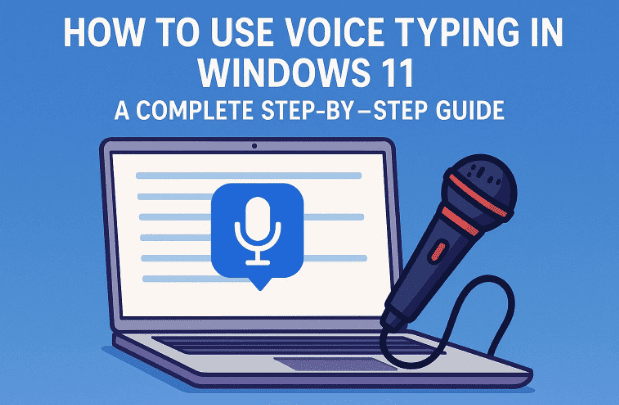
Voice typing is Microsoft’s built-in speech-to-text feature that allows you to speak naturally while your computer automatically converts your voice into written text.
Unlike older dictation tools that required downloading separate programs, this is built directly into Windows 11 and works across applications. Whether you’re:
- Writing a blog post in Microsoft Word.
- Searching on Google in your web browser.
- Sending a quick email.
- Taking notes in Notepad.
…voice typing can handle it.
It is powered by Microsoft’s speech recognition engine and supports multiple languages. Best of all, it comes at no extra cost—if you have Windows 11, you already have this tool.
2. How to Launch Voice Typing (Shortcut Keys)
Let’s start with the basics. To open voice typing:
- Press the shortcut
Windows + H.- This will open the Voice Typing toolbar at the top of your screen.
- The microphone button will appear. Click it or just start speaking.
- Your speech will immediately appear as text in the active text box.
👉 For example, if Microsoft Word is open, your words will directly appear in your document.
This shortcut works globally across apps, making it much faster than searching through menus.
3. Basic Commands You Should Know
Voice typing isn’t just about speaking. You can also control formatting with simple spoken commands.
Here are some essential ones:










- “Stop listening” → Ends the voice typing session.
- “New line” → Moves the cursor to the next line.
- “New paragraph” → Starts a completely new paragraph.
These small but powerful commands help keep your workflow smooth without needing to switch back to the keyboard.
4. Using Automatic Punctuation
Typing without punctuation can make your text hard to read. Luckily, Windows 11 voice typing comes with an Automatic Punctuation feature.
When enabled, it will:
- Insert commas, periods, and question marks where appropriate.
- Break sentences naturally, based on pauses in your speech.
To enable it:
- Open the Voice Typing toolbar with
Windows + H. - Click the Settings gear icon.
- Turn on Automatic Punctuation.
Once enabled, you can speak freely without constantly saying “comma” or “period.”
5. Voice Typing Launcher for Quick Access
One of the lesser-known features is the Voice Typing Launcher. This is like a floating shortcut that appears whenever you click into a text field.
- If the launcher is enabled, you’ll see a microphone icon appear inside the box.
- Simply click it to start dictating instantly.
This is particularly useful if you frequently switch between apps like browsers, chat software, and word processors.
To enable the launcher:
- Press
Windows + Hto open voice typing. - Click the Settings gear.
- Enable Voice Typing Launcher.
6. Switching and Adding Languages
Voice typing isn’t limited to English. You can easily switch between any installed languages.
- Shortcut to switch languages:
PressWindows + Spacebar. This cycles through all installed input languages.
For example:
- You can have English (US) and Hindi installed.
- A quick press of
Windows + Spacebarswaps the recognition language.
To add more languages:
- Open Settings → Time & Language → Language & Region.
- Click Add a language.
- Choose from supported languages and install the speech pack.
After installation, that language becomes available for voice typing.
7. Useful Shortcuts
Aside from the main Windows + H shortcut, there are several voice commands and tricks to speed up dictation.
- “Stop listening” → Ends dictation.
- “New line” → Moves to the next line.
- “New paragraph” → Creates paragraph spacing.
- Automatic punctuation toggle → Available in toolbar settings.
These small tweaks make voice typing much more powerful than basic speech recognition.
8. Practical Uses of Voice Typing
Now that you know the features, let’s explore real-world use cases.
- Writers & Bloggers → Dictate drafts quickly without typing.
- Students → Take lecture notes or write essays.
- Office workers → Draft emails, reports, and meeting notes faster.
- Multilingual users → Switch languages on the fly when writing in bilingual contexts.
- Accessibility → Helps users with mobility issues type without a keyboard.
9. Tips for Better Accuracy
To get the best out of voice typing, follow these tips:
- Use a good quality microphone or headset.
- Speak clearly at a natural pace.
- Avoid background noise when possible.
- Review your text after dictation to correct small errors.
- Enable automatic punctuation for better readability.
10. Troubleshooting Common Issues
Sometimes, voice typing may not work as expected. Here are solutions to frequent problems:
❌ Issue: Voice typing doesn’t start.
- Check that your microphone is connected and not muted.
- Ensure Windows privacy settings allow apps to access your mic (Settings → Privacy & Security → Microphone).
❌ Issue: Wrong language detected.
- Press
Windows + Spacebarto switch to the correct input language. - Make sure the speech pack is installed.
❌ Issue: Words are misheard.
- Speak more slowly and clearly.
- Use an external mic instead of a laptop’s built-in one for higher accuracy.
11. Frequently Asked Questions
Q1. Does voice typing work offline in Windows 11?
No, currently it requires an internet connection because it uses Microsoft’s online speech recognition engine.
Q2. Can I use voice typing in any app?
Yes, as long as there’s a text field. It works in Word, browsers, Notepad, chat apps, and more.
Q3. Does Windows 11 support voice typing in all languages?
Not all languages are supported yet. However, Microsoft is continuously adding new speech packs.
Q4. Is my voice data stored by Microsoft?
Microsoft may use speech data to improve recognition. You can manage permissions under Privacy & Security settings.
12. Final Thoughts
Voice typing in Windows 11 is an underrated feature that can boost productivity, aid accessibility, and make writing more natural. With its automatic punctuation, quick launcher, and multilingual support, it’s a tool that can replace or at least supplement traditional typing in many situations.
Whether you’re a student, a professional writer, or simply someone who finds typing long documents tiring, voice typing can save you time and effort.
🔗 To learn more about official features and supported languages, visit Microsoft’s documentation: Windows 11 Voice Typing
Tags
voice typing windows 11, speech to text windows, microsoft dictation tool, windows 11 productivity, accessibility features windows, windows shortcuts, typing without keyboard
Hashtags
#Windows11 #VoiceTyping #SpeechToText #Productivity #Accessibility #MicrosoftTools