When Apple introduced the first iPhone in 2007, it didn’t just release a new device — it redefined what technology could feel like. Steve Jobs wasn’t selling hardware; he was selling the future wrapped in glass and aluminum. Every keynote felt electric — like witnessing the birth of something that would reshape our relationship with the world.
But nearly two decades later, that spark feels dimmer. The company that once championed “Think Different” now seems to think only in terms of safe profits. The walled garden that once felt like a paradise of seamless design has slowly become a luxury cage — where freedom costs $9.99 a month and innovation often comes in the form of a new color option.
The iPhone 17 is the latest proof that Apple’s magic show might be over.
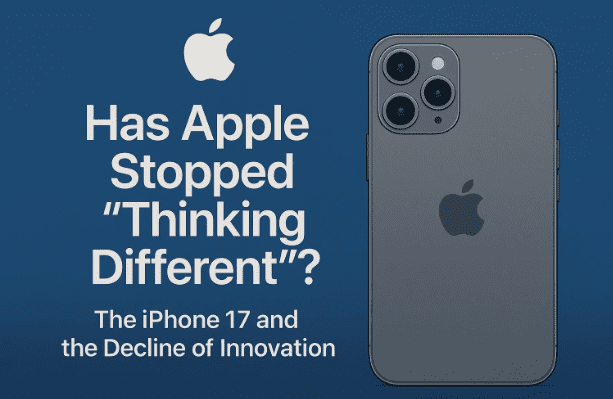
🧩 The iPhone 17: Evolution Without Revolution
Let’s start with the core question: what’s actually new in the iPhone 17 lineup?
Apple, as always, claims it’s “the best iPhone we’ve ever made.” Technically, that’s true. But this time, that statement feels hollow.
🔸 The Base Models
The entry-level iPhone 17 models look identical to their predecessors — same edges, same button layout, same camera bump that feels like déjà vu.
Yes, Apple finally brought its 120Hz ProMotion display to the base models. But this is something Android users have had for years, and even Apple’s own Pro devices introduced it way back in 2021. It’s progress, but late progress.
Sure, the screen now hits an eye-searing 30,000 nits of peak brightness, selfies shoot at 24 megapixels, and the new A18 chip delivers a modest 20% faster performance. But what does that really mean? Slightly smoother scrolling and marginally better TikToks. The “wow” factor feels replaced by an indifferent “well, okay.”
🔸 The Pro Models
The Pro variants usually carry the flagship torch — but even here, the innovation feels muted.
Apple ditched titanium and returned to anodized aluminum, marketing it as “lightweight precision.” But to many, it feels like a quiet downgrade. A new vapor cooling system promises 40% better sustained performance, though unless you’re editing 4K video on your phone, you’ll barely notice.
And while Apple highlighted a new telephoto zoom upgrade, it’s not the leap we once expected from a company that led the industry in camera design. The camera bump is now so massive that users are comparing it to “a metal blister glued to the back.”









It’s technically powerful — yes. But revolutionary? Not really.
🔸 The iPhone 17 Air: Thinness Over Function
Apple’s newest pride is the iPhone 17 Air — the thinnest iPhone ever made at just 5.6 mm. On paper, it sounds like a design marvel. In practice, it’s a warning sign.
- A thinner frame means a smaller battery and shorter endurance.
- It lacks mmWave 5G support.
- Early reviewers are already flagging heat buildup during prolonged use.
The price? $999 to start. And if the battery disappoints, Apple will gladly sell you a $100 MagSafe battery pack. That’s not innovation — that’s monetizing your inconvenience.
Some tech reviewers have already labeled the 17 Air a “red-flag device.” It’s beautiful, yes. But fragile, underpowered, and over-marketed — the very opposite of Apple’s old design philosophy of form serving function.
📉 The Decline of Innovation: From Bold to Boring
The iPhone once symbolized change. The iPhone X (2017) killed the home button, introduced Face ID, and gave us the first truly edge-to-edge display. It was bold, disruptive, and futuristic.
Compare that to today: the iPhone 17 is thinner, shinier, and has 5% more battery life — if you squint hard enough. That’s not revolution; that’s routine.
Every year now feels like an incremental press release:
“Slightly improved performance.”
“Slightly better camera.”
“Slightly lighter design.”
The problem isn’t the product. It’s the philosophy. Apple no longer leads by risk — it leads by refinement. And refinement, while safe, is the opposite of the daring creativity that built the company’s legacy.
💰 Profit Over Product: The Psychology of the Upgrade Cycle
Apple’s most powerful innovation these days isn’t technological — it’s psychological.
Each September, when a new iPhone launches, last year’s model instantly feels obsolete. That’s not a coincidence. It’s planned perception — a clever mix of marketing and design psychology known as psychological obsolescence.
Here’s how it works:
- Price Anchoring:
Apple launches the iPhone 17 Pro at $1,999, setting a new “premium” benchmark. Overnight, the previous year’s $999 iPhone 16 Pro feels mid-tier, even though it’s still perfectly capable. - Perceived Value Drop:
As thousands rush to trade in their iPhone 16s for the 17, the resale market floods. Supply spikes, demand dips, and resale prices plummet — often by 25% in just days. - Emotional Reinforcement:
Owners subconsciously start viewing their older phone as “outdated,” reinforcing the desire to upgrade.
It’s a cycle Apple has perfected — one that keeps customers running on an upgrade treadmill. But here’s the dark side: the more predictable Apple becomes, the less trust it builds. Customers don’t feel like they’re buying timeless devices anymore. They feel like they’re renting relevance at $1,000 a year.
🌏 The Global Shift: China Turns Away From Apple
While Apple continues to dominate Western markets, it’s facing a quiet rebellion in the East — particularly in China, its most critical overseas market.
Chinese consumers are no longer swayed by Apple’s prestige. Local brands like Huawei, Xiaomi, and Oppo are producing devices that are not only competitive but often superior in hardware innovation:
- Foldables that actually fold.
- Batteries that last 2–3 days.
- Charging speeds up to 120W — full charge in under 20 minutes.
Meanwhile, Apple is still selling its “all-day battery life” as if it’s 2015.
Add to that the political push from the Chinese government encouraging citizens to “buy local,” and Apple’s dominance looks increasingly fragile. In early 2025, Apple’s market share in China fell to just 13.7%, its lowest in years.
It’s not just competition — it’s cultural. In China, Apple is no longer seen as cool tech; it’s an overpriced import.
🧱 The Vision Pro: Apple’s Overpriced Experiment
When Apple finally swung for a “next big thing,” it wasn’t the iPhone 17 — it was the Vision Pro.
Hailed as the dawn of “spatial computing,” the $3,500 headset wowed early reviewers but quickly flatlined in sales. The hardware was stunning, but the use cases weren’t. Within months, it went from a “revolution” to a developer toy collecting dust.
The Vision Pro represents a growing pattern: big launch, small impact. It’s reminiscent of when Apple introduced 3D Touch or the Touch Bar — features that sounded futuristic but faded fast.
The difference? Those cost consumers a few hundred dollars. Vision Pro costs as much as a high-end laptop — for a “wow” moment that lasts five minutes.
📉 When the Internet Turns Your Product Into a Meme
Apple events used to feel sacred. Livestreams would crash under demand, hashtags would trend for days, and fans would line up overnight outside Apple Stores.
Now, every launch feels like a meme generator. When Tim Cook stood on stage in 2025 and proudly announced,
“We’ve raised the bar,”
it turned out the improvement was shaving off 1 milligram of weight. The internet responded instantly — and brutally. The new orange iPhone was compared to a traffic cone, the camera bump to a pasta strainer.
And here’s the irony: memes do more damage to a brand than bad reviews. They shape public perception. A thousand jokes can undo a billion-dollar marketing campaign.
📉 Apple’s Market Reality: Profitable, But Predictable
Let’s be clear — Apple isn’t dying. It’s still one of the most profitable companies in the world. But what’s fading is its aura.
In 2024, Apple slipped from first to third in global market capitalization. Not catastrophic, but symbolic. The company that once defined culture is now being defined by it.
The iPhone is still selling. But not because it’s groundbreaking — because it’s safe. Apple’s real innovation now lies in business models, not technology:
- Subscription-based iCloud+, Music, and TV+ services.
- “FineWoven” eco accessories.
- Incremental hardware upgrades wrapped in cinematic marketing.
At this point, Apple’s greatest product might not be the iPhone — it’s the illusion of progress.
🔮 Can Apple Get Its Magic Back?
So, is Apple’s golden age truly over? Or are we simply in a quiet phase before the next big leap?
Let’s be fair — innovation doesn’t happen on a schedule. Even the most creative companies go through cycles of iteration and stagnation. But for Apple, the challenge isn’t technical — it’s cultural. The company has become so risk-averse, so focused on quarterly safety, that it’s forgotten the spirit that made it legendary.
Apple once asked us to “Think Different.”
Now it seems content with “Think Profitable.”
The next few years will decide whether Apple can reclaim its position as a visionary or remain an excellent refiner of existing ideas. Maybe that “one more thing” moment still exists somewhere in Cupertino’s secret labs.
But for now, we’re stuck in a loop of thinner phones, higher prices, and smaller surprises.
❓ Frequently Asked Questions (FAQ)
Q1. Why are people calling the iPhone 17 “a red-flag device”?
Because while it looks premium, its design compromises performance. The ultra-thin body sacrifices battery life and heat control — making it beautiful but less practical.
Q2. What is “psychological obsolescence” and how does Apple use it?
It’s the strategy of making consumers feel like their device is outdated even when it still works perfectly. Apple achieves this through marketing, pricing, and design tweaks that trigger FOMO (fear of missing out).
Q3. How does Apple compare with competitors like Samsung or Huawei in innovation?
Right now, Samsung and Huawei lead in areas like foldable displays, AI integration, and battery technology. Apple’s focus remains on software polish and ecosystem integration — not on hardware breakthroughs.
Q4. Is the iPhone 17 worth upgrading to?
If you own an iPhone 15 or 16, probably not. The changes are incremental. Unless you’re upgrading from a much older model, you’re paying premium prices for minor differences.
Q5. What could Apple do to regain its edge?
To truly innovate again, Apple must:
- Take creative risks (like the early iPhone and iPad days).
- Reimagine Siri using generative AI.
- Explore functional breakthroughs (like foldables or adaptive screens).
- Focus less on profits per device and more on meaningful utility.
🧭 Final Thoughts
Apple hasn’t failed — but it has settled. The company that once inspired the world to dream bigger now inspires memes about color choices.
The iPhone 17 is technically impressive, but emotionally forgettable. For a company built on magic, that might be the biggest red flag of all.
The world doesn’t need another slightly better iPhone.
It needs another reason to believe.
⚠️ Disclaimer
This article is an independent analysis based on public product data and industry commentary as of October 2025. The views expressed are opinions for educational and discussion purposes only.
Tags:
Apple, iPhone 17, iPhone 17 Air, Apple Innovation, Tech Editorial, Smartphone Market, Psychological Obsolescence, Vision Pro, Apple China Market, Cupertino Strategy
Hashtags:
#Apple #iPhone17 #TechOpinion #InnovationCrisis #Cupertino #TimCook #Smartphones #AppleEvent #TechEditorial #GadgetTrends