If you’ve ever opened too many Chrome tabs and heard your laptop’s fan roar like a jet engine, you already know the problem — Chrome is heavy on RAM. It’s fast and feature-rich, yes, but it can easily choke older laptops or systems with 2–4 GB of memory.
The good news? You don’t need a new PC — you just need a smarter, lighter browser.
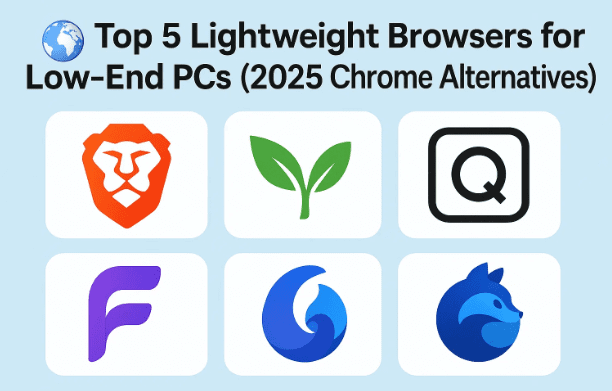
In this detailed guide, we’ll explore five amazing Chrome alternatives that are designed to run efficiently even on low-end or aging hardware. Whether you use Windows 10, Windows 11, or even Linux, these browsers can help you browse faster, save memory, and extend your battery life — without sacrificing privacy or usability.
🧠 1. Why Chrome Feels So Heavy on Old PCs
Let’s start with the big question — why does Chrome slow down older computers?
Chrome runs each tab, extension, and plugin as a separate process for stability and security. While this is good for crash protection, it multiplies memory usage. Each open tab can consume anywhere between 200–500 MB of RAM, and background extensions add even more.
When your PC has only 2–4 GB of memory, Chrome quickly eats it up — leading to lag, page reloads, and stutters.
So instead of upgrading your hardware, it’s smarter to pick a browser designed to use fewer background services, load fewer scripts, and prioritize performance.
Let’s go through five browsers that do exactly that.
🦁 2. Brave Browser – Privacy-First and Surprisingly Fast
Let’s begin with one of the most popular Chromium-based browsers that’s both fast and secure — Brave.
If you’re coming from Chrome, Brave feels instantly familiar, but it’s lighter, faster, and far more privacy-conscious.
🌟 What Makes Brave Special
Brave is built on the same open-source Chromium foundation as Chrome, but with a bold difference: it blocks ads and trackers by default.
Trackers and ads are major culprits behind heavy memory use — they constantly run scripts in the background. By blocking them at the browser level, Brave saves significant RAM and CPU cycles.
Here’s what Brave offers out of the box:










![How to Enable and Sync Data on Microsoft Edge Browser [Tutorial – 2025]](https://dtptips.com/wp-content/uploads/2025/06/image-526-300x175.png)
- 🚫 Built-in ad and tracker blocking (no need for extensions)
- 🔒 Privacy tools such as HTTPS upgrades and fingerprint protection
- 🧩 Chrome extension support via the same Web Store
- 💨 Faster page loads (often 30–40% quicker than Chrome)
- 🧠 Lower memory footprint on systems with 2–4 GB RAM
- 🧱 Optional features like “Aggressive ad blocking” for extreme speed mode
⚙️ How to Optimize Brave for Low-End PCs
Let’s move step-by-step so you get the best results:
- Download Brave:
Visit the official site — https://brave.com/ - Install and Launch:
The interface is almost identical to Chrome, so you’ll feel at home. - Enable Aggressive Ad Blocking:
- Click the Brave shield icon next to the address bar.
- Under “Trackers & Ads Blocking,” select Aggressive.
- Disable Background Tasks:
Go to Settings → System → Continue running background apps → Turn Off. - Sync or Import Data:
You can import bookmarks and passwords from Chrome easily.
With these tweaks, Brave becomes one of the fastest Chrome-like browsers that can run comfortably on even a 2 GB laptop.
🧠 Extra Tip
If you often multitask, keep tab groups small and use Brave’s Memory Saver mode (available in newer versions) to pause inactive tabs automatically.
🍃 3. Midori Browser – Minimalism Done Right
Now, if your laptop barely runs Windows or you’re using something with 1–2 GB RAM, Midori Browser might be your best friend.
It’s a lightweight, open-source browser that focuses on speed, simplicity, and minimal background processing.
💡 Why Choose Midori
Midori’s philosophy is “do less, do it faster.”
It skips fancy animations and unnecessary scripts, focusing purely on loading web pages efficiently. The interface is clean, with fewer toolbars and minimal UI clutter.
Let’s look at what it offers:
- 🪶 Extremely light on system resources
- ⚡ Fast startup (launches in under two seconds)
- 💾 Tiny disk footprint — less than 200 MB after installation
- 🌐 Supports essential features like bookmarks, private mode, and tab management
- 🪟 Ideal for basic browsing (news, email, blogs, lightweight web apps)
🧭 Getting Started with Midori
- Download from the official site:
https://www.midori-browser.org/ - Install and Run:
The setup is quick, and the browser opens instantly. - Use for Light Tasks:
Midori is best for email, reading, and simple sites — not for Google Docs or heavy streaming. - Keep Tabs Minimal:
Stick to 3–5 open tabs for best performance on 1 GB RAM systems.
✨ Real-World Performance
In tests on old Intel Atom and Celeron laptops, Midori loaded sites like Wikipedia and Gmail much faster than Chrome, using 50–60% less RAM. It’s ideal for anyone who wants browsing without background bloat.
⌨️ 4. QuteBrowser – Keyboard-Driven Power for Minimalists
If you love shortcuts and want total control without the weight of a GUI-heavy browser, QuteBrowser is something special.
It’s unlike traditional browsers — instead of clicking menus and icons, you control everything with keyboard commands. Think of it like the “Vim” editor of web browsers.
🧩 Why QuteBrowser Feels So Light
The secret lies in its minimalist design.
No big toolbars, no multiple layers of UI — just a simple interface built around the QtWebEngine, which is modern but efficient.
Because of that, QuteBrowser uses far less memory than Chrome or even Firefox while still supporting modern web standards.
⚙️ Features at a Glance
- 🧠 Keyboard-first navigation (use
:open,:tab-close, etc.) - 💨 Lightweight rendering engine based on Qt
- 🧱 Configurable key bindings for power users
- 🧩 Scriptable with Python for automation
- 💻 Runs well on 1–2 GB RAM systems
- 🔋 Minimal background activity (no telemetry or analytics)
🧭 Getting Started with QuteBrowser
Don’t worry if you’re new to shortcut-based browsing — it’s easier than it sounds.
- Download from the official site:
https://qutebrowser.org/ - Install it like a normal app.
The first launch gives you a small welcome guide. - Basic Navigation:
- Press
:openfollowed by a URL to load a page. - Use
Ctrl + Tto open new tabs andCtrl + Wto close. - Press
:helpanytime for a full list of commands.
- Press
- Customization:
Modify theconfig.pyfile to tweak appearance, shortcuts, and performance options.
🧠 Pro Tip
If you’re new to keyboard-driven tools, start slow. Use it for reading or light research sessions and gradually adopt shortcuts as you go.
Once you get used to it, you’ll realize how efficient and minimal it feels — almost zero mouse usage, lightning-fast responsiveness, and very low memory use.
🦊 5. Floorp Browser – A Lightweight Firefox Fork with Control
Originally referred to as “Hailmon” in older sources, the correct name is Floorp — a modern Firefox fork built for speed, control, and privacy.
If you like Firefox’s flexibility but find it heavy, Floorp is a great middle ground.
🔧 What Makes Floorp Special
Floorp retains Firefox’s customization strength while trimming unnecessary bloat. It keeps support for older extensions and classic interface layouts while improving startup time and memory efficiency.
Key highlights include:
- 🧩 Support for legacy and modern Firefox extensions
- ⚙️ Classic toolbar layout (for users who dislike Firefox’s new UI)
- 🚀 Faster load times and lighter RAM use
- 🔒 Enhanced privacy settings with user control over telemetry
- 🪶 Better performance on 2–4 GB RAM systems
🧭 Getting Started
- Download from the official site:
https://floorp.app/ - Install and Import Data:
Floorp allows you to import bookmarks, history, and logins from Firefox easily. - Customize Your Interface:
You can rearrange buttons, restore the old menu bar, or switch to compact layouts. - Disable Unused Extensions:
To keep it lightweight, remove any add-ons you don’t absolutely need.
🧠 Tip
Avoid using too many heavy web apps simultaneously. Even though Floorp is lighter, having multiple modern sites (e.g., Google Docs + YouTube + Gmail) open at once can still slow things down on older hardware.
💧 6. Waterfox – The Balanced Firefox Alternative
Last but not least, we have Waterfox, another browser based on Mozilla Firefox that focuses on speed, privacy, and backward compatibility.
🌟 What Makes Waterfox Unique
Waterfox gives you the performance of modern Firefox without the unnecessary background telemetry and sync processes that can slow it down.
There are two main versions:
- Waterfox Classic: best for very old PCs or users who rely on legacy add-ons.
- Waterfox Current: updated regularly with new web standards and features, yet lighter than the official Firefox release.
💡 Why It’s a Great Choice
- 🧠 Uses fewer background services than Firefox
- 🧩 Supports both legacy XUL add-ons and WebExtensions
- 🔒 Enhanced privacy and reduced data collection
- 💨 Noticeably faster tab switching on 4 GB RAM systems
- 🪶 Ideal middle ground between “modern” and “lightweight”
🧭 Setup and Optimization
- Download Waterfox:
https://www.waterfox.net/ - Pick Your Version:
- Classic for low-end PCs
- Current for systems with 4 GB RAM or more
- Customize Settings:
- Disable telemetry in Settings → Privacy → Data Collection
- Reduce animations by toggling “Use smooth scrolling” off
- Install Only Essential Extensions:
Stick with lightweight ones like uBlock Origin or Dark Reader.
⚖️ 7. Performance Comparison Table
| Browser | Base Engine | RAM Usage (Approx.) | Built-in Ad Block | Extension Support | Best For | OS Compatibility |
|---|---|---|---|---|---|---|
| Brave | Chromium | Medium-Low (400–600 MB with 5 tabs) | ✅ Yes | ✅ Chrome Web Store | Everyday use, privacy | Windows, macOS, Linux |
| Midori | Custom lightweight engine | Very Low (200–300 MB) | ❌ Minimal | ❌ Limited | Old PCs, 1 GB RAM | Windows, Linux |
| QuteBrowser | QtWebEngine | Very Low (200 MB) | ❌ | ⚙️ Scriptable | Power users, keyboard fans | Windows, Linux |
| Floorp | Firefox (fork) | Medium (400–700 MB) | ✅ Optional | ✅ Firefox Add-ons | Customization & privacy | Windows, Linux |
| Waterfox | Firefox (optimized) | Medium (400–600 MB) | ✅ Optional | ✅ Firefox Add-ons | Balanced modern use | Windows, macOS, Linux |
🧭 8. Best Browser Choices for Your System
Here’s a quick recommendation list depending on your device:
- 💻 1 GB RAM or older netbooks: Midori or QuteBrowser
- 🧮 2 GB RAM laptops: Brave (with aggressive blocking) or Floorp
- 🧠 4 GB RAM and above: Waterfox or Brave for daily multitasking
- 🔒 Privacy enthusiasts: Brave or Floorp
- ⚡ Minimalist users: Midori or QuteBrowser
Each browser has its own balance between speed, privacy, and features. The best one is simply the one that feels smoothest on your hardware.
❓ 9. Frequently Asked Questions (Q&A)
Q1. Why is Chrome so heavy compared to these alternatives?
Chrome runs each tab and extension separately, increasing stability but also memory usage. Lightweight browsers merge or simplify processes to save RAM.
Q2. Which browser is safest for online banking or payments?
Brave and Waterfox are both excellent, as they prioritize HTTPS and block trackers. Always keep your browser updated regardless of choice.
Q3. Can I use Chrome extensions in these browsers?
- Brave: ✅ Yes (Chromium base)
- Midori: ❌ No
- QuteBrowser: ⚙️ Scriptable only
- Floorp/Waterfox: ✅ Firefox add-ons
Q4. Which browser uses the least CPU?
Midori and QuteBrowser are the most efficient since they avoid unnecessary background services.
Q5. Can these run on Windows 7?
Yes, but only some versions:
- Brave supports Windows 10 + 11 officially.
- Midori, Floorp, and Waterfox still run on Windows 7.
- QuteBrowser supports older Windows via manual installation.
Q6. Is Brave truly open source?
Yes — Brave is fully open source under the MPL license and can be verified on GitHub.
🏁 10. Final Thoughts
You don’t need a gaming laptop or a high-end machine to browse the internet smoothly.
By choosing the right browser, even a 10-year-old system can feel fresh again.
Let’s recap:
- Brave – The best all-rounder: fast, private, and familiar.
- Midori – For extreme low-end systems or casual browsing.
- QuteBrowser – For power users who prefer keyboard control.
- Floorp – For those who love Firefox’s flexibility but want less bloat.
- Waterfox – For users seeking balance between modern web support and speed.
Take a week to try a few of them and see which one feels snappiest on your system. You’ll be surprised at how much smoother web browsing can feel once you escape Chrome’s RAM hunger.
⚠️ Disclaimer
All browsers mentioned are available from their official websites only.
Always download software from the original source to avoid malware or tampered builds.
Performance may vary based on operating system version, background processes, and hardware configuration.
#BrowserTips #LightweightBrowser #ChromeAlternative #BraveBrowser #Midori #QuteBrowser #Floorp #Waterfox #LowEndPC #Windows11 #TechGuide #PrivacyTools