Artificial Intelligence (AI) is no longer a futuristic buzzword or a laboratory experiment. It has become the invisible backbone of our daily lives. From predictive keyboards to personalized video recommendations, AI is quietly embedded in the way we use technology. Yet, beyond these consumer-facing features lies a much deeper transformation — one that may redefine the very foundation of operating systems, including Linux.
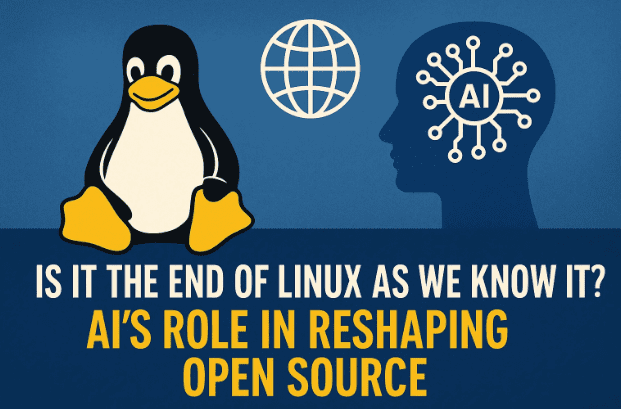
This article explores how AI is merging with operating systems, why this represents a paradigm shift, and what it could mean for Linux, open source, and digital freedom in the decades ahead.
📑 Table of Contents
- The Everyday AI We Don’t Notice
- From Assistants to Operating Systems
- The Three Historical Leaps in Human-Computer Interaction
- AI as the New Interface Layer
- Research: AI Inside the Kernel
- Linux at a Crossroads: Community vs Corporations
- The Paradox of Control
- Historical Parallels: From Terminals to GUIs
- Open Source in the Age of AI: Transparency or Illusion?
- Possible Futures for Linux and Open Source
- The Ethical Question: Who Controls Intelligence?
- Why Open Source Still Matters
- Q&A: Addressing Common Concerns
- Conclusion: The End or a Transformation?
1. The Everyday AI We Don’t Notice
Let’s start with a simple reality: AI is everywhere, often without us realizing it.
- When your smartphone keyboard predicts the next word, it’s an AI model at work.
- When YouTube or Netflix recommends a video, algorithms analyze billions of data points to decide what you might like.
- Even the ads you see online are targeted using machine learning systems.
So far, this seems harmless — even useful. But these “peripheral” applications of AI are just the surface. Beneath them lies a revolution in how humans interact with computers.
2. From Assistants to Operating Systems
The world’s biggest tech companies are already showing us where this is going:
- Microsoft has deeply integrated Copilot into Windows 11. It’s not just an add-on anymore but a native layer of the OS.
- Apple is re-imagining Siri as more than a voice assistant — positioning it as the main mediator between the user and the system.
- Google is transforming Android through Gemini, aiming to make AI the core of the entire ecosystem.
The message is clear: the operating system of the future isn’t just an OS with AI on top. The OS itself is AI.
3. The Three Historical Leaps in Human-Computer Interaction
If we look at history, human-computer interaction has evolved in giant leaps:
- The Text Era
Black terminals, cryptic commands, and raw power for those who mastered the language. - The Graphical Era (GUI)
Windows, icons, and mice made computing accessible to the masses. This was not just a technical leap but a cultural revolution. - The AI Era (Now Emerging)
We’re moving toward natural, multimodal interaction — voice, gestures, and dialogue with intelligent agents that understand intent, not just commands.
Each leap made the previous one look obsolete. And we’re right in the middle of the third leap.
4. AI as the New Interface Layer
Think about this: when you tell your computer, “Update the system tomorrow,” you’re not writing commands or clicking menus. You’re delegating the task to AI.
This means AI is sliding between you and your operating system, becoming the true interface. Over time, it won’t just manage reminders or emails but complex processes like system maintenance, security, and energy optimization.
That’s a colossal shift.





5. Research: AI Inside the Kernel
This isn’t science fiction. Universities and researchers are already experimenting:
- AI models that optimize Linux kernel scheduling better than static algorithms.
- Machine learning systems that predict memory usage to improve performance.
- Prototypes of AI-driven kernels that can analyze system processes in real time and make corrections without human intervention.
In short, we’re heading toward a world where the kernel itself could “think.”
6. Linux at a Crossroads: Community vs Corporations
Here’s the tension:
- On one side, corporations like Microsoft, IBM, Google, and Meta are major contributors to Linux via the Linux Foundation. Their influence is undeniable.
- On the other side, the open-source community fears that AI integration will compromise Linux’s philosophy of transparency and user control.
This divide isn’t just technical — it’s philosophical.
7. The Paradox of Control
Linux has always stood for giving users absolute control. But if the kernel itself becomes intelligent, making autonomous decisions, then human control naturally decreases.
That’s the paradox: more stability and automation may come at the cost of personal control.
8. Historical Parallels: From Terminals to GUIs
This isn’t the first time Linux has faced a cultural battle.
When desktop environments like GNOME and KDE emerged, purists called it a betrayal of Linux’s “true spirit.” Yet today, GUIs are an essential part of Linux distributions.
The difference now is that AI doesn’t just change interfaces — it changes the very nature of decision-making inside the OS.
9. Open Source in the Age of AI: Transparency or Illusion?
Here’s the dilemma:
Open source was built on the principle of transparency. Anyone could read, understand, and modify the code. But with AI:
- A neural network with billions of parameters may be “open” on paper.
- Yet, practically, only a handful of experts can truly interpret it.
This creates a dangerous illusion — the code is technically open, but not meaningfully accessible.
10. Possible Futures for Linux and Open Source
We can imagine several scenarios:
- Co-optation
Linux becomes a shell for corporate AI integration. Open source survives formally, but real power lies with corporations. - Resistance
Forks and parallel projects arise, rejecting AI integration. These may be less powerful but truer to the original open-source spirit. - Fusion
A balance is found — AI integrates into Linux, but with open audits, community governance, and democratic oversight. - Hybrid Reality
Multiple approaches coexist: AI-driven Linux for the masses, alongside niche “pure” Linux distributions for power users.
11. The Ethical Question: Who Controls Intelligence?
The real question goes beyond technology: Who controls AI?
- Corporations with vast resources?
- Governments with surveillance ambitions?
- Or communities defending transparency and freedom?
This is a political, cultural, and existential debate — not just a technical one.
12. Why Open Source Still Matters
Linux and open source are not just software projects. They’re symbols of freedom, collaboration, and resistance against monopolies.
Even if AI threatens to centralize power, history shows that communities can resist. Linux itself started as a small student project and went on to challenge giants.
The same spirit can keep open-source AI alive — through new licenses, federated models, and decentralized projects.
13. Q&A: Addressing Common Concerns
Q1. Will Linux disappear because of AI?
Not likely. Linux will adapt, just as it did during the GUI revolution. The question is whether it stays true to its roots.
Q2. Is AI integration into Linux necessarily bad?
Not entirely. It could make systems more efficient and secure. The issue is whether users retain control and transparency.
Q3. Can open-source AI compete with corporate AI?
It will be difficult, given resource gaps. But even smaller, less powerful open models can preserve freedom and provide alternatives.
Q4. What can users do today?
Support open-source AI projects, stay informed, and demand transparency from corporations. Even small actions (like choosing open tools) matter in shaping the ecosystem.
14. Conclusion: The End or a Transformation?
So, is this the end of Linux as we know it?
In one sense, yes. AI will inevitably transform Linux into something different. But “end” doesn’t mean death. It means transformation.
Linux’s greatest strength has never been perfection — it has been freedom. As long as communities fight to preserve openness and collaboration, Linux will continue to thrive, even in an AI-driven future.
The choice is ours: surrender to closed systems or demand a future where AI remains open, transparent, and democratic.
Because in the end, Linux is more than code — it’s an idea. And ideas, once set free, don’t die. They evolve.
Tags
linux, artificial intelligence, open source, ai in operating systems, linux future, microsoft copilot, google gemini, apple siri ai, linux foundation, ai kernel, open source philosophy
Hashtags
#Linux #ArtificialIntelligence #OpenSource #OperatingSystems #TechFuture #AIIntegration #DigitalFreedom