Artificial Intelligence (AI) is everywhere today — from fast-food drive-throughs to banking chatbots and enterprise workflows. But beneath the hype lies a less glamorous truth: many companies are struggling to make AI deliver real results.
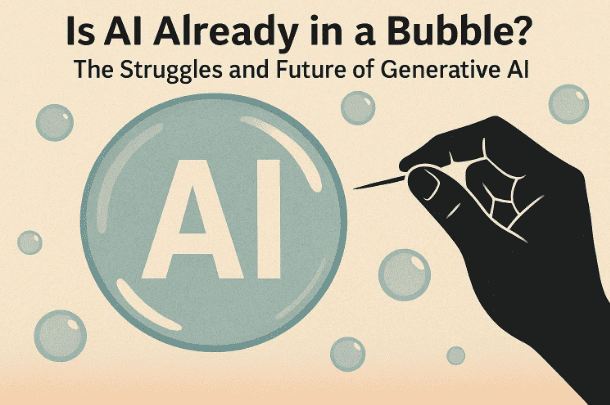
In this article, we’ll explore where consumer generative AI stands right now, why so many implementations fail, real-world stories of AI gone wrong, and whether we might be heading toward an “AI bubble” similar to the dot-com crash of the 1990s.
1. AI in Fast Food Chains: A Case of Early Missteps
When Taco Bell introduced AI ordering at over 500 U.S. locations in 2023, the goal was clear: reduce mistakes and speed up customer service. Instead, the opposite happened. Customers reported confusing exchanges with AI systems that misunderstood orders or added unintended items.
McDonald’s also experimented with AI-driven drive-throughs, only to abandon the project after bizarre failures. One customer ended up with bacon added to their ice cream; another was mistakenly billed for hundreds of dollars’ worth of chicken nuggets.
These early missteps highlight a common theme: AI works most of the time, but when it fails, the errors can be both costly and frustrating.
2. The MIT Study: Why 95% of AI Pilots Fail
A 2024 MIT report painted a sobering picture:
- Out of 150 business leaders and 350 employees surveyed, only 5% of AI pilots delivered measurable profit impact.
- In 95% of cases, AI produced no significant financial value.
The market reacted quickly. Nvidia’s shares dropped by 3.5%, and Palantir fell by 9% following the report. Investors were spooked, interpreting the results as proof of an AI bubble.
However, the deeper message wasn’t that AI is worthless. Rather, it showed that AI integration is incredibly difficult, and only thoughtful, well-targeted implementations succeed.
3. Why Current AI Models Hallucinate and Mislead
The foundation of modern generative AI lies in a 2017 Google paper introducing the transformer neural network architecture. This breakthrough enabled AI systems to “pay attention” to multiple words in a sequence simultaneously, revolutionizing natural language processing.
But here’s the catch:
- Transformers predict the next word based on statistical probability.
- They don’t truly “understand” what they’re saying.
- This leads to hallucinations — plausible-sounding but completely fabricated outputs.
For businesses, this is disastrous. Imagine relying on AI to generate patient documents or legal filings, only to discover later that 10% of the details are false. The time spent verifying and correcting these errors often negates any productivity gains.










4. Real-World Company Experiences with AI Failures
Employees across industries are sharing their frustrations with AI rollouts:
- Scheduling Chaos: One company adopted AI scheduling software, hoping to freeze hiring in accounts. Instead, staff spent extra hours double-checking errors, and the tool was eventually scrapped in favor of simpler software.
- Medical Missteps: In clinical settings, AI misfiled patient records, confused doctors with patients, and mishandled insurance data. These mistakes created serious compliance risks.
- Meeting Summaries Gone Wrong: Teams using AI to summarize Zoom meetings discovered that 5–20% of the notes were hallucinated — even when transcripts were provided.
Each of these cases illustrates a recurring theme: instead of saving time, poorly integrated AI can create more work.
5. The Human Cost: Job Cuts and Regrets
Some companies rushed to cut jobs, betting on AI to fill the gap. One bank fired employees and replaced them with an AI chatbot. The result? Customers demanded human service back, and the company had to reverse course.
Swiss bank Cler reduced its workforce from 3,800 to 2,000 between 2022 and 2024, citing AI adoption. Yet customer satisfaction fell sharply, and executives admitted human interaction remained irreplaceable.
A wider survey revealed that 55% of companies regret replacing staff with AI.
6. Fortune’s Warning: Why Replacing People with AI Backfires
The publication Fortune summed it up well:
“The companies cutting people today in the name of AI will be the ones playing catch-up tomorrow.”
AI can streamline workflows, eliminate repetitive tasks, and support human teams. But AI alone cannot innovate. True progress comes from combining human creativity with AI’s efficiency.
7. Cases of AI Success: Startups and Targeted Use Cases
It’s not all doom and gloom. The same MIT study that highlighted widespread failures also showcased success stories:
- Young startups focusing on a single pain point have scaled revenues from zero to $20 million in a year.
- Companies partnering with specialized AI vendors succeed 67% of the time, compared to just 33% for those building in-house solutions.
- Successful cases often involve narrow, specific tasks, like automated translation, transcription, or prototype web design.
This shows that precision and focus matter more than blanket adoption.
8. The AI Bubble Comparison: Lessons from the Dot-Com Era
The late 1990s dot-com bubble offers valuable lessons:
- Companies with “.com” in their name received sky-high valuations without solid business models.
- When reality hit, most collapsed, leaving behind only true innovators like Amazon and Google.
Similarly, today’s AI boom is fueled by massive investment, hype-driven valuations, and lofty promises. If results fail to match expectations, the crash could be just as severe — leaving only genuine problem-solvers standing.
9. The Economic Reality: Costs, GPUs, and Energy Usage
AI’s financial and environmental costs are staggering:
- Nvidia H100 GPUs cost $30,000–$40,000 each.
- Google operates ~26,000 units, powering breakthroughs like AlphaFold and Gemini.
- Meta owns ~600,000 units but has little to show beyond its Llama LLM.
- AI has already contributed to a 4% increase in U.S. electricity demand.
- Data center investments are projected to hit $3 trillion in the next three years, much of it debt-funded.
Meanwhile, OpenAI reportedly spends $40 billion annually on infrastructure but generates only $15–20 billion in revenue.
The math simply doesn’t add up without major efficiency improvements.
10. What Happens if AI Doesn’t Improve Soon?
If AI continues to stagnate, several outcomes are likely:
- Executives lose patience. Businesses will abandon AI tools that produce hallucinations and poor ROI.
- AI leaders admit limitations. Current LLMs may be declared a “dead end” for achieving artificial general intelligence (AGI).
- Public backlash grows. Frustrated users will tire of unreliable AI tools flooding the internet with low-quality content.
- Venture capital dries up. Expensive, power-hungry AI becomes unsustainable without major breakthroughs.
- An AI winter arrives. Just like after the dot-com bust, many AI firms will vanish, leaving only the strongest to survive.
11. The Gartner Hype Cycle: Where Are We Now?
The Gartner Hype Cycle describes how new technologies typically progress:
- Technology Trigger
- Peak of Inflated Expectations
- Trough of Disillusionment
- Slope of Enlightenment
- Plateau of Productivity
So, where is AI today? Many analysts believe we’re sliding into the Trough of Disillusionment, as inflated promises meet harsh business realities.
But this doesn’t mean the story ends. A new neural architecture, improved efficiency, or a revolutionary breakthrough could reignite another wave of progress.
12. FAQs
Q1. Why do AI systems hallucinate?
Because they predict text statistically rather than reasoning logically. They sound confident even when wrong.
Q2. Should companies stop adopting AI?
No. The key is thoughtful, targeted use — solving specific pain points rather than replacing humans wholesale.
Q3. Which industries benefit most from AI today?
Translation, transcription, customer support augmentation, and certain medical imaging tasks show promising results.
Q4. Is AI in a bubble?
Many signs suggest it is. But like the dot-com era, a crash could separate hype from genuine value creators.
Q5. Will AI replace human creativity?
Unlikely. AI supports efficiency but lacks the intuition, empathy, and innovation humans bring.
13. Final Thoughts
The AI boom feels both exciting and uneasy. On one hand, startups are achieving incredible results with focused solutions. On the other, corporations face disappointment when rushing headlong into AI without strategy.
Just like the internet revolution, AI’s path won’t be linear. Some companies will vanish, others will rise, and eventually the technology will mature into indispensable tools we can trust.
Until then, the lesson is clear: don’t believe the hype blindly. Implement AI carefully, test thoroughly, and always keep humans in the loop.
Disclaimer
This article is for informational purposes only. AI adoption strategies should be evaluated based on each company’s specific needs, resources, and risk tolerance. Always validate AI-generated outputs in critical fields like healthcare, finance, and legal.
Tags
ai bubble, ai failures, ai hallucinations, generative ai, artificial intelligence adoption, mit ai study, nvidia ai costs, dot com vs ai, business technology
Hashtags
#AI #GenerativeAI #AIBubble #TechTrends #ArtificialIntelligence #BusinessTech #MachineLearning