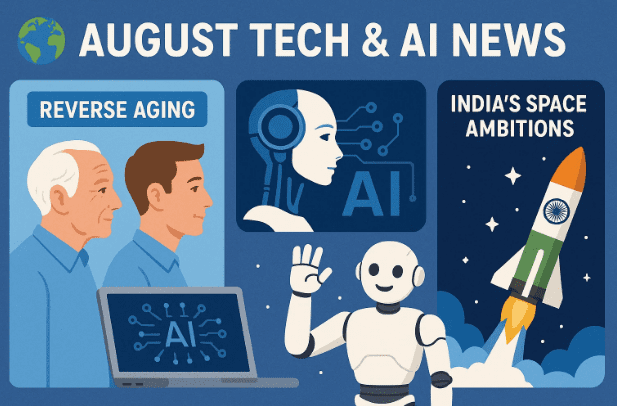
The world of technology is evolving at a pace we’ve never witnessed before. From AI models that can heal our bodies, to chips implanted in human brains, to VR environments that come alive from a child’s sketch—everything we thought of as science fiction is inching closer to reality.
In today’s article, we’ll go through some of the most fascinating developments in artificial intelligence, biotechnology, space exploration, and consumer technology. Along the way, I’ll also add my personal reflections and questions that many of us might be wondering about.
Let’s get started step by step.
🧬 1. Reverse Aging With AI: OpenAI and Retro Bioscience’s Protein Model
Imagine a world where aging can be slowed, or even reversed. That’s no longer just a fantasy. OpenAI, in collaboration with Retro Bioscience, has introduced GPT-4 Billion Micro, an AI model trained on protein sequences.
What Does This Mean?
Proteins are the building blocks of life. They define how cells function, repair, and communicate. By understanding and modifying proteins, we can potentially treat—and even cure—many diseases.
One fascinating element here is the “Yamanaka Factor” (sometimes shortened as Yama factor). It is a combination of stem-cell reprogramming factors that can restore damaged cells to a youthful state. The AI model is capable of modifying these factors up to 50 times, making them more effective at entering the body and repairing DNA damage.
Why Is This Revolutionary?
- Potential treatments for blindness, diabetes, and organ damage.
- Reversal of organ aging—your heart, liver, or lungs could potentially be “reset” to a younger state.
- Accessibility: since AI can scale discoveries, this might not be limited only to the ultra-rich.
👉 In simpler terms, this is the closest we’ve ever been to using AI for cellular medicine—a future where injections might restore youth, heal damaged organs, and extend healthy lifespan.
🩺 2. GPT-5 Outperforms Doctors in Diagnosis
Moving from proteins to hospitals, another breakthrough comes from GPT-5. In a controlled experiment, this AI model was tested against pre-licensed human medical experts.
The Results Were Astonishing:
- Reasoning ability: GPT-5 scored 24.23% higher than humans.
- Understanding and explanation: GPT-5 performed 29.40% better.
- Consistency: It provided fewer “hallucinations” (false answers) and explained diagnoses more clearly.
This doesn’t mean doctors are obsolete, but it highlights a major shift: AI may soon act as a trusted second opinion for medical reports, lab tests, and diagnoses.
Personal Reflection
Many patients feel pressured into unnecessary procedures for commercial reasons. Imagine being able to cross-verify your reports with an unbiased AI model before making a life-changing decision.
❓ Q&A: Should We Trust AI Over Doctors?
Q: Can AI really replace human doctors?
A: Not entirely. Medicine is not only about diagnosis but also empathy, ethical judgment, and hands-on treatment. However, AI can reduce human error and provide accurate insights that doctors might miss.





Q: Is it safe to rely on GPT-5 for medical advice?
A: For everyday analysis like blood reports or lifestyle guidance, yes. But for life-threatening conditions, AI should only be a supplementary tool, not a replacement for professional care.
🧠 3. Neuralink’s First Patient: From Paralysis to Entrepreneurship
Elon Musk’s company Neuralink implanted its first brain chip in a paralyzed patient in 2024. The patient, who suffered lower-body paralysis after a swimming accident, can now operate a computer using only his thoughts.
By August 2025, this individual announced plans to start his own business. Initially, Neuralink only demonstrated basic mouse movements. Today, the patient is able to play games and control complex systems—all through a coin-sized implant in the brain.
This development shows how neurotechnology is restoring independence to people with disabilities. Tomorrow, it might enhance human capabilities beyond natural limits.
🧫 4. Lab-Grown Organs: A Kidney in a Dish
In Israel, researchers grew a kidney using stem cells and a 3D organoid environment that mimicked a uterus. It took 34 weeks for the organ to develop.
Though the kidney cannot yet be transplanted, it functions well enough for scientists to:
- Test drug toxicity.
- Study how alcohol affects kidneys.
- Understand congenital kidney diseases.
This milestone means one day patients might not need long waiting lists for organ transplants—organs could be grown from their own stem cells.
💊 5. Health Caution: Paracetamol During Pregnancy
While not directly linked to tech, this finding is critical for families. A study involving 100,000 participants across 46 studies found that paracetamol use during pregnancy may increase the risk of autism and ADHD in children.
Doctors advise:
- Only take paracetamol if absolutely necessary and prescribed.
- Explore safer alternatives for fever and mild pain during pregnancy.
Awareness here could prevent long-term risks for future generations.
🎭 6. LipSync 2 Pro: AI Lip Movement That Matches Any Language
Another big leap in AI comes from LipSync Lab, which has launched LipSync 2 Pro.
Previously, lip-syncing software often looked unnatural because lip movements didn’t align with translated audio. Now, LipSync 2 Pro generates perfect 4K lip movements across multiple languages.
Why It Matters
- Movies can be translated seamlessly—an Indian actor’s dialogue could look naturally French.
- YouTube creators could dub content into dozens of languages without breaking immersion.
- Realism improves audience trust, since lip expressions finally match words.
Netflix has already set boundaries on AI use in content, requiring transparency when AI is involved. But one thing is clear: this technology will redefine global cinema and online content.
🎮 7. Mirage 2 vs Google Genie: Gaming Worlds From Sketches
Gaming also received a futuristic upgrade with Mirage 2, released by Dynamics Lab.
Here’s how it works:
- Upload an image (even a child’s drawing).
- The AI instantly turns it into an interactive 3D world you can explore.
For example, a black-and-white sketch of a house can become a full VR environment where you walk around inside.
Google has a competing model called Genie 3, which some users say produces better quality. But regardless of the winner, the concept is groundbreaking:
👉 Within 3-4 years, we might see prompt-based games where environments build themselves dynamically based on your interests.
This could dramatically reduce game development costs and speed up VR content creation.
👓 8. Google & HTC: Building AI Glasses Together
Google is stepping deeper into AR/VR by partnering with HTC. HTC has handed over patents, R&D staff, and manufacturing to Google in a deal worth $250 million.
This comes after Google already acquired HTC’s smartphone division in 2017 for $1.1 billion.
With Apple Vision Pro and Meta Quest already competing, Google’s AI-powered glasses might mark a new chapter in immersive computing.
🤖 9. NVIDIA Jetson Thor: A Robotic Supercomputer
NVIDIA continues to dominate AI hardware. Its new Jetson Thor is an on-robot supercomputer designed for industrial robots and humanoids.
Key Specs:
- 7.5x more AI compute than previous chips.
- 3.5x better energy efficiency.
- Developer kit priced at $3,499; bulk modules at $2,999.
This means factories, service robots, and personal humanoids will soon have computing power that rivals desktop supercomputers.
🚀 10. India’s Ambitious 6G and Space Plans
Prime Minister Narendra Modi announced two landmark goals:
- 6G Development Under Make in India – India successfully rolled out 5G in record time, and now aims to pioneer 6G technologies.
- Indian Space Station by 2035 – The first module is expected to launch in 2028.
However, experts highlight a concern: low salaries at ISRO compared to private firms often drive talent abroad. If India wants to lead in space, investment in human capital must match technological ambition.
📱 11. Google Play Store Developer Verification
Google will soon require all developers to verify their identity if distributing apps outside the Play Store.
This move aims to reduce malware and clone apps (like fake Netflix clones). However, critics argue it could stifle independent developers and limit open-source innovation.
🛡️ Disclaimer
The information provided in this article is for educational purposes only. Medical details, particularly those related to GPT-5 diagnosis, paracetamol risks, or Neuralink implants, should not replace professional medical consultation. Always consult a qualified doctor before making health decisions.
✅ Conclusion
From curing aging with proteins, to lab-grown kidneys, to VR environments created from children’s drawings—the future is arriving faster than expected. AI is no longer just about chatbots and search engines; it is reshaping medicine, gaming, film, robotics, and even national space programs.
The big question remains: are we ready to accept these changes? Technology may be progressing, but human trust, ethics, and governance will decide how smoothly we adopt it.
Tags
AI news, reverse aging, GPT-5 medical, Neuralink brain chip, lab grown organs, LipSync 2 Pro, Mirage 2, Google Genie, NVIDIA Jetson Thor, Google AI Glasses, India 6G, Indian Space Station, Google Play Store verification
Hashtags
#AI #TechNews #ReverseAging #GPT5 #Neuralink #LipSyncAI #Mirage2 #GoogleGenie #NVIDIA #SpaceTech #6G #IndiaTech