If you’re anything like me, you love beautiful desktop wallpapers. Over the years, I’ve built up a massive collection of breathtaking Windows backgrounds — but there’s one source that consistently delivers stunning, high-quality images right to your computer: Windows Spotlight.
Introduced in Windows 10, the Spotlight feature automatically changes your lock screen background daily, showing photos curated by Microsoft from around the world. From mountain landscapes to architectural marvels, they’re often too good to ignore.
However, Microsoft never made it obvious how to save those images for personal use. They appear on your screen, but where do they actually live on your system?
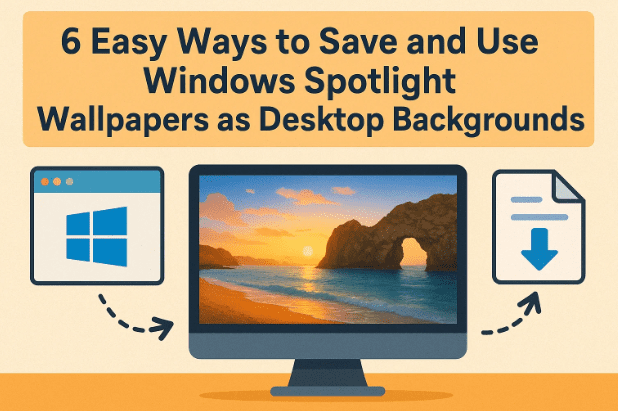
In this guide, we’ll explore six proven ways to save and reuse Windows Spotlight images, whether you prefer to do it manually, through an app, or with a dedicated wallpaper manager. By the end, you’ll have all the tools to build your own ever-growing gallery of Spotlight wallpapers.
🌠 What is Windows Spotlight?
Windows Spotlight is a built-in feature that displays new background images and fun facts on your lock screen each day. These pictures are sourced from Microsoft’s Bing search platform, which features breathtaking landscapes, architecture, wildlife, and abstract art from professional photographers worldwide.
Each time you log in, you’ll see a new wallpaper — and if you click “Like what you see?” on the lock screen, Windows uses that feedback to show you similar images in the future.
But here’s the catch: while these wallpapers appear automatically, they aren’t stored in your Pictures folder. Instead, Windows hides them deep inside your system directories, stored without file extensions or recognizable names.
💡 Why Save Windows Spotlight Photos?
There are a few good reasons you might want to keep your Spotlight images:
- They’re high-resolution and copyright-free for personal use.
- You can use them as desktop backgrounds or screensavers.
- You might want to create a personal wallpaper slideshow.
- Sometimes, Microsoft removes older Spotlight images, so saving them ensures you don’t lose your favorites.
Now let’s explore the six ways to get your hands on these stunning wallpapers.
🧭 Method 1: Manual Method – Locate Hidden Spotlight Files
Let’s start with the most direct method. Windows already stores every Spotlight image you’ve seen — you just need to find them.
Before we begin, make sure hidden folders are visible:






- Open File Explorer (
Windows + E). - Go to the View tab and check Hidden items.
Now, navigate to this location (copy and paste it into the address bar):
C:\Users\<YourUsername>\AppData\Local\Packages\Microsoft.Windows.ContentDeliveryManager_cw5n1h2txyewy\LocalState\Assets
Inside the Assets folder, you’ll find dozens (or even hundreds) of oddly named files with no extensions. These are your Spotlight photos — but Windows doesn’t label them as images yet.
Convert them to JPG
Here’s how to make them viewable:
- Right-click one of the files and select Rename.
- Add “.jpg” at the end of the filename.
- Double-click to open it — voilà, your Spotlight wallpaper appears!
If you like it, copy and paste it into a new folder inside your Pictures directory for easy access.
💬 Tip: You can create a shortcut to this “Assets” folder on your desktop so you can quickly check for new Spotlight images anytime.
This method is a bit tedious but entirely offline and 100% safe, since the files are already stored on your system.
🌐 Method 2: Use a Spotlight Wallpaper Repository Website
If you’d rather not dig through system folders, you can visit an online repository that archives all the Spotlight images Microsoft has ever distributed.
One such trusted resource is:
👉 https://www.windows10spotlight.com/
Here, you’ll find:
- Thousands of archived Spotlight wallpapers.
- Search and tag-based filters (e.g., “beach”, “mountains”, “cityscapes”).
- Downloadable, high-quality JPG versions of every image.
Simply:
- Open the site.
- Browse or search using tags.
- Click on the image you like.
- Right-click and choose Save image as…
This is arguably the simplest way to build your own Spotlight collection without touching system files.
🖼️ Method 3: Install Bing Wallpaper App from Microsoft
Microsoft also provides an official app called Bing Wallpaper, which automatically updates your desktop with high-quality Bing and Spotlight images.
To download it:
- Visit https://bingwallpaper.microsoft.com/
- Click Install now and follow the on-screen instructions.
After installation:
- A small Bing icon will appear in your taskbar.
- Right-click it to choose different wallpapers.
- You can also set it to change automatically each day.
While it doesn’t give you access to the entire Spotlight archive, it’s an excellent way to keep your desktop fresh without any effort.
⚠️ Note: The Bing Wallpaper app rotates between a limited set of daily photos, so it’s more of a background manager than a collector’s tool.
🌈 Method 4: Use Microsoft’s Dynamic Theme App
If you prefer staying within the Windows ecosystem, Microsoft’s Dynamic Theme app is a powerful and official way to access Spotlight images directly.
You can download it for free from the Microsoft Store:
👉 https://apps.microsoft.com/detail/dynamic-theme/9nblggh1zbkw
Once installed:
- Open Settings → Personalization → Themes.
- Launch Dynamic Theme from the sidebar.
- Under “Background” or “Lock Screen,” select Windows Spotlight.
Bonus: Auto-Save Spotlight Images
This app includes an auto-save option, allowing you to store each day’s Spotlight wallpaper in your chosen folder (like Pictures\Spotlight).
This is perfect if you love new wallpapers every day but don’t want to manually fetch them.
🟡 Drawback: If you dislike some of the images, the auto-save feature might still save them all, requiring you to delete unwanted ones manually.
Still, for most users, this is one of the easiest and most elegant solutions.
💾 Method 5: Try the Spotlight Saver Utility (Open Source)
During research, many users discovered a free, open-source utility made specifically for this purpose — Spotlight Saver.
It automatically detects and saves your Windows Spotlight wallpapers to a folder in your Pictures library.
Download Spotlight Saver:
👉 https://github.com/MapyCZ/Spotlight-Saver
Once installed:
- The app runs in the background and monitors new Spotlight images.
- It saves them as JPGs in a folder called
Pictures\Windows Spotlight. - You can view, copy, or set them as desktop backgrounds anytime.
Requirements:
- Windows 10 Anniversary Update (Version 1607) or newer.
It’s lightweight, automatic, and doesn’t interfere with system performance.
Just make sure to verify you’re downloading from the official GitHub page to avoid fake versions.
⚙️ Method 6: Use WinAero Tweaker for Spotlight Access
Last but not least, let’s talk about a powerful utility that goes far beyond wallpapers — WinAero Tweaker.
You can download it from its official site:
👉 https://winaerotweaker.com/
This free tool is trusted by Windows enthusiasts and technicians worldwide. Among its many features (such as UI customization, performance tuning, and registry tweaks), it also includes a handy function for retrieving and saving Spotlight lock screen images.
After installation:
- Open WinAero Tweaker and accept the license terms.
- In the sidebar, navigate to Boot and Logon → Find Lock Screen Images.
- Browse through available Spotlight photos and choose a location to save them.
This approach gives you both control and convenience. Plus, you can explore dozens of other optimization tweaks safely within the same tool.
🧩 Note: While WinAero Tweaker is safe, always download it from the official website and avoid third-party downloaders.
🗂️ Bonus Tips: How to Organize and Manage Your Saved Wallpapers
Once you’ve collected dozens (or even hundreds) of Spotlight images, it’s a good idea to organize them for easy access. Here’s how:
- Create a dedicated “Spotlight Collection” folder under
Pictures. - Rename files based on theme (e.g.,
Beach_01,Cityscape_02). - Use Windows’ built-in Slideshow Background feature to rotate them automatically.
- Optionally, back up your collection to cloud storage like OneDrive or Google Drive.
This keeps your desktop feeling fresh without the hassle of switching wallpapers manually.
💬 Frequently Asked Questions (FAQ)
1. Are Windows Spotlight photos copyright-free?
Yes — Microsoft licenses these photos for personal use within Windows. You can use them as wallpapers but not for commercial redistribution.
2. Can I get older Spotlight images from previous years?
Yes, websites like Windows10Spotlight.com maintain archives of older wallpapers, including Windows 10 and 11 versions.
3. Does Windows Spotlight still exist in Windows 11?
Absolutely. In fact, Windows 11 integrates Spotlight into both the lock screen and desktop backgrounds.
4. Why do some Spotlight photos disappear?
Windows regularly clears out older Spotlight images to save space. That’s why saving them manually or using an app is useful.
5. Can I use Spotlight photos on multiple monitors?
Yes — once saved as JPGs, you can set them as wallpapers on any monitor through Windows Personalization.
🌄 Final Thoughts
Windows Spotlight is one of the most underappreciated features in Windows 10 and 11. It brings breathtaking photography right to your screen every day — yet most users never realize those images can be saved permanently.
Whether you prefer the manual digging method, a repository website, or tools like Dynamic Theme, Spotlight Saver, and WinAero Tweaker, you now have multiple reliable ways to build your own wallpaper gallery.
Take a few minutes to explore these options — your desktop will never look the same again.
Disclaimer:
This guide is for educational purposes only. Windows Spotlight images are free for personal use but cannot be commercially redistributed. Always download third-party software from official sources.
Tags: Windows Spotlight, save Windows wallpapers, Bing Wallpaper, WinAero Tweaker, Dynamic Theme, Windows 10 wallpapers, Windows 11 lock screen
Hashtags: #WindowsSpotlight #Wallpapers #Windows10 #Windows11 #DynamicTheme #WinAero #WallpaperTips