If you’ve ever felt that your SSD is quick but not always as snappy as you expected — especially when installing big games, applying Windows updates, or copying a pile of small files — you’re not alone. Windows actually has a feature tucked away called Write Caching that can give your storage a nice little boost.
It doesn’t cost anything, it’s already built into Windows, and with just a few clicks you can enable it. But before you dive in, there are a few important things you should know — because while write caching can make your PC feel more responsive, it comes with some caveats if power cuts out or if your drive doesn’t handle it well.
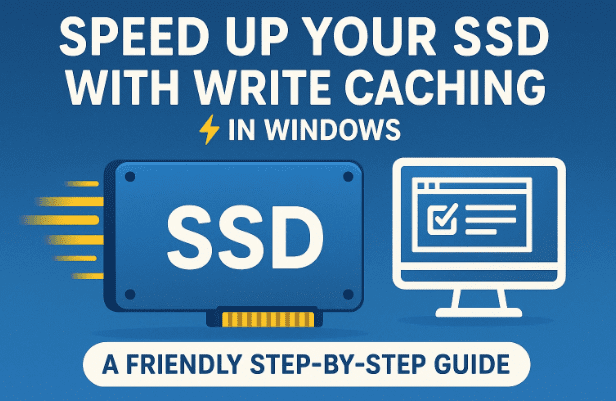
Let’s walk through it together step by step.
📑 Table of Contents
- 1. What Exactly Is Write Caching?
- 2. How Does It Work Behind the Scenes?
- 3. Why You Might Want to Enable It
- 4. Risks You Should Be Aware Of
- 5. How Different Drives Benefit (or Don’t)
- 6. Getting Ready Before You Flip the Switch
- 7. Step-by-Step: How to Enable Write Caching in Windows
- 8. The Mysterious “Buffer Flushing” Option Explained
- 9. Testing: How to See the Difference
- 10. Troubleshooting and Rolling Back
- 11. FAQs You Might Be Wondering About
- 12. Quick Cheat Sheet: Who Should Use Write Caching?
- 13. Wrapping Up
1. What Exactly Is Write Caching?
Think of write caching as a “waiting room” for your files. Instead of forcing your SSD to immediately write every little piece of data as it comes in, Windows first stores those writes in fast memory — either your system RAM or your SSD’s own built-in cache (if it has one).
Because memory is so much faster than storage, your apps get to move on immediately, and the actual writing to disk happens in the background a moment later.
That’s why the system often feels faster when write caching is on.
2. How Does It Work Behind the Scenes?
Here’s a simple flow:
- An app (say Steam or Photoshop) sends data to be saved.
- Windows quickly parks it in RAM (or SSD cache).
- A few seconds later, it writes that data permanently to the drive.
The key here is speed vs. safety. You gain responsiveness, but if power goes out before the “waiting room” empties, the data sitting in memory is lost.
3. Why You Might Want to Enable It
Let’s be honest: not everyone needs it. But if you do a lot of things like:
- Installing and updating software or games
- Working with many small files (coding, unpacking archives, etc.)
- Running apps that constantly log or cache data
…then write caching can shave off time and make your system feel smoother.
On SATA SSDs (the older kind that top out around 500 MB/s), the difference can be noticeable. On NVMe drives, which are already blazing fast, the gains are smaller — but still useful for tiny, random writes.








4. Risks You Should Be Aware Of
Before you flip it on, here are the gotchas:
- ⚡ Power loss danger: If your PC shuts down suddenly (power cut, crash, battery drained), any data still in cache may vanish.
- 📉 Possible corruption: Rare, but if flushing is mishandled by Windows or your SSD, cached data could get corrupted.
- 🎮 Odd slowdown in apps: A few users see worse performance in apps like Steam downloads with write caching on.
- 🧠 RAM-heavy systems work best: If you’re on a very old machine with only 2–4 GB RAM, it won’t help much.
👉 Rule of thumb: desktops without UPS should think twice, laptops are safer since they have a battery backup.
5. How Different Drives Benefit (or Don’t)
Here’s a quick breakdown:
| Drive Type | Baseline Speed | Gains from Write Caching | Notes |
|---|---|---|---|
| SATA SSD | ~500 MB/s | Big improvement | Best candidate. |
| NVMe SSD | 2–7 GB/s | Moderate | Already fast, helps with small writes. |
| M.2 SSD (SATA) | ~500 MB/s | High | Behaves like SATA. |
| M.2 SSD (NVMe) | 2–7 GB/s | Moderate | Same as NVMe above. |
| DRAM-less SSD | Slower consistency | Moderate | Relies on system RAM. |
| HDD (spinning disk) | 80–200 MB/s | High but risky | Benefits, but big risk without UPS. |
6. Getting Ready Before You Flip the Switch
It’s tempting to dive in, but let’s do some prep first:
- 🔒 Back up critical files. Always.
- 📊 Benchmark before. Run CrystalDiskMark or AS SSD to measure your baseline.
- 🔌 Check your power situation. Desktop users: a UPS is strongly advised. Laptop users: the battery gives you some safety net.
- 💻 Check RAM. At least 8 GB is comfortable for caching.
Once that’s done, you’re safe to try it.
7. Step-by-Step: How to Enable Write Caching in Windows
Here’s the exact path:
- Press Windows + X → choose Device Manager.
- Expand Disk drives and right-click your SSD.
- Select Properties.
- Go to the Policies tab.
- Check Enable write caching on the device.
- Leave the second option (buffer flushing) alone for now.
- Hit OK.
- Restart if Windows asks.
That’s it — write caching is now active and if you want to check health of your SSD or HDD can follow this 3 Easy Ways to Check HDD, SSD, or USB Drive Health in Windows 10/11
8. The Mysterious “Buffer Flushing” Option Explained
You’ll notice another box: “Turn off Windows write-cache buffer flushing on the device.”
Here’s what it means:
- If left unchecked (default), Windows flushes cache regularly to keep things safe.
- If checked, Windows delays flushing longer for higher performance — but this seriously increases risk if the power goes out.
👉 Only enable this if you have a UPS or are on a laptop with a good battery. Otherwise, it’s better left off.
9. Testing: How to See the Difference
Now comes the fun part — testing.
- Run CrystalDiskMark again and compare with your earlier results. Pay attention to 4K random writes — that’s where the boost usually shows.
- Notice real-world tasks like installing a game or extracting a zip. If things feel smoother, the tweak worked.
10. Troubleshooting and Rolling Back
If things don’t go as planned:
- Performance got worse? → Go back and uncheck write caching.
- Apps acting odd? → Same fix: disable and restart.
- System unstable? → Make sure buffer flushing isn’t disabled without proper backup power.
It’s reversible in just a few clicks.
11. FAQs You Might Be Wondering About
Q1. Does write caching wear out SSDs faster?
👉 Actually, it can reduce wear since it batches writes more efficiently.
Q2. Should I enable it on NVMe drives?
👉 You can. Gains are smaller but noticeable with small random files.
Q3. Is it safe on laptops?
👉 Safer than desktops because laptops have built-in batteries.
Q4. What about HDDs?
👉 Works, but without UPS, the risk of losing data is higher.
Q5. Can I just leave it enabled forever?
👉 Yes, if you’ve tested it and your workload benefits. If not, you can always disable it.
12. Quick Cheat Sheet: Who Should Use Write Caching?
| Scenario | Recommendation |
|---|---|
| Gaming PC with SATA SSD | ✅ Enable, good gains |
| Laptop with SSD | ✅ Enable, safe with battery |
| Desktop without UPS | ⚠ Enable cautiously |
| Server with critical data | ❌ Avoid, prioritize stability |
| Old PC with <4 GB RAM | ❌ Not worth it |
13. Wrapping Up
Write caching is one of those Windows settings that many people never touch, but once you understand it, it makes sense to try. On older SATA SSDs and even HDDs, it can feel like an upgrade. On modern NVMe drives, the improvements are subtler but still helpful for certain workloads.
The main rule: balance performance with safety. If you have stable power (UPS or battery), enabling write caching is worth testing. If you’re on shaky ground with frequent outages, it might be safer to leave it off.
At the end of the day, it’s a free tweak — test it, compare results, and decide if it fits your needs.
⚠ Disclaimer
Enabling write caching may increase the risk of data loss during sudden power failures. Always back up important data before making system changes. Proceed at your own discretion.
Tags: ssd write caching, windows performance, enable write caching, disk optimization, nvme vs sata, device manager, storage speed tweaks
Hashtags: #SSD #Windows #WriteCaching #PerformanceTips #TechGuide