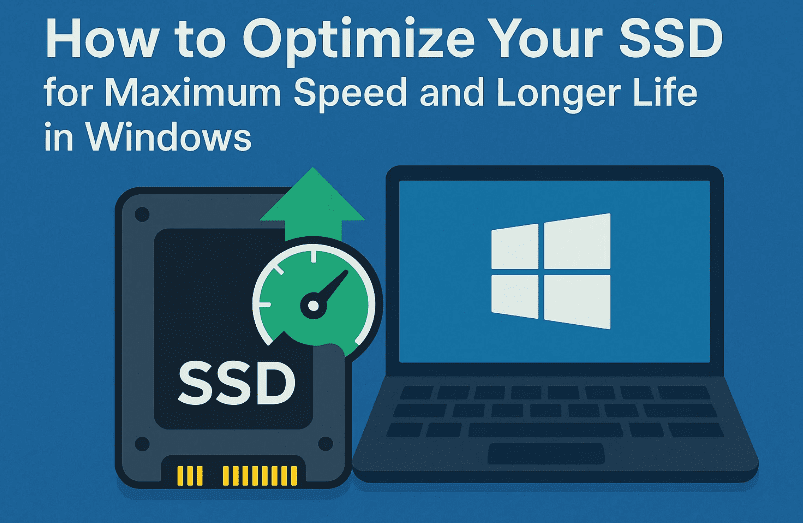
Many people believe that once they’ve upgraded their PC with an SSD (Solid State Drive), they’ve already unlocked the best possible performance. While it’s true that SSDs are much faster and more reliable than traditional HDDs, there are still several optimization steps you can take to push your SSD even further, improve system responsiveness, and even extend the drive’s life.
In this article, we’ll go step by step through the process of testing, optimizing, and tuning your SSD using a combination of built-in Windows settings and a free utility called SSD Booster. Along the way, we’ll also explain why each tweak matters so you fully understand the benefits.
1️⃣ Why Optimize Your SSD?
It’s natural to assume an SSD will “just work” at maximum speed. But Windows often runs background tasks originally designed for mechanical hard drives (HDDs). These tasks can cause unnecessary wear and tear on SSDs and reduce their efficiency.
By disabling features like defragmentation, superfetch, or legacy naming conventions, and enabling features like TRIM support, you can:
- Improve read and write performance
- Reduce write operations (increasing SSD life)
- Lower boot times
- Free up system resources
Optimization is not about “overclocking” your SSD—it’s about making sure the operating system handles it correctly.
2️⃣ Testing Baseline Performance with AS SSD Benchmark
Before making changes, it’s important to know your SSD’s current speed. That way, you can compare results after optimization.
The tool we’ll use is AS SSD Benchmark, a popular free utility for measuring sequential and random read/write performance.
Steps:
- Download and install AS SSD Benchmark.
- Launch the tool.
- Select your SSD (usually the
C:drive). - Click Start to begin the test.
👉 Example baseline results before optimization:
- Read Speed: ~488 MB/s
- Write Speed: ~465 MB/s
Keep these figures in mind—we’ll compare them after using SSD Booster.
3️⃣ Download and Install SSD Booster
The next tool we need is SSD Booster, a lightweight freeware utility that provides quick access to key SSD-related optimizations.










- Official download link: SSD Booster on MajorGeeks
- File size is small, so it downloads quickly.
- Extract the downloaded file and keep it ready to use.
👉 Unlike heavy optimization suites, SSD Booster focuses only on SSD-specific tweaks, making it both safe and efficient.
4️⃣ Create a Restore Point (Safety First)
Before changing system-level settings, it’s always a good idea to create a restore point. This way, if you’re unhappy with the results or something breaks, you can roll back easily.
Steps:
- Open Windows Search → type
restore. - Select Create a Restore Point.
- Under System Protection, click Create.
- Name it something clear, like
SSD Booster. - Wait a few moments until Windows confirms the restore point is ready.
Now, you’re fully protected. Let’s move on to the actual tweaks.
5️⃣ Exploring SSD Booster Options
Once you right-click SSD Booster and select Run as Administrator, you’ll see a simple dashboard with several toggles. Each option will either appear in red/pink (needs change) or green (already optimized).

Let’s walk through them one by one.
🔹 Kernel Paging Executive
- What it does: Moves parts of the Windows kernel to the page file on disk.
- Why disable it: On SSDs, constant writing to disk can reduce lifespan. Disabling it keeps critical data in RAM.
- Recommended Setting: Off (Green).
🔹 Last Access Time Stamp
- What it does: Updates the “last accessed” timestamp for every file you open.
- Why disable it: Creates unnecessary write operations on SSDs.
- Recommended Setting: Disabled.
🔹 Boot File Defragmentation
- What it does: Reorganizes boot files for faster startup on HDDs.
- Why disable it: SSDs don’t benefit from defragmentation, and it only adds extra writes.
- Recommended Setting: Disabled.
🔹 Prefetch and Superfetch
- What it does: Preloads commonly used files into memory for faster access.
- Why disable it: Designed for HDDs. SSDs already provide instant access times, making this redundant.
- Recommended Setting: Disabled.
🔹 8.3 Name Creation
- What it does: Maintains short legacy filenames (like
PROGRA~1) for older programs. - Why disable it: Most modern software doesn’t require this, so disabling reduces overhead.
- Recommended Setting: Disabled.
🔹 Thumbnail Cache
- What it does: Stores previews of images and videos.
- Why disable it: On SSDs, this cache isn’t necessary, and rebuilding thumbnails is quick.
- Recommended Setting: Disabled.
🔹 Search Indexing
- What it does: Continuously indexes files for faster search results.
- Why disable it: While useful on HDDs, it creates extra writes on SSDs. You can still search normally without it.
- Recommended Setting: Disabled.
🔹 Event Logging
- What it does: Records detailed system event logs.
- Why disable it: Useful for debugging, but most users don’t need constant detailed logs. Disabling reduces writes.
- Recommended Setting: Disabled (optional—leave enabled if you often troubleshoot with logs).
🔹 Hibernate
- What it does: Saves the current system state to disk for fast startup.
- Why disable it: Hibernation can consume large amounts of SSD space and write data frequently.
- Recommended Setting: Disabled (unless you rely heavily on Hibernate).
🔹 TRIM Support
- What it does: Informs the SSD which data blocks are no longer used so they can be erased internally.
- Why enable it: TRIM is essential for SSD performance and longevity.
- Recommended Setting: Enabled.
🔹 Drive Optimization
- What it does: Runs built-in optimization tools in Windows.
- Why leave it: Windows handles this automatically for SSDs.
- Recommended Setting: Default.
6️⃣ Running the Optimization Process
Once all the toggles are switched to their recommended positions (green), you’re ready for the final step.
- Click the gear icon (Settings) at the bottom of SSD Booster.
- Select Optimize System Drive.
- Wait for the process to finish (may take a few minutes).
👉 If you see any “fail” messages, don’t panic. Simply restart your computer and try again.
7️⃣ Re-Testing with AS SSD Benchmark
Now that the optimizations are applied, let’s see the difference:
- Open AS SSD Benchmark again.
- Run the test on your SSD.
- Compare the results with your earlier baseline.
👉 Example optimized results:
- Read Speed: ~510 MB/s (previously ~488 MB/s)
- Write Speed: ~477 MB/s (previously ~465 MB/s)
Even small gains in these numbers can result in noticeably faster boot times, snappier app launches, and smoother multitasking.
8️⃣ Expected Performance Gains
Here’s what you can realistically expect after optimizing:
- Faster boot and shutdown times
- Quicker app loading
- Reduced background disk activity
- Extended SSD life by reducing unnecessary writes
- Slight but measurable improvements in benchmark results
🔍 9. FAQs
Q1. Is SSD Booster safe to use?
👉 Yes, as long as you download it from trusted sites like MajorGeeks. It simply toggles Windows settings already available in the OS.
Q2. Can I break my SSD by disabling these features?
👉 No. Most of the disabled features are legacy optimizations for HDDs. Disabling them actually helps SSD health.
Q3. Do I need to run SSD Booster regularly?
👉 No. Once optimized, your SSD stays tuned. You may rerun it after major Windows updates.
Q4. Should I disable Hibernate if I use a laptop?
👉 Only if you don’t rely on Hibernate. Many laptop users prefer Sleep mode instead.
Q5. Will this make my SSD as fast as a newer NVMe drive?
👉 No. This won’t change the physical limits of your SSD—it just ensures it performs at its best.
⚠️ Disclaimer
This guide is for educational purposes. SSD Booster and AS SSD Benchmark are third-party tools—download only from official sites. Always create a restore point before making system-level changes. Performance improvements vary depending on SSD model and system configuration.
👉 Official Tools:
📑 Tags
ssd optimization windows, ssd booster tool, as ssd benchmark guide, speed up ssd windows, increase ssd lifespan, disable indexing ssd, disable hibernate ssd, trim support windows, ssd performance tweaks, boost windows 10 ssd speed
📢 Hashtags
#SSD #Windows10 #Windows11 #Optimization #Performance #TechTips #Storage #SpeedBoost #SSDBooster #ASSSDBenchmark