Cloud storage has become an essential part of modern digital life. We rely on it for work, personal projects, collaboration, and even backing up photos of our pets. Among the major players—Google Drive, Dropbox, OneDrive—Apple’s iCloud Drive has always been a slightly different experience. Some people love its seamless integration across Apple devices, while others get frustrated because it doesn’t work quite like traditional drives.
In this article, we’ll go in-depth into how iCloud Drive works, how you can organize it effectively, and what new features in macOS 2026 bring to the table, such as color-coded folders using tags. We’ll also explore how to use Finder settings, how to manage tags without going overboard, and why iCloud feels more like a secondary hard drive than just “another online folder.”
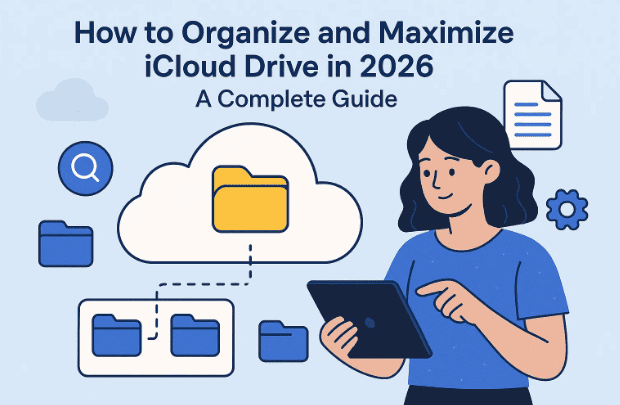
👉 Official page: iCloud Drive – Apple
1. Why iCloud Drive is Different
If you’re new to iCloud Drive, you may expect it to behave exactly like Google Drive or Dropbox. But Apple has designed iCloud Drive with a different philosophy—it’s more of a cloud-based extension of your device’s storage.
That means:
- Instead of acting like a shared external hard drive, it syncs system folders (Desktop, Documents, Downloads) seamlessly across devices.
- Apps often create their own folders inside iCloud Drive, sometimes without you realizing it. For example, installing Obsidian automatically creates an “Obsidian” folder.
This can confuse new users who expect iCloud to just be a blank folder in the cloud. But once you understand its design, it becomes clear: Apple wants iCloud Drive to disappear into the background, keeping your digital life unified across Mac, iPhone, and iPad.
2. Storage Plans and Family Sharing
Apple offers different iCloud storage tiers, from free 5 GB (which fills up very quickly) to premium plans of 2 TB or more. Many users, especially families, opt for the higher tiers because of:
- Family Sharing: One plan can be shared with multiple family members.
- Photo Storage: If you or your partner take hundreds of photos daily, storage vanishes fast.
- File Flexibility: Having terabytes available means you don’t need to micromanage space.
For example, one author of this article keeps 2 TB active because family members constantly back up photos, ensuring peace of mind that no memory is ever lost.
3. How iCloud Syncs Across Devices
The beauty of iCloud Drive is in its synchronization:
- Take a screenshot on your Mac desktop, and within seconds it’s accessible on your iPhone.
- Draft a document in Pages on your iPad, and it’s instantly available on your MacBook.
- Store files for a podcast or design project, and they sync across devices without effort.
This is where iCloud truly shines—its integration is seamless because it’s built directly into the operating system. There’s no need for third-party syncing apps.
4. Color Coding and Tags in macOS 2026
One of the most exciting improvements in recent Apple updates is the ability to color-code folders via tags. This allows you to visually organize your work and personal projects.






Here’s how one user organizes:
- Orange Tag → Business Projects (CPI)
- Red Tag → English Language Business
- Blue Tag → Personal Files
With just a glance, you can separate business from personal life. These tags sync across Mac, iPhone, and iPad, making organization consistent everywhere.
5. Step-by-Step: Setting Up Tags in Finder
Now let’s get into the practical side. To create and organize tags in Finder, follow these steps:
- Open Finder on your Mac.
- Go to Finder > Settings > Tags.
- Review the existing tags. Many will be unused or auto-created by apps.
- Delete unnecessary tags: right-click and choose “Delete Tag.” (Note: sometimes a bug prevents certain tags, like “Gray,” from being removed.)
- Create new tags: choose from Apple’s limited palette (around 7 colors). While you can’t fully customize colors, the preset range is usually enough.
- Reorder tags: drag them into the sequence you want. The order you set here determines how they appear in Finder windows.
- Enable Grouping by Tags: In Finder, click the three dots (•••) at the top > “Use Groups” > “Group by Tags.”
Now, your Finder view will neatly organize files by color-coded tags, making it much easier to separate projects.
6. Organizing Your Work and Personal Life
Here’s how a professional might structure iCloud Drive with tags:
- Business (Orange)
- Podcasts → Audio files, images, episode notes.
- Invoices → Quotations, client payments, PayPal receipts.
- Campaigns → Logos, graphics, and resources for upcoming launches.
- Secondary Business (Red)
- Teaching materials.
- Notes for online classes.
- Personal (Blue)
- Family photos.
- Travel documents.
- Personal notes and hobbies.
Keeping it simple with only three to five tags is crucial. If you create dozens of tags, you’ll forget them and the system collapses into chaos.
7. Managing Shared Folders
iCloud also allows folder sharing, useful when working with multiple devices or colleagues:
- A coaching folder can be shared with a demo computer, ensuring all client notes are available during calls.
- A project folder can be shared with another Mac logged into a different Apple ID.
Shared folders appear with people icons in Finder, so you can easily spot them.
8. Practical Examples of iCloud Use
To bring this guide to life, here are real examples of how iCloud can be used daily:
- Podcast Production: Episodes stored in iCloud mean audio files are accessible from Mac or iPad when editing.
- Business Accounting: All PayPal receipts automatically filed into an “Accounts” folder.
- Creative Projects: Monthly thumbnails for social media campaigns organized into subfolders.
- Archiving Old Apps: Even if you stop using an app like Obsidian, the folder remains in iCloud, keeping old notes safe.
This combination of archiving + active use makes iCloud a hybrid between storage and backup.
9. iCloud Drive vs Google Drive, Dropbox, and OneDrive
So how does iCloud compare to competitors?
- Google Drive → Best for cross-platform collaboration. Works seamlessly across Windows, Mac, Android, and web.
- Dropbox → Known for fast sync and sharing, but smaller free tier.
- OneDrive → Ideal for Microsoft 365 users, tightly integrated with Office apps.
- iCloud Drive → Best for Apple ecosystem users. Feels less like a shared drive and more like a native part of your Mac, iPhone, and iPad.
For mixed-platform teams, Google Drive or OneDrive may be more practical. But for personal and family use in the Apple ecosystem, iCloud is hard to beat.
10. Potential Limitations and Bugs
No tool is perfect. With iCloud, you may run into:
- Limited color customization for tags.
- Occasional bugs with undeletable tags.
- Frustration if you expect iCloud to behave exactly like Dropbox or Google Drive.
- Heavy reliance on internet access—though files can be set to download for offline use.
11. Tips to Avoid Common Tagging Mistakes
Here are lessons learned from years of iCloud usage:
- Don’t create too many tags. Stick to 3–5.
- Review your tags quarterly—delete ones you don’t use.
- Use tags for broad categories (Business, Personal, Study) rather than micro-organizing every file.
- Always reorder tags in Finder settings to prioritize the categories most important to you.
12. FAQs
Q: Can I use iCloud Drive on Windows?
A: Yes. Apple provides an iCloud for Windows app, though the integration is less smooth compared to macOS.
Q: Does deleting a tag delete the files?
A: No, removing a tag only unlinks it from the file. The file itself remains safe.
Q: Can I access iCloud Drive offline?
A: Yes. You can mark files as “Download Now” for offline access. Otherwise, they stay in the cloud until opened.
Q: Is iCloud secure?
A: Yes. Apple uses end-to-end encryption for sensitive data, though users should always enable two-factor authentication for extra safety.
13. Conclusion
iCloud Drive is not a replacement for Google Drive or Dropbox—it’s something different. Think of it as your device’s second hard drive that lives in the cloud. Once you understand this, it becomes far easier to use effectively.
With macOS 2026’s new tagging and color-coding system, organizing your iCloud has never been easier. Whether you’re managing businesses, personal files, or shared projects, you can keep everything structured, searchable, and accessible across every Apple device.
For those deep in the Apple ecosystem, iCloud Drive is one of the most seamless tools available. It might frustrate people who expect it to act like Google Drive, but if you lean into Apple’s philosophy, you’ll find it can be a game-changer for organization.
Disclaimer
This article is based on personal usage experiences and Apple’s official documentation. Features may differ slightly depending on macOS or iOS version. Always back up critical files externally in case of sync errors.
Tags: icloud drive, macos 2026, apple productivity, cloud storage organization, icloud tips, icloud tags, file management mac
Hashtags: #iCloudDrive #AppleEcosystem #MacTips #CloudStorage #Productivity