For nearly two decades, we’ve lived in the age of apps. Every task on your smartphone—be it booking a cab, paying bills, or editing photos—has meant tapping open yet another app. But what if, just a few years from now, this very idea of “installing apps” becomes obsolete?
It may sound unbelievable, but the winds of change are already blowing. The next evolution of operating systems is unfolding right before our eyes—where AI doesn’t just assist your phone, it becomes your phone. Welcome to the era of the AI-powered OS, a world where digital agents will handle your daily tasks seamlessly, without the need for dozens of separate applications cluttering your home screen.
Let’s dive deep into how this transformation is happening, who’s leading the race, and what it means for all of us who live through the end of the “app era.”
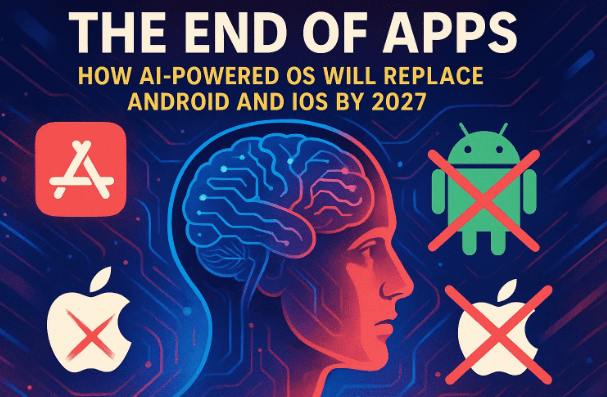
⚙️ 1. The Turning Point in Tech History
If we rewind 20 years, we were transitioning from simple feature phones to the first wave of smartphones. Apple’s iPhone had just arrived, Android was emerging, and the world was introduced to touchscreens, app stores, and mobile internet. That revolution redefined how humans interacted with technology.
Now, in 2025, a similar shift is taking shape again—this time from smartphones to AI-driven devices. Just like in 2007, the signs may look small right now, but the change will soon feel massive.
In short, we’re standing at the edge of a new era: from smartphones to “smart agents.”
🤖 2. What Is an AI-Powered OS?
Before we go deeper, let’s clarify what exactly this means.
An AI-powered operating system (AI-OS) is not just an Android or iOS with a chatbot added on top. It’s a complete rethinking of how a device works. In this new world, your phone doesn’t just respond to what you tap—it understands what you want.
Imagine saying:
“Book me a flight to Mumbai tomorrow morning, and reserve a hotel near the airport.”
Instead of opening five different apps—MakeMyTrip, Paytm, Google Maps, Booking.com, and your bank app—your AI-OS will understand the intent, compare flight options, check your schedule, choose the best deal, handle payment securely, and even email your itinerary—all without you switching apps.




That’s the vision behind AI agents, a concept being shaped by companies like OpenAI and Microsoft.
💡 3. The Rise of AI Agents — From Chatbots to Task Executors
Let’s move to the next part: understanding AI agents, the backbone of this transformation.
In 2024, OpenAI introduced Agents in ChatGPT — customizable AI bots that can perform real-world actions on your behalf. These agents can already book tickets, make calendar appointments, summarize data, and even execute automated workflows.
The magic lies in what’s coming next: on-device integration. Right now, ChatGPT agents run in the cloud. But as smartphone processors become more powerful, these capabilities will move directly into your device—allowing real-time decision-making even when offline.
That’s when your phone will evolve into something more than a communication tool—it will become an intelligent companion.
📱 4. Why Apps Might Become Obsolete
So far, we’ve always used phones the same way—open an app, log in, fill forms, click buttons. But AI is about to remove all those steps.
In the AI-OS future, the process will be conversational and intent-driven:
- You tell your OS what you want.
- It understands your goal.
- It handles everything—from data entry to payment.
No separate app installs. No “accept cookies” pop-ups. No constant switching.
This could eventually render thousands of apps unnecessary. Instead of hundreds of isolated tools, the OS itself will act as a unified interface—your one app to rule them all.
Think of it as the death of the “App Store” model—and the birth of an Agent Store.
🔊 5. Haven’t We Seen This Before? (Alexa, Siri & Beyond)
A fair question arises: Haven’t we had voice assistants before—like Alexa or Siri—that could do similar things?
Yes, but the difference is trust and comprehension.
Old assistants followed scripts:
- “Play a song.”
- “Set an alarm.”
- “Tell me the weather.”
They couldn’t truly think. They lacked reasoning and context.
In contrast, modern agentic AI understands full scenarios. If you say,
“Plan my next weekend trip with good weather and budget hotels,”
it doesn’t just search—it evaluates flight times, reviews, your budget, and preferences. It can even talk back, explain its reasoning, and let you approve or modify details.
So, while Alexa was a novelty, AI agents are a necessity—a practical evolution of personal computing.
🔩 6. The Hardware Revolution Powering the AI-OS
Now, let’s move to the part that makes all this possible—the hardware.
To run these large AI models locally, you need processors designed for on-device intelligence. Companies like Qualcomm are already paving the way with chips like the Snapdragon 8 Elite Gen 5.
This processor doesn’t just boost graphics or speed—it includes a dedicated NPU (Neural Processing Unit) capable of running advanced AI tasks without relying on cloud servers. That means faster execution, better privacy, and real-time results.
In Qualcomm’s own demo, the chip could analyze app layouts, understand button positions, and execute multi-step tasks on behalf of the user—all autonomously.
This is the beginning of agentic hardware—processors built not for humans to click, but for AI to act.
🔐 7. Privacy and On-Device AI
With all this power, one concern naturally arises: What about privacy?
Today’s AI models often rely on external servers. Every command you give to ChatGPT or Perplexity is processed in the cloud. But the AI-OS of tomorrow will bring much of that intelligence to your own device.
Your biometrics, UPI details, and personalized data will stay local—encrypted and secure. AI will perform tasks like comparing product reviews, filling online forms, or finding best deals—all without transmitting your personal data elsewhere.
This shift is not just about speed—it’s about sovereignty over your data. The same way offline modes changed browsing, on-device AI will change how you trust your phone.
🔧 8. The Software Ecosystem — OpenAI, Google, and Apple’s Paths
Every major tech player is racing toward this new future, but each one is taking a different route.
- OpenAI is expanding ChatGPT’s capabilities into a full ecosystem—browser, agents, and possibly hardware (rumored collaboration with Jony Ive, the legendary iPhone designer).
- Google is transforming Android’s foundation through Gemini and DeepMind projects, embedding AI at every layer.
- Microsoft is turning Windows into a true AI OS with Copilot+ PCs, integrating agentic intelligence directly into the system.
- Apple, traditionally focused on design and hardware, is experimenting with “Apple Intelligence,” but many believe it may eventually need to collaborate with OpenAI to stay competitive.
If history repeats itself, this next race won’t be about screens or form factors—it’ll be about who owns the smartest digital brain.
🧩 9. Why This Time Is Different
Let’s pause for a moment and look back.
Attempts like Humane AI Pin and Rabbit R1 tried to reinvent smartphones, but they failed because the ecosystem wasn’t ready. Cloud dependency was high, hardware weak, and trust low.
But 2025’s environment is different.
- Cloud models have matured.
- NPUs in chips are powerful.
- UPI and fingerprint payment systems are widespread.
The infrastructure for a self-sufficient AI-OS finally exists.
By 2027, we may see the first full-fledged devices that operate entirely on this model—perhaps under a new name we haven’t even heard yet.
🚀 10. The Real-World Use Case: From Tap to Talk
Picture this:
You’re planning to order groceries.
Instead of opening BigBasket or Blinkit, you simply say—
“Order my usual weekly groceries and add some fresh fruits.”
Your phone checks your history, compares current prices, selects the best vendor, applies loyalty credits, and confirms with your fingerprint. Within seconds, it’s done.
That’s not futuristic sci-fi. That’s where AI-OS is headed. Every repetitive app-based task—from bill payments to travel planning—will become a conversation instead of a process.
⚡ 11. The Challenges Ahead
Of course, there are hurdles.
- Hardware Limitations: AI models require massive memory and storage. Phones may soon need 24–32 GB RAM or more.
- Energy Efficiency: On-device AI consumes significant power, demanding better cooling and battery design.
- Ethical AI: Delegating decisions to machines requires deep transparency and accountability.
- User Trust: The same issue Alexa faced—“Will it order the right thing?”—must be solved with visible, verifiable feedback loops.
Yet, these challenges aren’t roadblocks—they’re stepping stones toward refinement.
🧭 12. Beyond Phones — The AI Ecosystem Expands
AI-OS won’t stop at smartphones. Smart glasses, rings, bracelets, and AI pendants are already under development. These wearable devices will sync with your main AI brain—the OS—to extend its reach beyond your pocket.
Even on PCs, Microsoft is already merging Copilot Vision into the file explorer and photo gallery, allowing contextual suggestions and summaries right from your desktop. The future will not be mobile vs desktop—it will be AI across all devices.
💬 13. Questions & Answers
Q1: Will Android and iOS disappear completely?
Not immediately. They’ll evolve. Android may transform into Google’s AIOS, while iOS might merge Apple Intelligence with OpenAI capabilities. The traditional app-based model, however, will fade gradually.
Q2: What happens to app developers?
Developers will shift from building standalone apps to creating “AI skills” or “agents” that plug into the OS. The focus will move from UI design to logic and intent modeling.
Q3: Will privacy improve or worsen?
Surprisingly, it may improve. On-device AI ensures that sensitive data stays local instead of being sent to external servers.
Q4: When will we see the first AI-powered phones?
Prototypes are expected by 2026, with mainstream availability around 2027—once chipsets like Snapdragon 8 Elite Gen 6 and enhanced RAM/storage standards are widely available.
Q5: Can this work without the internet?
Partially. Core intelligence and automation will run offline, but real-time data (like flight info or prices) will still need a connection.
🌍 14. Conclusion: The End of the App Era
So far, we’ve seen how the app-based ecosystem that ruled our digital lives is slowly being replaced by AI-driven systems that think, plan, and act.
We’re stepping into a future where you won’t manage your phone—your phone will manage your world. The evolution from Android/iOS to AI-OS isn’t about changing screens or icons; it’s about changing interaction itself.
The next time you tap open an app, remember: that tap might soon be history.
Disclaimer:
This article is for informational purposes only. Predictions and timelines are based on current technological trends and publicly available data from companies such as OpenAI, Google, Microsoft, and Qualcomm. Actual developments may vary.
#AIOS #ArtificialIntelligence #OpenAI #Android #iOS #FutureTech #Qualcomm #MicrosoftCopilot #PerplexityAI #ChatGPT #AITechnology #TechInnovation