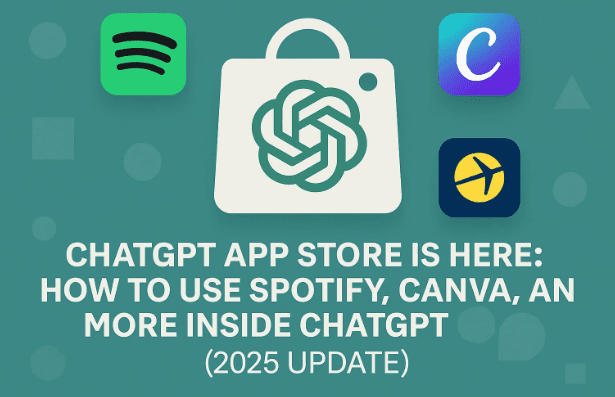
Artificial intelligence has just entered a new chapter. OpenAI has officially introduced Apps inside ChatGPT, allowing you to connect, browse, and use your favorite platforms like Spotify, Canva, Zillow, Expedia, and more—directly within ChatGPT.
If you remember the early days of smartphones, you’ll recall that the first iPhone (2007) was fairly limited—it had only Apple-made apps. But everything changed when Apple launched the App Store, giving third-party developers freedom to build their own apps. That single move revolutionized the mobile world.
OpenAI is now doing the same for AI: bringing an App Store-like ecosystem into ChatGPT. This change doesn’t just add new features—it’s transforming ChatGPT into an all-in-one workspace that connects to your digital life.
What Are ChatGPT Apps?
ChatGPT Apps are third-party integrations that run inside the ChatGPT interface. Instead of switching between multiple websites or tabs, you can now interact with services like Spotify, Canva, or Zillow directly through conversation.
For example, you can type:
“Create a two-hour relaxing work playlist using Spotify.”
…and ChatGPT, via the Spotify app, will instantly generate and save a playlist for you.
These integrations are not browser plug-ins or browser-based add-ons—they’re native app connections that use APIs and OpenAI’s new App SDK to communicate securely between your ChatGPT session and external platforms.
Availability: Who Can Use ChatGPT Apps
At the moment, ChatGPT Apps are available for Free, Plus, and Pro users.
However, Business, Education, and Enterprise plans will get access later this year (OpenAI has already confirmed this rollout).
If you’re using the Pro plan (with GPT-4), you’ll enjoy deeper integration capabilities, including agentic actions and file upload compatibility within apps.
So far, the rollout supports seven official apps, with more being added weekly. Let’s now look at how to use them.






How to Use Apps Inside ChatGPT
To use a ChatGPT App, you don’t need to click any new button or enable any hidden setting.
All you have to do is type the name of the app followed by your request.
For instance:
Spotify create a playlist for evening study music
ChatGPT will recognize “Spotify” as an app and open a connection popup.
When connecting an app for the first time, you’ll see a secure login prompt asking you to authenticate your account (e.g., signing into Spotify or Canva).
Once connected, you can:
- Interact with the app using natural language
- Perform actions like “edit,” “update,” or “change title”
- Disconnect or remove the app anytime by clicking the ❌ icon beside its name
💡 Tip: After an app is connected, you’ll also find it listed under the “More” section when you click the ➕ (plus) icon below your chat input bar.
Now let’s look at how each app works in real life.
🎵 Using Spotify Inside ChatGPT
Spotify is the first officially integrated app for ChatGPT. It allows you to generate, view, and manage playlists without ever leaving the chat window.
Let’s walk through it step by step.
Step 1: Connect Spotify
When you type something like:
Spotify make a relaxing work playlist for two hours
ChatGPT will prompt a connection window asking you to sign into your Spotify account.
Once you authorize access, the ChatGPT Spotify App gets linked.
Step 2: Create or Modify a Playlist
Now ChatGPT communicates with Spotify’s API and returns a curated playlist right inside the chat. You’ll see a message such as:
“Spotify has put together great options for a two-hour relaxing work session.”
You can then refine it naturally:
“Make it instrumental only.”
“Add some lo-fi tracks.”
Spotify updates the playlist dynamically.
Step 3: Open in Spotify
Playback doesn’t happen inside ChatGPT due to copyright and media policies. You can click “Open in Spotify” to listen on your actual account.
🔗 Official site: https://www.spotify.com
🎨 Designing with Canva Through ChatGPT
Next comes Canva, one of the most powerful integrations so far.
Canva is widely used for graphic design—everything from posters to slides. The ChatGPT App version lets you generate presentations, social media posts, or thumbnails right from your text prompt.
Example Prompt
“Canva, turn this script into five slides.”
ChatGPT will then ask you to upload your text file or paste your content. Once connected, Canva automatically generates multiple slide options.
Step 1: Connection & Authorization
Just like Spotify, the first time you use it, Canva will ask you to log in and authorize ChatGPT access.
Step 2: Generate Slides
Canva will process your input and return several slide designs. Each design can be opened directly in Canva for final adjustments.
Step 3: Edit Inside ChatGPT
You can also ask ChatGPT to modify elements.
For instance:
“Change the intro title to ‘Hello to Google Gemini’.”
When you reopen it in Canva, the edit will already be applied.
That seamless back-and-forth between ChatGPT and Canva makes this feature game-changing.
🔗 Official site: https://www.canva.com
🏡 Finding Homes with Zillow
If you’re house-hunting, ChatGPT’s Zillow App integration turns your conversation into a real-estate search assistant.
Simply type:
Zillow find me a home for $500K in Chicago
ChatGPT displays:
- An interactive map with property listings
- Photo galleries
- Price filters and sliders
You can continue refining:
“Remove all listings under $400K.”
The map updates instantly inside ChatGPT, letting you preview homes without leaving the chat. Clicking any listing shows all photos and key details right inside the interface.
🔗 Official site: https://www.zillow.com
✈️ Planning Trips with Expedia and Booking.com
Travelers will love this part. Both Expedia and Booking.com are now available as ChatGPT Apps, letting you plan entire trips conversationally.
Let’s go through an example.
Step 1: Search Hotels
Type:
Expedia find me a hotel in San Francisco for this weekend under $500 a night
Expedia connects and instantly lists hotels with details like star rating, reviews, and amenities.
If your prompt is vague, ChatGPT will ask clarifying questions such as:
- “How many guests?”
- “Minimum rating preference?”
This ensures you get accurate results.
Step 2: Refine the Results
Once results appear, you can update your filters naturally:
“Only show 4-star hotels with free breakfast.”
Expedia updates the list accordingly, all within ChatGPT.
Step 3: Dining and Extras
ChatGPT can even pull restaurant suggestions or reservations using its AI Agent browsing tool.
For example:
“Find dinner reservations nearby.”
It uses ChatGPT’s virtual computer to browse for live data. While still in experimental mode, it’s already surprisingly effective.
🔗 Official sites:
🎓 Learning with Coursera
OpenAI has also added Coursera, a leading online learning platform.
You can search for free or paid courses directly inside ChatGPT.
For example:
Coursera find free courses on machine learning
The app displays a carousel of available courses with titles, durations, and direct links.
Many of these courses are playable directly in ChatGPT, allowing you to start learning immediately without switching tabs.
🔗 Official site: https://www.coursera.org
🧩 Prototyping with Figma
If you’re a designer, this is where things get magical.
Figma’s ChatGPT integration lets you turn a sketch or napkin drawing into a digital diagram.
For instance, upload an image and say:
“Figma, convert this drawing into a clean workflow diagram.”
ChatGPT passes your file to Figma, which then generates a professional-looking flowchart or wireframe that you can open and refine.
🔗 Official site: https://www.figma.com
🚀 Upcoming Apps: Uber, DoorDash, and More
The current list of apps is just the beginning. OpenAI confirmed upcoming integrations including:
- Uber – to book rides directly through ChatGPT
- DoorDash – to order food conversationally
- Khan Academy – for interactive lessons
- Target and OpenTable – for shopping and reservations
These will make ChatGPT not just a chatbot but a centralized control hub for your digital lifestyle.
💻 For Developers: ChatGPT App SDK and Monetization
Alongside these public apps, OpenAI has launched the ChatGPT App SDK, enabling developers to create and submit their own ChatGPT Apps.
The SDK allows developers to:
- Connect APIs or external tools
- Create specialized agents for niche use-cases
- Use data securely inside the ChatGPT ecosystem
OpenAI also hinted at a new Agentic Commerce Protocol, which will allow instant in-chat purchases and checkouts—a potential revolution for e-commerce and service automation.
🧠 Example: In the future, you could say,
“Order a pepperoni pizza from DoorDash,”
and confirm your order directly inside ChatGPT—no external tabs needed.
Monetization details for developers will be shared soon, similar to how Apple’s App Store shares revenue.
🌐 Real-World Benefits and Use Cases
The arrival of ChatGPT Apps opens up new workflows across industries.
| Sector | Example Use Case | App Involved |
|---|---|---|
| Music | Generate personalized playlists | Spotify |
| Education | Enroll in short AI or ML courses | Coursera |
| Design | Turn text or sketches into slides or prototypes | Canva, Figma |
| Real Estate | Search and refine property listings | Zillow |
| Travel | Book hotels, flights, and dining | Expedia, Booking.com |
| Business | Build data dashboards or visual summaries | Future integrations |
Why It Matters
Until now, ChatGPT was largely text-based. You could brainstorm, write, and research—but still had to leave the chat for execution.
With Apps, ChatGPT becomes a unified workspace—where you can think, plan, and act all in one place.
❓ Frequently Asked Questions
Q1. Do ChatGPT Apps require payment?
No, most integrations are free to connect. However, some apps (like Spotify Premium or Canva Pro) may require you to have an active subscription with that service.
Q2. Can I build my own ChatGPT App?
Yes. OpenAI’s new SDK lets developers create their own integrations. Documentation will soon be available inside the ChatGPT Developer Platform.
Q3. Are these apps safe?
Yes. OpenAI enforces data privacy and never trains models using your connected app data unless you explicitly allow it in settings.
Q4. Can I disconnect an app anytime?
Absolutely. You can click the ❌ icon next to any app name to revoke its access instantly.
Q5. Will these apps work on ChatGPT mobile?
Yes, support is rolling out progressively for Android and iOS versions of ChatGPT.
🏁 Final Thoughts
The launch of ChatGPT Apps marks a massive turning point in AI usability. What the App Store did for the iPhone, this update is doing for AI assistants.
Soon, ChatGPT won’t just answer questions—it’ll book your trips, design your slides, generate playlists, and even help you order lunch.
This isn’t a simple upgrade—it’s the beginning of a new AI-driven operating system for daily life.
Keep an eye on OpenAI’s official updates as more apps and monetization tools roll out throughout 2025.
Disclaimer:
All brand names (Spotify, Canva, Expedia, etc.) belong to their respective owners. The article is for informational purposes only and does not imply any sponsorship or partnership with OpenAI or third-party platforms.
Tags: ChatGPT apps, OpenAI App Store, Spotify integration, Canva presentation maker, Expedia travel AI, Figma design, Coursera AI learning, Zillow real estate search, ChatGPT SDK, AI automation
Hashtags: #ChatGPTApps #OpenAI #Spotify #Canva #Zillow #Expedia #AItools #ArtificialIntelligence #Productivity #TechUpdate