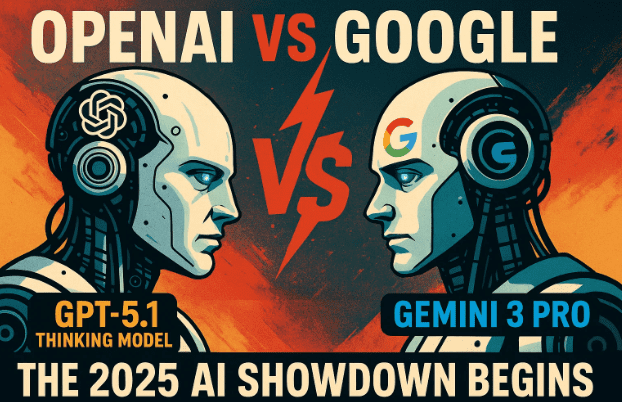
The artificial intelligence race has officially entered its next great chapter. Both OpenAI and Google DeepMind are preparing to launch their most advanced AI models yet — and this time, it’s not just about speed or scale. It’s about how these models think.
In one corner, OpenAI’s leaked GPT-5.1 “Thinking” model is making waves for its promise of multi-step reasoning and human-like deliberation. In the other, Google’s Gemini 3 Pro and the mysterious Nano Banana 2 image generator are gearing up to dominate multimodal AI creativity.
And what makes it even more thrilling? Both companies appear to be targeting late November 2025 — meaning we might witness two groundbreaking releases within days of each other.
Let’s unpack what’s going on behind the scenes, what these technologies mean for users, and how this next wave of AI could redefine everything from reasoning to image generation.
🧠 1. OpenAI’s Secret Weapon — The “Thinking” Revolution
Hidden deep within the ChatGPT backend, developers recently discovered traces of something unusual: gpt-5.1-thinking. Unlike previous upgrades, this isn’t just about faster text generation or higher token counts. It represents a philosophical shift in how large language models operate.
Instead of producing instant replies, GPT-5.1 Thinking appears designed to pause and reason — to think before it speaks.
What Does “Thinking Model” Really Mean?
Traditionally, large language models generate outputs token by token, predicting the next word as fast as possible. The new “thinking” approach introduces something called multi-step reasoning — where the AI silently breaks a complex problem into smaller parts, evaluates them, and then forms a complete, cohesive answer.
This shift mimics human problem-solving behavior: taking time to reflect, analyze, and connect dots.
There’s also speculation about “thinking budgets.”
Imagine you give ChatGPT a difficult math problem or a strategic decision to make. Instead of rushing, the model allocates extra time and computation power to handle that complexity — just as a human pauses before answering a tricky question.
That makes GPT-5.1 potentially the most cognitively advanced model OpenAI has ever built.
🧩 2. Depth Over Speed — OpenAI’s New Strategy
For years, OpenAI’s improvements centered on making models faster, cheaper, and more accessible. But GPT-5.1 marks a new direction: depth over speed.








Developers who’ve examined the leaked code say this version emphasizes contextual understanding, nuance detection, and ambiguity resolution.
In other words, it doesn’t just answer — it understands the gray areas.
This mirrors the evolution of Anthropic’s Claude 4.5, which pioneered “chain-of-thought reasoning” earlier in 2025. The race is now about which company can build an AI that truly thinks — not just reacts.
⚙️ 3. Inside the Leak — What We Know About GPT-5.1 Thinking
The discovery of GPT-5.1 wasn’t rumor. It came from actual internal code references spotted in ChatGPT’s architecture, listing:
gpt-5.1gpt-5.1-reasoninggpt-5.1-pro
This all but confirms that OpenAI is preparing a family of new models, likely segmented for different use cases:
- “Thinking” for deep reasoning
- “Mini” for speed
- “Pro” for enterprise-grade stability
Interestingly, enterprise logs also suggest that companies using OpenAI’s APIs will soon be able to “lock” model versions — meaning no more surprise upgrades that break production workflows. That’s a big win for developers and corporate clients.
And according to internal rollout notes, November 24 2025 is the tentative launch date — aligning suspiciously close to Google’s next Gemini release.
🧪 4. What Makes GPT-5.1 Different?
Let’s take a closer look at the capabilities hinted in early benchmarks and community experiments (like the mysterious “Polaris Alpha” model spotted on OpenRouter, believed to be GPT-5.1 Thinking in disguise).
- Multi-Step Logic Chains: The model can reason through multi-part prompts, similar to solving word problems or analyzing long-form essays.
- Context Longevity: Better memory retention allows it to handle multi-turn conversations without “forgetting” earlier context.
- Ambiguity Handling: GPT-5.1 interprets uncertain or conflicting prompts more gracefully, often asking clarifying questions instead of guessing.
- Creative Depth: Writers testing Polaris Alpha noted richer storytelling and more cohesive plot arcs — a sign of improved internal reasoning.
These features point to OpenAI’s evolving philosophy: it’s no longer about the fastest text output, but about the most deliberate thought process.
🌍 5. Meanwhile at Google — The Gemini 3 Pro Era
While OpenAI fine-tunes its internal reasoning, Google DeepMind is focused on something equally impressive — scale and multimodality.
After months of quiet development, Gemini 3 Pro recently appeared on Google’s Vertex AI platform labeled “Gemini 3 Pro Preview1 2025.” That confirms one thing: it’s nearly ready for release.
So, what’s new in Gemini 3 Pro?
The Giant Context Leap
Gemini 3 Pro is rumored to support an astonishing 1-million-token context window.
That’s large enough to process entire codebases, long research papers, or even multiple books in one prompt — a major leap from Gemini 2.5 Pro’s 200k-token limit.
In simple terms, Gemini 3 Pro can remember far more information at once.
Instead of summarizing one chapter, it can analyze a whole novel — or cross-reference thousands of lines of code in real time.
Reasoning + Multimodality
Gemini 3 Pro isn’t just a text model. It fuses text, image, and code reasoning in one system. This makes it ideal for analyzing visuals, diagrams, or even source code directly within a single chat.
While OpenAI is chasing human-like reflection, Google is building a universal reasoning engine that can handle any media type.
📊 6. Gemini 3 Pro vs GPT-5.1 Thinking: A Tale of Two Philosophies
Let’s pause to compare their approaches side by side:
| Feature | OpenAI GPT-5.1 Thinking | Google Gemini 3 Pro |
|---|---|---|
| Core Focus | Cognitive depth & reasoning | Massive memory & multimodal analysis |
| Approx. Context Size | 256k tokens (est.) | 1 million tokens |
| Primary Advantage | Structured, stepwise thinking | All-in-one model for text + image + code |
| Rollout Window | Late Nov 2025 | Late Nov – Dec 2025 |
| Target Audience | Analysts, researchers, enterprises | Developers, creatives, and content teams |
Both are tackling the same ultimate goal — making AI feel more human — but through radically different philosophies.
OpenAI wants its models to think like us.
Google wants its models to see and process the world like us.
🖼️ 7. Nano Banana 2 — Google’s Surprise Image Generator
Just when everyone thought Gemini 3 Pro was the main event, another codename surfaced: Nano Banana 2.
It sounds playful, but it might be Google’s most powerful visual AI yet.
A Quick Throwback
The first Nano Banana launched earlier in 2025 as a fun image generator inside the Gemini mobile app. It let users turn selfies into glossy 3D-style portraits, and the feature exploded in popularity, bringing over 10 million new users in weeks — helping Gemini briefly overtake ChatGPT’s mobile downloads.
Even NVIDIA’s CEO Jensen Huang called it “a breakthrough in creative AI.”
Now, the sequel takes that playful idea and pushes it into professional-grade territory.
📸 8. What’s New in Nano Banana 2?
Nano Banana 2 isn’t just about selfies anymore — it’s a full creative rendering engine powered by the Gemini 3 Pro Image architecture.
Let’s move through the major upgrades one by one:
1️⃣ Native 2K + 4K Upscaling
Images now render at 2K resolution natively, with built-in 4K upscaling for designers, photographers, and digital artists. That means crisp poster-quality visuals directly from a phone.
2️⃣ Perfect Prompt Accuracy
Using Gemini’s new text-to-image v2 pipeline, the model can finally produce legible typography — no more warped or gibberish text. It understands font style, layout, and proportion.
3️⃣ Cultural & Geographic Awareness
Nano Banana 2 learns from globally diverse data.
If you prompt “family picnic in Tokyo springtime” or “streetwear shoot in Berlin winter,” it captures realistic clothing, lighting, and local details — a first for consumer AI imagery.
4️⃣ Character Consistency
Earlier models often changed faces or outfits across frames. This one keeps characters consistent, allowing storytelling continuity across scenes — ideal for animation and brand campaigns.
5️⃣ Real-Time Editing Tools
A new “Edit with Gemini” mode lets users highlight specific regions to modify (lighting, outfits, backgrounds) instead of regenerating from scratch. It’s a true iterative workflow, cutting render time from 30 seconds → 10 seconds.
6️⃣ Multi-Image Fusion
Under the hood, it can blend multiple references — sketches, photos, or concepts — into a single coherent output. This capability will likely power Google Photos, Workspace, and Android wallpaper generators by 2026.
In short, Nano Banana 2 turns casual image generation into professional visual storytelling — and it’s fast enough to rival Midjourney 6 or Adobe Firefly v3.
🔧 9. How Gemini 3 Pro Image Powers Nano Banana 2
All these features run on Gemini 3 Pro Image, a new multimodal backbone uniting text, image, and vision-language reasoning.
This means the same core architecture can analyze an uploaded photo, understand your description, and modify it contextually — not just stylistically.
For example, if you write:
“Add sunset reflections on the glass building without changing the car colors,”
Gemini 3 Pro Image interprets both visual intent and semantic detail.
This is exactly what sets it apart from typical text-to-image tools: it reasons across both domains at once.
💻 10. The Developer Side — Google’s ADK Go Framework
While all the attention is on flashy AI models, Google quietly released something deeply significant for developers: the Agent Development Kit (ADK) for Go.
Let’s understand why this matters.
Bringing AI Back to Real Engineering
ADK Go extends Google’s open-source framework that already supports Python and Java, allowing developers to build AI agents directly in code instead of drag-and-drop tools.
That means engineers can:
- Write structured agent logic
- Test and debug locally
- Version-control their AI systems
- Deploy seamlessly from laptop → cloud
This shift brings discipline and transparency back into AI development — treating agents like any other software service.
MCP Toolbox & A2A Support
The framework comes bundled with the MCP Toolbox, offering ready-made connectors for 30+ databases, simplifying real-world data integration.
Even more exciting is A2A (Agent-to-Agent) communication.
Developers can now create networks of specialized agents that collaborate — like a manager delegating work to a team — without exposing private memory or logic.
To support this, Google even open-sourced an A2A Go SDK, encouraging experimentation in distributed multi-agent ecosystems.
In essence, ADK Go is Google’s way of saying:
“AI development should feel like real programming again — not just prompting.”
⚔️ 11. The Upcoming AI Duel — Timing and Tactics
If leaks are accurate, OpenAI’s GPT-5.1 family will roll out around November 24, while Gemini 3 Pro and Nano Banana 2 are set for late November to December.
This near-simultaneous timing feels far from coincidental.
OpenAI may be intentionally syncing its release to intercept Google’s spotlight, just as it did during previous launches.
For users, that means a double AI drop — new models from both giants within days, each claiming to be smarter, faster, and more creative.
🔍 12. What It Means for the Future of AI
Let’s take a breather and look at the big picture.
The Divergence of Philosophies
- OpenAI’s Path: Create AI that reasons like a human mind — deliberate, logical, cautious.
- Google’s Path: Create AI that perceives like a human brain — multimodal, contextual, connected to the physical world.
Eventually, both paths may merge, producing systems that think and see — capable of end-to-end cognition.
Implications for Users
- Expect more accurate analysis, fewer hallucinations, and deeper contextual understanding.
- AI will shift from reactive chatbots to collaborative assistants that reason, design, and even debug code autonomously.
- The new image tools will empower creators without requiring technical know-how — making visual storytelling accessible to everyone.
💬 13. FAQs — Quick Answers to Common Questions
Q1. What’s the release date for GPT-5.1 and Gemini 3 Pro?
→ Leaks point to late November 2025 for both, though OpenAI might give enterprise customers early access.
Q2. What does “Thinking Model” mean in GPT-5.1?
→ It refers to multi-step reasoning where the AI breaks complex queries into smaller logical steps instead of rushing to an answer.
Q3. Will Nano Banana 2 be public or Gemini-exclusive?
→ Initially exclusive to the Gemini app and Google Workspace, with broader rollout expected by 2026.
Q4. How is Gemini 3 Pro different from GPT-5.1?
→ Gemini focuses on multimodal intelligence (text + image + code), while GPT-5.1 emphasizes deep reasoning and controlled cognition.
Q5. What is Google’s ADK Go used for?
→ It’s a developer toolkit for coding autonomous AI agents in the Go language, complete with debugging, database, and agent-to-agent support.
🚀 14. Final Thoughts — The AI Arms Race Evolves
So far, we’ve seen OpenAI and Google trade blows with GPT-4 Turbo vs Gemini 1, then GPT-4o vs Gemini 2.5 Pro. But GPT-5.1 Thinking and Gemini 3 Pro represent a new kind of battle — not about raw power, but how machines reason.
OpenAI wants to teach AI to think with purpose.
Google wants it to see and create with context.
Both are necessary if AI is ever to feel truly intelligent.
And with Nano Banana 2 and ADK Go, Google is signaling a broader vision — one where creativity, engineering, and real-world integration merge seamlessly.
The next few weeks could mark the most transformative moment in AI since ChatGPT’s debut. Whether you’re a developer, designer, or just an enthusiast, one thing’s clear:
the AI future isn’t coming — it’s dropping any day now.
Official Links:
🔹 OpenAI – ChatGPT & API
🔹 Google AI – Gemini & Vertex AI
#OpenAI #GPT5 #GoogleGemini #NanoBanana2 #AI2025 #ArtificialIntelligence #ChatGPT #Gemini3Pro #DeepLearning #dtptips