Windows has always offered powerful system administration tools, but they were spread across different apps, snap-ins, and management windows. Windows Admin Center (WAC) changes all of that by bringing the most essential tools—Event Viewer, Device Manager, PowerShell, Services, Storage, Networking, and more—into a single, browser-based dashboard.
Whether you’re a home user looking to monitor your PC more efficiently or an IT administrator managing dozens of machines across a domain, Windows Admin Center provides a clean, centralized, real-time management environment.
In this guide, we’ll explore everything WAC can do, how it works, what you need to run it, and why it’s quickly becoming one of Microsoft’s most important system management tools.
🌐 1. What Is Windows Admin Center?
Before diving into use cases and capabilities, it helps to understand what WAC actually is. Think of it as a modern, web-based version of the traditional Windows management tools—but redesigned for speed, simplicity, and remote access.
Windows Admin Center:
- Runs locally in your web browser
- Lets you manage Windows PCs, servers, VMs, and clusters
- Replaces many traditional MMC snap-ins
- Works both in domain environments and home networks
- Gives real-time performance statistics and system information
It is sometimes called WAC, and it’s fully developed and supported by Microsoft.
Download page (official):
🔗 https://learn.microsoft.com/windows-server/manage/windows-admin-center/
🏢 2. Who Can Use Windows Admin Center?
Let’s move into how WAC is deployed, because this determines how you use it.
You can install Windows Admin Center in two main scenarios:
2.1 Enterprise / Domain Environments
Ideal for IT administrators managing:
- Windows Server machines
- Clusters and virtual machines
- Multi-department networks
- Shared infrastructure
- Azure-connected services
In a business environment, WAC allows admins to:




- Manage servers remotely with no RDP sessions
- Configure roles and features
- Manage VMs, containers, and clusters
- Run PowerShell remotely
- Control certificates and Windows Updates
- Handle network settings and storage performance
The centralization reduces admin overhead and eliminates the need for juggling different management snap-ins.
2.2 Home Users or Small Offices
If you aren’t running a domain, WAC still works extremely well on:
- Standalone PCs
- Home media servers
- NAS-like Windows machines
- Personal lab setups
- Virtualization hobby projects
Important note: It only runs on Windows Pro / Enterprise editions—not Windows Home.
For home users, WAC simplifies tasks like:
- Monitoring CPU, RAM, and disk usage
- Starting/stopping services
- Browsing files on another PC
- Managing drives and storage volumes
- Viewing event logs
- Running PowerShell commands remotely
- Checking hardware health
You can even manage multiple PCs on the same home network from one browser window.
📊 3. The Dashboard: Your Real-Time System Overview
Every time you connect to a machine using WAC, you land on a Dashboard filled with live statistics. This is where the Windows Admin Center flexes its strongest feature—centralized, real-time monitoring.
Let’s move to what the dashboard shows:
Key Info You’ll Find on the Overview Page:
- Computer name
- Domain or workgroup
- Operating system version
- Installed RAM
- Processor model
- Disk capacity and health
- Logged-in users
- Uptime
And then comes the real-time monitoring section:
Live Performance Charts
- CPU activity
- Memory usage
- Network throughput
- Disk read/write operations
Every chart updates instantly, meaning you can troubleshoot performance spikes without opening Task Manager.
Alerts & Notifications
The dashboard automatically highlights problems such as:
- Application crashes
- Faulty disks
- High CPU usage
- Network failures
- Update or configuration issues
Admins can dig deeper right from the alert window.
This page alone replaces several classic admin tools.
🛠️ 4. Exploring Windows Admin Center Tools (Hands-On Features)
Now let’s walk through the main tools available in WAC, the ones you would commonly use day-to-day.
To keep things structured, we’ll move section by section.
🧩 4.1 Processes
Similar to Task Manager, this section lets you:
- Sort processes
- View memory and CPU usage
- End a process remotely
Example: Ending Notepad or a stuck app from your browser with one click.
⚙️ 4.2 Services
This is equivalent to services.msc.
From here, you can:
- Start a service
- Stop a service
- Restart a service
- Change startup type
Perfect for troubleshooting apps that require service resets.
📁 4.3 File Explorer (Remote File Management)
You can fully manage files on the remote computer:
- Browse folders
- Create files or folders
- Rename, cut, copy, paste
- Upload or download files
- Delete files
- View shared folders
This essentially replaces the need for remote desktop when performing file operations.
📝 4.4 Event Viewer
Windows Admin Center integrates a full event viewer:
- Application logs
- System logs
- Security logs
- Custom filtering (e.g., Warnings only)
This is extremely useful for diagnosing system crashes or application failures.
💾 4.5 Storage Management
You can manage:
- Physical disks
- Volumes
- Partition styles (GPT/MBR)
- Create or delete VHD files
- Manage recovery and system partitions
A full disk overview without needing Disk Management.
🔌 4.6 Devices (Device Manager)
Check hardware like:
- Network adapters
- Bluetooth modules
- Disk controllers
Actions available:
- Disable a device
- Update drivers
- View properties
This works like Device Manager, but inside a browser.
🌐 4.7 Network Management
You’ll see:
- Active connections
- IP address
- Gateway
- Interface status
- Connection speed
And you can adjust adapter settings as needed.
🔐 4.8 Registry Editor
A full remote registry editor is included.
You can:
- Add values (DWORD, string, binary)
- Modify existing values
- Delete entries
- Browse all registry hives
This is a powerful feature that typically required RDP earlier.
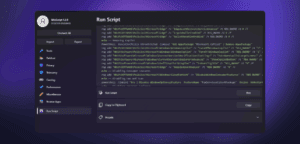
🧰 4.9 PowerShell Terminal
You can open a remote PowerShell session and run commands such as:
get-process | sort CPU -descending
This makes automation and troubleshooting significantly faster.
🔧 5. Additional Features Worth Noting
Windows Admin Center also includes tools for:
- Firewall management
- Local users and groups
- Scheduled tasks
- Windows Updates
- Certificates
- Azure hybrid capabilities
- Cluster and server manager (if configured)
Every tool is integrated into one clean interface.
🧭 6. Security Note: Non-Secure Local Page Warning
When you first open WAC, your browser may say it’s an unsecure website. This is normal because:
- WAC runs locally on your own network
- It uses a self-signed certificate
For home use, this warning is not a concern. In enterprise setups, admins usually install a trusted certificate.
💡 Why Windows Admin Center Matters
WAC modernizes Windows management by replacing:
- MMC snap-ins
- Remote desktop requirements
- Multiple disconnected consoles
- Outdated admin tools
Even as a home user, it gives you the power to manage your entire network from a web browser—something previously only possible with enterprise-class tools.
❓ FAQs
1. Does Windows Admin Center replace Server Manager?
Not fully yet, but it’s becoming Microsoft’s long-term replacement for older tools.
2. Does it work on Windows Home edition?
No. You need Windows 10/11 Pro or Windows Server editions.
3. Do I need a domain?
No. WAC works perfectly on standalone PCs or small networks.
4. Can I manage multiple computers?
Yes. You can add as many as you want as long as they are on the same network.
5. Does it require installing agents on each computer?
Most features work without agents, but certain advanced modules install lightweight extensions automatically.
#WindowsAdminCenter #WAC #WindowsServer #SystemAdmin #RemoteManagement #TechGuide #DTPtips