Nightmares are strange things — fleeting fragments of fear that wake us at 3 a.m. and fade by morning. Some of them, though, linger. They take shape, sprout meaning, and live on in art, stories, and games. The Little Nightmares series built its entire identity around this concept — the childlike helplessness that lurks behind surreal horror.
So when Little Nightmares III arrived, expectations were high. It promised not just new locations and monsters, but something bolder — a cooperative journey through fear itself. Yet the result feels more like a recurring dream than a fresh nightmare: familiar, hauntingly beautiful, but treading old ground.
In this article, we’ll unpack what Little Nightmares III does right, where it plays too safe, and what its design reveals about the challenges of sustaining horror in a well-loved series.
🛒 Play Little Nightmares III on Steam
🎮 Publisher: Bandai Namco Entertainment | Developer: Supermassive Games
1️⃣ The Evolution of Little Nightmares
The original Little Nightmares (2017) was a masterclass in silent storytelling — a dark fairy tale that captured helplessness with precision. Little Nightmares II expanded the formula with multiple playable sections and more complex puzzles, deepening both fear and empathy.
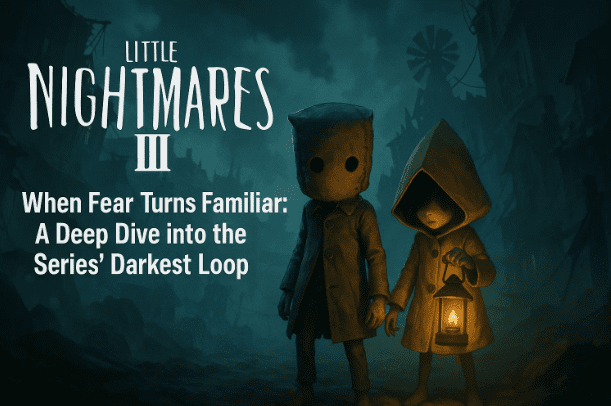
Little Nightmares III continues that legacy, but with an entirely new cast: Low and Alone, two small figures navigating enormous, grotesque worlds. This time the developers hand the torch from Tarsier Studios to Supermassive Games — known for Until Dawn and The Dark Pictures Anthology.
That studio switch changed more than technical flavor — it reshaped the tone. Supermassive is cinematic and focused on cooperative narratives, but also cautious. Their challenge was enormous: evolve a beloved formula without breaking its delicate rhythm of dread.
2️⃣ The Story of Low and Alone
Every nightmare needs a dreamer. In this story there are two.
Low and Alone are trapped in The Spiral — a series of distorted realms connected by mirrors. Each domain mirrors a twisted aspect of the real world:
- The Necropolis, a desert of broken idols and decayed civilization.
- The Candy Factory, where sweetness turns grotesque.
- Kane Valley, a carnival of indulgence and decay.
- The Institute, a sterile maze of medical horror.
Unlike Six and Mono before them, these two share the spotlight equally. You pick one; the other follows — either as an AI companion or as a friend online.
There’s something quietly moving about their bond. They rarely speak, yet their gestures show care: holding hands, waiting at ledges, sharing items. It’s a fragile warmth inside a bleak world.










But the story’s emotional arc is thinner this time. Little Nightmares III trades narrative mystery for mechanical familiarity. We’re given a journey, not a revelation. The horror doesn’t crescendo — it hums, steady but safe.
3️⃣ Designing Fear: Atmosphere and Art Direction
If there’s one area where Supermassive shines, it’s the visual composition. Every frame feels painted with unease.
The Necropolis introduces scale — towering baby dolls, sand-swept ruins, echoing emptiness. Kane Valley glows under string lights, revealing carnival grotesques frozen in indulgence. The camera stays distant, reminding you of your insignificance.
Lighting remains central to the experience. Each world breathes with soft color palettes — muted browns and blues broken by sudden bursts of crimson or neon candy hues. The blend of stop-motion aesthetic with digital polish keeps it uncanny but alluring.
However, the beauty comes with a side effect: repetition. The environments impress visually but don’t evolve mechanically. You enter, hide, solve, climb, flee — and then do it again. The dread becomes decorative rather than transformative.
Still, for sheer mood, Little Nightmares III stands among the best-looking horror platformers of 2025.
4️⃣ Co-op Mode: The Promise and the Problem
When the game was announced, co-op was the headline. A shared nightmare — what could be better?
Initially it feels delightful. You and your partner solve puzzles together, coordinate movements, and share that sense of “don’t move!” panic when a giant creature lumbers past.
But design choices undercut the novelty:
- 🕹️ Online only — no local couch play, a shock for fans who love huddling under one blanket.
- ⛓️ No drop-in/out — you can’t seamlessly switch between solo and co-op.
- 🎭 Symmetry over asymmetry — Low’s bow and Alone’s wrench are too similar in practical use, leading to identical gameplay flows.
So while the friend-pass system is generous, the mode doesn’t unlock the creative potential of two minds solving horror together. It’s less A Way Out and more We’ll Just Walk Together.
5️⃣ Gameplay and Puzzle Design: Where Repetition Creeps In
Let’s move to the mechanical heart — how it plays moment to moment.
Each character has contextual tools:
- Low’s bow can hit ropes and switches.
- Alone’s wrench can break barriers or operate machinery.
Yet, as clever as these ideas sound, their implementation is constrained. The tools only activate near pre-designated prompts. There’s no freeform experimentation, no accidental discovery. That sense of playful problem-solving — one of the hallmarks of Little Nightmares II — is muted.
Example sequence:
- Low spots a rope.
- Shoot → crate drops.
- Alone smashes a wall → path opens.
- Hide, wait for patrol → run → climb.
It’s functional, even elegant at times, but seldom surprising.
The umbrella mechanic early in the game offers brief freshness: gliding updrafts, cushioning falls, invoking Mary Poppins turned macabre. Then, halfway through, it’s replaced by a flashlight that adds light but no thrill.
The result is a predictable rhythm: stealth, chase, checkpoint, repeat. By hour four you start anticipating every scream before it happens.
6️⃣ Symbolism and Themes: Childhood Horror Reimagined
Every Little Nightmares entry functions as a metaphor. Where the first explored hunger and captivity, and the second tackled control and media, the third seems obsessed with isolation and dependence.
Low and Alone are opposites by name and nature. The mirrors they use to travel suggest reflection, identity, and the way trauma repeats across realities. The worlds they cross — a decaying necropolis, a gluttonous carnival, a clinical hospital — could easily represent stages of dependency and decay.
There’s subtle commentary here: when you face fear alone, it consumes; when you face it with someone else, it stagnates. The game’s cooperative structure mirrors its theme: connection is both salvation and burden.
But this nuance never crystallises. The imagery is there — just not the catharsis.
7️⃣ Technical Notes and AI Behavior
Under the hood, Little Nightmares III performs well but reveals cracks.
AI issues: Players have reported moments where the AI-controlled partner repeats actions endlessly — for instance, Low firing arrows at an enemy that keeps respawning until the projectile physics break the scene. These loops can cause soft locks and restarts.
Checkpoints: Generous and forgiving, mitigating frustration after instant-fail chases.
Performance: Smooth on modern PCs and consoles, with minimal loading time. The game maintains its cinematic quality without major frame drops.
The irony? The technical performance is solid, but the AI — central to both solo play and the game’s emotional heartbeat — sometimes feels less “alive” than the world it inhabits.
8️⃣ How It Compares to Previous Entries
| Aspect | Little Nightmares (2017) | Little Nightmares II (2021) | Little Nightmares III (2025) |
|---|---|---|---|
| Developer | Tarsier Studios | Tarsier Studios | Supermassive Games |
| Main Protagonist(s) | Six | Mono & Six | Low & Alone |
| Structure | 5 chapters | 5 chapters | 4 chapters |
| Core Theme | Hunger / captivity | Control / media | Isolation / dependence |
| Gameplay Focus | Puzzle stealth | Expanded puzzle and combat | Co-op puzzle mechanics |
| Innovation Level | High (Original Concept) | Moderate (Story Depth) | Low (Repetition) |
| Fear Factor | High – Claustrophobic | Very High – Psychological | Medium – Predictable |
| Replay Value | Moderate | Strong with themes to analyse | Low due to similarity of characters |
The third entry feels like an echo — polished yet cautious. Where II risked discomfort and ambiguity, III plays safe, almost formulaic.
9️⃣ Lessons for Future Horror Games
- Fear needs uncertainty.
Predictable structure dulls dread. Horror thrives on disorientation — mechanical, spatial, or emotional. - Tools should invite experimentation.
Contextual actions are convenient but limit creativity. Letting players break the rules can spark memorable fear. - Co-op horror needs asymmetry.
Shared terror only works when partners rely on distinct strengths. Imagine one player blindfolded but able to hear, the other seeing but mute — that’s tension. - Short doesn’t mean shallow.
A 5-hour runtime is fine — if it’s layered. Every chapter should introduce new mechanical or thematic language. - AI companions must feel human.
In a game about loneliness, robotic AI ruins immersion. Responsive emotion loops could turn annoyance into empathy.
🔍 10️⃣ Frequently Asked Questions
Q: Do I need to play the previous games first?
Not strictly. Each story stands alone, though knowing Six and Mono’s journey enriches the lore.
Q: Is there local split-screen co-op?
No. Co-op is online-only, with a friend-pass option on Steam.
Q: How long does it take to finish?
Roughly 5 hours for a first playthrough, maybe longer if you explore meticulously.
Q: Is it still scary?
Visually yes, psychologically less so. You might feel uneasy but rarely terrified.
Q: Will there be a Little Nightmares 4?
Bandai Namco has not confirmed it. Given Supermassive’s ongoing projects, a follow-up is possible but may shift direction again.
🌘 11️⃣ Final Thoughts and Takeaway
Little Nightmares III sits in an uncanny middle ground — neither a radical reinvention nor a lazy sequel. It’s a technically strong, aesthetically rich work that plays like a dream you’ve already had too many times.
It reminds us that horror isn’t only about monsters. It’s about discovery — the fear of not knowing what the next room holds. In this chapter, we know too much. The mirrors may still shimmer, the music may still haunt, but the mystery has faded into memory.
Still, there’s beauty in familiarity. Even when the series treads water, it does so gracefully — a lullaby for those who love their nightmares gentle, predictable, and exquisitely crafted.
⚠️ Disclaimer: This article is an independent analytical commentary for educational and critical discussion purposes. All images, names, and trademarks belong to their respective owners.
#LittleNightmaresIII #HorrorGameAnalysis #GameDesign #SupermassiveGames #VideoGameDeepDive #NarrativeDesign #BandaiNamco