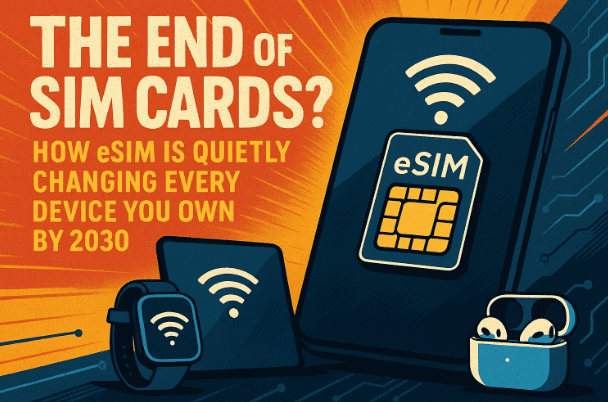
Imagine a time when that tiny plastic SIM card — the one you’ve swapped countless times with a paperclip — simply disappears.
No tray, no chip, no “SIM not inserted” message. Your phone, watch, car, and even laptop all connect automatically, without you ever touching a thing.
Sounds futuristic? Not really. That future has already begun — and its name is eSIM.
In this article, we’ll explore how eSIM (embedded SIM) is transforming mobile connectivity across phones, wearables, cars, and even IoT devices. We’ll look at why companies are moving toward eSIM-only designs, what makes it more secure, where the technology still struggles, and what everyday users like you can expect between now and 2030.
So grab your metaphorical SIM ejector pin one last time — because by the end of this decade, you might not need it again.
🌍 1. What Exactly Is eSIM, and Why Does It Exist?
Before we talk about the big revolution, let’s take a step back.
For over 30 years, mobile networks relied on physical SIM cards — those little chips that carried your phone number, carrier data, and identity on the network. They worked, but they were fragile, easy to lose, and a hassle to replace.
Now picture all of that information stored digitally inside your phone, ready to switch carriers or plans with just a tap. That’s what eSIM, short for embedded SIM, does.
Unlike traditional SIMs, an eSIM is soldered directly onto your device’s motherboard. It can store multiple network profiles and can be activated remotely — no store visits, no tray slots, and no waiting for delivery.
Technically, eSIM follows the GSMA Remote SIM Provisioning (RSP) standard — the same global organization that defines how networks talk to each other. You can read about it on the GSMA website.
So, eSIM isn’t just a cool upgrade. It’s a foundational redesign of how connectivity works — a shift from hardware identity to software identity.
📈 2. Why the World Is Moving Toward eSIM
Alright, now that we know what it is, let’s ask why this quiet shift is happening.
At first, eSIM sounded like a luxury feature only premium phones had. But companies like Apple, Google, and Samsung have steadily normalized it. Apple even made its US iPhone 14 and 15 models eSIM-only, with no physical SIM tray at all. And by 2030, researchers predict around 75% of global mobile devices — nearly 6.7 billion — will use eSIM.








Why such aggressive adoption? Here’s the reasoning behind it:
- Convenience: You no longer need to visit a store or swap tiny cards. You can add or change plans digitally in seconds.
- Security: A physical SIM can be stolen or cloned. eSIMs, being encrypted and device-locked, make that nearly impossible.
- Design freedom: Without a SIM tray, phones become slimmer and more water-resistant.
- Sustainability: Fewer plastic cards mean less e-waste — a big plus for manufacturers under environmental scrutiny.
- Instant global connectivity: For travelers, switching carriers or adding roaming plans can be done with a QR code instead of hunting for local SIM sellers.
In short, eSIM fits perfectly into a world that’s going fully wireless, digital, and remote-first.
⌚ 3. Where You’re Already Using eSIM Without Realizing It
So far, we’ve understood why eSIM is a big deal. Now let’s see where it already exists — often without you noticing.
When people hear “eSIM,” they immediately think of smartphones. And yes, phones are the main playground. But the technology’s reach is far wider.
Let’s explore a few examples:
- Smartwatches: Modern LTE-enabled watches (like Apple Watch Cellular or Samsung Galaxy Watch LTE) use eSIM to mirror your phone number. You can leave your phone at home and still take calls, message, or stream music directly from your wrist.
- Cars & EVs: Connected vehicles use eSIM for live traffic updates, emergency calls, remote locking, and even GPS tracking. Every modern Tesla, BMW, and many electric two-wheelers in India already come with built-in eSIM modules.
- IoT Devices: Smart security systems, trackers, drones, and industrial sensors use eSIM for remote connectivity where manual SIM swapping is impractical.
- Laptops & Tablets: Always-connected 5G laptops (like the Surface Pro 9 or iPad Pro Cellular) often rely on eSIM instead of bulky SIM trays.
So yes, even if you’ve never manually activated one — chances are, you already own an eSIM device.
🔒 4. The Security and Safety Edge
Now let’s talk about one of eSIM’s biggest strengths — security.
Traditional SIM cards could be removed and misused. A stolen SIM could be inserted into another phone and abused for OTPs or identity fraud. eSIM eliminates that vulnerability.
Here’s why:
- eSIM profiles are tied to the device hardware, not just your number.
- They use hardware-level encryption that makes duplication nearly impossible.
- Even if your device is stolen, the eSIM can’t be physically removed — which makes tracking and recovery easier.
Telecom operators like Airtel and Jio in India have publicly recommended eSIM activation for users who prioritize data privacy. Airtel’s CEO himself mentioned that eSIM helps reduce SIM swapping and cloning incidents.
So from a security standpoint, eSIM isn’t just convenient — it’s a genuine step forward in mobile safety.
⚙️ 5. The Hidden Headaches: Transfers and Switching Devices
Okay, let’s pause for a reality check.
Everything we’ve discussed so far sounds perfect, but nothing in technology is ever flawless.
eSIM still has a few practical challenges — especially when switching phones or carriers.
The tricky parts include:
- Device migration: Moving your eSIM from one phone to another can sometimes require carrier support or manual steps. It’s not yet as simple as popping out a card.
- Carrier compatibility: Not all telecom providers, especially in smaller regions, support eSIM.
- Porting issues: If you want to switch from Jio to Airtel or vice versa, the process can be slower and sometimes needs physical verification.
- Damaged phones: If your phone gets damaged or bricked, recovering your eSIM profile may take extra steps — since there’s no card to pull out.
That’s why, in 2025, many Indian users still prefer the old-school physical SIM for simplicity. But with every software update, the migration process is improving.
🇮🇳 6. India’s eSIM Reality — Growing, but Gradually
So far, we’ve done a good job covering global adoption. Now let’s talk about India, where the transition is still halfway.
In India, eSIM arrived around the iPhone XS era, when Apple first introduced support for it. Initially, it was clunky — QR codes, multiple SMS verifications, waiting hours for activation. But by now, the major telecoms (Jio, Airtel, and Vi) have streamlined the process.
Still, most Indian users — especially in the budget and mid-range segment — prefer physical SIMs for three main reasons:
- Easy swapping between devices.
- Wider compatibility with dual-SIM phones.
- Fear of activation issues if the phone is damaged or replaced.
However, above ₹50,000 phones, the trend reverses. Most flagship phones today ship with hybrid or eSIM-only setups, which means that over the next few years, even Indian carriers will have to standardize eSIM onboarding.
🇨🇳 7. China’s Restriction Problem — The Global Speed Bump
Interestingly, there’s one major country slowing eSIM’s global dominance — China.
The Chinese government has long placed restrictions on eSIM technology, mainly for data security and regulatory control. As a result:
- iPhones sold in China still come with dual physical SIM slots instead of eSIM.
- Domestic brands like Xiaomi, Oppo, and Vivo avoid eSIM in local models.
This matters because Chinese manufacturers control around 80% of the global smartphone market by volume. If they hesitate, the global rollout slows down too.
However, once China changes its stance — and it’s likely inevitable as IoT expands — expect the eSIM wave to flood every tier of the market almost overnight.
🚘 8. Beyond Phones: The New eSIM Ecosystem
Let’s move to something more futuristic — where eSIM is expanding beyond phones.
We’re already seeing wearables and vehicles adopting eSIM, but that’s just the beginning.
Here’s where eSIM is heading next:
- Smart laptops: Always-on 5G laptops using eSIM for remote work without tethering to phones.
- Connected headsets & AR glasses: Future XR devices will have embedded connectivity via eSIM for real-time cloud interaction.
- Electric vehicles: eSIMs manage OTA firmware updates, diagnostics, and live navigation.
- Smart homes & IoT: Imagine smart cameras or doorbells with cellular backup built directly into their board — no setup required.
Basically, eSIM is becoming the connectivity backbone of the next generation of gadgets — invisible, efficient, and ever-present.
📊 9. 2030 Forecast — The End of the Plastic Era
Let’s talk numbers.
Analysts predict that by 2030, around 6.7 billion devices — roughly 75% of all smartphones — will operate on eSIM.
That’s not even counting laptops, cars, and IoT products.
We’ll still see physical SIM cards in entry-level phones and rural markets, but the premium and mid-range tiers will go fully eSIM.
Apple’s roadmap already points toward portless iPhones — no SIM tray, no USB-C, entirely wireless. And as always, where Apple goes, the rest of the industry tends to follow.
So yes, the SIM card’s physical era is ending — quietly, but surely.
🔄 10. Step-by-Step: How to Convert Your SIM to eSIM (Safely)
If you’re curious and want to experience it yourself, here’s how you can convert your existing SIM to eSIM from home. Let’s go step by step.
For Airtel (India)
- Send eSIMregistered email ID to 121.
- You’ll receive a confirmation message — reply with 1 to proceed.
- You’ll get a QR code on your registered email.
- Go to your phone’s Settings → Mobile Data → Add eSIM and scan the code.
For Jio
- Send GETESIM to 199.
- Follow the link received to confirm your email and verify OTP.
- You’ll get an email with your eSIM profile QR code.
- Scan and activate via Settings → Mobile Data → Add eSIM.
It’s that simple. But remember — once converted, your physical SIM will stop working immediately.
⚙️ 11. Troubleshooting Common eSIM Scenarios
While eSIM is convenient, here are some real-world hiccups and how to handle them:
- Switching phones: Before trading in your old device, deactivate or transfer your eSIM profile to the new one through carrier settings.
- Damaged phone: Contact your carrier’s customer care; they’ll reissue your eSIM remotely once identity is verified.
- Traveling abroad: You can buy temporary eSIM plans from platforms like Airalo or Nomad eSIM for instant connectivity in over 190 countries.
- Dual numbers: Most premium phones let you store multiple profiles, so you can toggle between personal and work lines without carrying two SIMs.
🧠 12. Real-World Use Cases
Let’s look at how eSIM improves life for different types of users:
- Frequent travelers: Easily add local data plans without physical swaps.
- Enterprises: IT admins can deploy mobile plans across hundreds of devices remotely.
- Families: Parents can manage kids’ data access through linked profiles.
- Developers: IoT builders can embed connectivity directly into hardware without external SIM slots.
In short — eSIM isn’t a luxury anymore; it’s becoming the default fabric of modern connectivity.
💬 13. FAQs
Q1. Can eSIM be hacked or cloned?
No. eSIM data is hardware-locked and encrypted using secure elements; cloning is virtually impossible.
Q2. Can I use eSIM and physical SIM together?
Yes, most modern smartphones allow dual-SIM functionality — one physical and one eSIM.
Q3. Does every carrier support eSIM?
Not yet. But major telecoms in 80+ countries already do, and the number is increasing rapidly.
Q4. What happens if I reset my phone?
Your eSIM profile stays on the device unless you manually delete it. You can also re-download it from your carrier if needed.
⚖️ 14. Quick Comparison: eSIM vs Physical SIM
| Feature | Physical SIM | eSIM |
|---|---|---|
| Setup | Insert card manually | Activate digitally |
| Security | Can be stolen/cloned | Device-locked & encrypted |
| Portability | Easy to move | Needs carrier support |
| Durability | Can be damaged | Permanent, soldered |
| Global usage | Needs swapping | Works via multiple profiles |
| Eco impact | Plastic waste | Minimal |
🚀 15. Final Thoughts
Technology has a way of making the invisible normal.
Just as Wi-Fi replaced Ethernet cables and digital wallets replaced cash, eSIM is replacing the last visible piece of your mobile identity — the SIM card.
It’s faster, safer, and undeniably the future. Yet, like every evolution, it demands patience and adaptation. We may still see hybrid SIM devices for a few more years, especially in developing regions. But make no mistake: by 2030, the world’s connectivity will be almost entirely virtual.
So next time you unbox a new phone and notice there’s no slot on the side, smile. You’re witnessing the quiet disappearance of one of the most iconic pieces of 21st-century tech.
⚠️ Disclaimer
This article is for educational purposes only.
Always verify carrier-specific steps and compatibility before converting your SIM to eSIM. Procedures vary by region and network.
#eSIM #TechFuture #5G #SmartDevices #Connectivity #Telecom #iPhone #Android #IoT #FutureTech