Mobile technology has transformed the way we live, work, and communicate. Today, we use our phones not just for calls but for video conferencing, gaming, banking, navigation, and even controlling smart devices in our homes. But this incredible journey didn’t happen overnight. It took decades of research, trial, and continuous upgrades to move from the first generation (1G) of mobile networks to the blazing-fast 5G era that is reshaping industries today.
In this article, we’ll take a detailed look at each generation—1G, 2G, 3G, 4G, and 5G—exploring their features, limitations, technological breakthroughs, and real-world impact. Along the way, we’ll answer some common questions and also reflect on what lies ahead in the future of mobile communication.
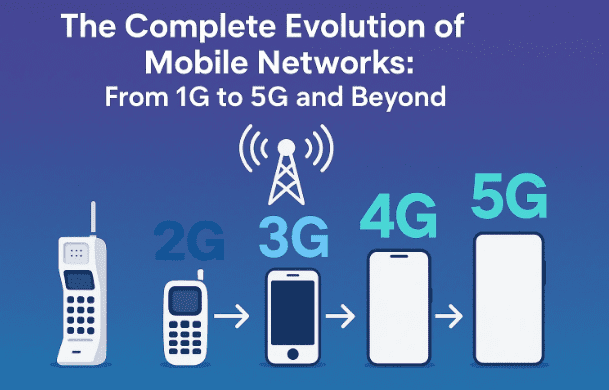
1. Introduction: Why Generations Matter
Every jump from one generation to the next marked a major leap in technology and lifestyle.
- 1G allowed people to make calls for the first time without wires.
- 2G introduced digital communication and text messaging.
- 3G connected phones to the internet, opening the door to apps and emails.
- 4G gave us high-definition streaming, mobile gaming, and video calls.
- 5G is now driving automation, smart cities, and futuristic technologies like AI and IoT.
Without these transitions, today’s world of smartphones, online businesses, and global communication would not exist. Let’s walk through the journey step by step.
2. The Birth of Mobile Networks – 1G (1979)
The story of mobile networks began in 1979, when Japan became the first country to launch the 1G network in Tokyo. By 1984, this network had expanded across the entire country.
Key Features of 1G
Before we list the features, it’s important to remember that 1G was analog-based, meaning it transmitted voices as raw radio signals without encryption or compression.
- Only voice calls were possible.
- Very poor call quality – static, background noise, and frequent interruptions.
- No security – since there was no encryption, anyone with the right equipment could eavesdrop.
- Extremely slow speed – just 2.4 kbps, which is millions of times slower than today’s 5G.
Real-World Impact
Despite its flaws, 1G was revolutionary. For the first time, people could walk outside and make a call without being tied to a landline.
However, because the technology was limited, data services like SMS or internet were not possible yet. Still, this first step paved the way for everything that followed.
3. The Rise of Digital Communication – 2G (1991)
After a decade of analog systems, the 1990s brought a major shift—2G networks. They launched in 1991, based on the GSM (Global System for Mobile Communications) standard.
Why 2G Was Different
Unlike 1G, 2G was digital. This meant voice signals were converted into digital data before being transmitted, making calls clearer and more secure.
Key Features of 2G
- Encrypted calls: Conversations were harder to intercept.
- SMS and MMS: The world’s first text message (“Merry Christmas”) was sent in 1992.
- Better call quality with reduced static.
- Speeds up to 64 kbps, enabling basic data transfer.
Real-World Impact
2G did more than improve calls—it introduced messaging culture. SMS became a huge phenomenon worldwide, changing the way people communicated. Later, MMS allowed sending pictures and ringtones.





This was also the beginning of mobile data, albeit at extremely slow speeds compared to today.
4. Mobile Internet Begins – 3G (2001)
The next milestone came in 2001, when Japan launched the first 3G network. For the first time, mobile phones became internet-enabled devices.
Key Features of 3G
- Internet browsing became possible.
- International roaming allowed users to travel and stay connected.
- Data speeds up to 2 Mbps (stationary devices).
- Support for emails, video calls, and early streaming services.
Real-World Impact
The jump from 2G to 3G was like moving from a simple pager to a pocket computer. People could now:
- Check emails on the go.
- Make video calls (though still low quality).
- Stream basic videos and access online services.
This laid the foundation for smartphones. Without 3G, app stores and mobile internet culture could not have developed.
5. The Era of Speed and Streaming – 4G (2009)
In 2009, Sweden and Norway became the first countries to launch 4G LTE (Long-Term Evolution). This marked the true beginning of the smartphone era.
Key Features of 4G
- High-speed internet up to 1 Gbps for fixed users.
- Typical mobile speeds of 100 Mbps.
- Latency reduced to 10–30 milliseconds.
- Support for HD video streaming, online gaming, and smooth video calls.
Real-World Impact
With 4G, our phones became entertainment hubs. We could:
- Watch YouTube in HD.
- Play online multiplayer games like PUBG or Fortnite.
- Use ride-sharing apps, navigation, and live-streaming.
To use 4G, however, people needed phones designed for 4G compatibility—something that pushed the smartphone industry to new heights.
6. The Digital Revolution – 5G (2019)
Finally, in 2019, South Korea launched the world’s first 5G networks. Unlike its predecessors, 5G isn’t just an upgrade—it’s a technological revolution.
Key Features of 5G
- Download speeds from 60 Mbps up to 1000 Mbps, depending on coverage.
- Ultra-low latency under 2 milliseconds (compared to 50 ms in 4G).
- Supports 10 times more devices per square kilometer than 4G.
- Enables advanced technologies like AI, IoT, cloud computing, blockchain, and smart automation.
Real-World Impact
5G is not just about faster Netflix downloads—it is reshaping industries:
- Healthcare: Remote surgeries, real-time monitoring.
- Industry: Automated factories with machine-to-machine communication.
- Transport: Self-driving cars and smart traffic systems.
- Smart cities: Efficient energy, security, and infrastructure management.
South Korea currently leads with the fastest average 5G download speed (360 Mbps), followed by Taiwan (309.9 Mbps) and the UAE (269 Mbps).
7. Comparing the Generations: 1G vs 2G vs 3G vs 4G vs 5G
Let’s look at how each generation stacks up side by side:
| Generation | Year Launched | Speed | Key Features | Main Limitations |
|---|---|---|---|---|
| 1G | 1979 | 2.4 kbps | Voice calls (analog) | Poor quality, no security |
| 2G | 1991 | 64 kbps | SMS, MMS, digital encryption | Slow data, limited internet |
| 3G | 2001 | 2 Mbps | Internet, roaming, video calls | Expensive, limited speed for apps |
| 4G | 2009 | 100 Mbps – 1 Gbps | HD streaming, gaming, VoIP | Requires 4G devices |
| 5G | 2019 | 60–1000 Mbps | IoT, AI, smart cities, automation | Coverage still limited |
8. Frequently Asked Questions
Q1: Can you still use 1G or 2G today?
Most countries have shut down 1G and 2G networks to free spectrum for 4G and 5G. Only a few regions still keep 2G for basic services.
Q2: Why was 3G discontinued in many countries?
Because maintaining 3G was costly, and 4G provided much better speed and efficiency. Many carriers are now reusing 3G spectrum for 5G.
Q3: Is 5G dangerous for health?
Multiple studies show that 5G operates within safe frequency ranges regulated by international bodies. So far, no evidence proves it poses unique health risks compared to earlier networks.
Q4: Do all phones support 5G?
No, you need a 5G-compatible device. Older smartphones will continue to work on 4G or lower networks.
Q5: Will there be a 6G?
Yes, research on 6G has already begun. It is expected to launch around 2030, offering even more futuristic possibilities.
9. The Road Ahead: What Comes After 5G?
While 5G is still being rolled out, researchers are already looking ahead to 6G. Expected features may include:
- Speeds over 1 Tbps.
- Integration with space-based internet systems.
- Seamless merging of physical and digital worlds through extended reality (XR).
If 5G is the foundation of smart cities, 6G could be the backbone of fully connected societies, where everything communicates in real time.
10. Conclusion
From the crackly analog calls of 1G to the futuristic possibilities of 5G, mobile networks have transformed the way we live. Each generation didn’t just improve speed—it changed lifestyles and industries.
- 1G made wireless calls possible.
- 2G created the texting culture.
- 3G connected us to the internet.
- 4G unlocked the era of apps, streaming, and online services.
- 5G is powering automation, AI, and the Internet of Things.
The journey doesn’t end here—6G is already on the horizon. Mobile networks will continue shaping our world in ways we can only imagine today.
Disclaimer
This article is for educational purposes only. The technical specifications provided are based on widely accepted standards, though real-world performance may vary depending on location, carrier, and device compatibility.
Tags: 1G, 2G, 3G, 4G, 5G, mobile networks, smartphone technology, telecom history, GSM, LTE, wireless communication
Hashtags: #1Gto5G #MobileNetworks #Telecom #Smartphones #TechnologyEvolution #5G