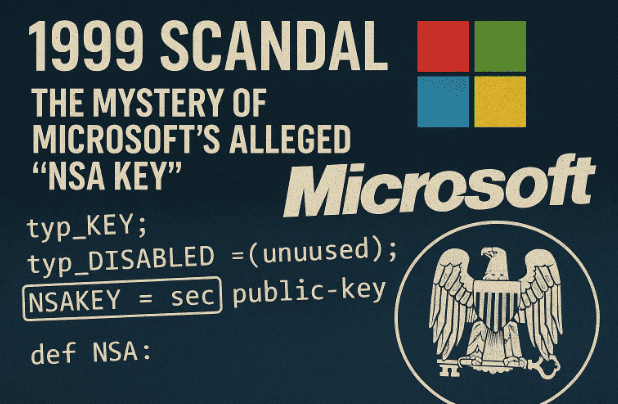
In 1999, a Canadian cryptographer uncovered something unusual inside a Microsoft Windows update: a second digital signing key buried in the code, labeled “NSA Key.” The discovery set off a firestorm of speculation about government backdoors in one of the world’s most widely used operating systems.
The Discovery
That summer, Andrew Fernandez, a respected cryptographer at a security firm called Krypton, was analyzing Windows NT Service Pack 5. His goal was routine: to better understand how Microsoft digitally signs and verifies software inside its operating system.
But what he found was anything but routine. Instead of a single trusted Microsoft key, Fernandez discovered two cryptographic keys embedded in the code. One was the expected Microsoft key. The other was simply labeled: “NSA Key.”
Cryptographic keys act like digital signatures, ensuring that files such as drivers and updates truly come from their source. In Windows, if a file has the right signature, it is trusted and allowed to run. Normally, only Microsoft’s key is present. But this second key, at least theoretically, could allow software to bypass those protections—raising the chilling possibility of a hidden backdoor.
Public Reaction and Panic
Fernandez went public with his findings and even released a small demonstration program showing that Windows accepted software signed with the second key. The revelation spread quickly online and across mainstream media, sparking widespread alarm.
The central question was blunt: Did Microsoft give the U.S. National Security Agency (NSA) secret access to every Windows machine on Earth?
The speculation was not baseless. In the 1990s, the United States was locked in the “crypto wars,” a policy struggle over limiting the export of strong encryption. The government had already tried introducing the controversial Clipper Chip, a hardware device designed to give law enforcement a built-in surveillance channel. Many wondered if software backdoors in Windows were simply another path to the same goal.
Microsoft Responds
Facing growing hysteria, Microsoft issued a statement denying any NSA involvement. The company claimed the so-called “NSA Key” was nothing more than a backup key for internal compatibility testing, poorly named by a developer.
“There is no backdoor in Windows,” Microsoft insisted.
Yet, skeptics were unconvinced. If it was merely an internal backup, why was it labeled after a government agency? Why had it never been documented? And why was it hidden so deeply inside the code?
Lingering Doubts
In the wake of the uproar, Microsoft quietly removed the explicit “NSA Key” label from future versions of Windows. The functionality, however, remained.







To this day, no one has proved the key was ever misused. Many experts believe it was a case of unfortunate naming rather than deliberate collusion. Still, the episode left behind a lasting scar. It became part of cybersecurity folklore—a reminder that closed-source software requires absolute trust in the vendor, trust that may never be fully justified.
The Unanswered Questions
Even decades later, critical details remain a mystery:
- Who named it the “NSA Key”?
- Was it ever used outside Microsoft’s labs?
- And if it wasn’t a backdoor, why was it there in the first place?
No clear answers have emerged. What is certain, however, is that the 1999 “NSA Key” controversy permanently shaped the conversation about trust, transparency, and the risks of closed software.
As the debate over backdoors and government access continues in today’s world of cloud computing and AI-driven systems, the lesson from 1999 still resonates: when one entity can silently unlock your machine, you’re not just being asked to trust them—you’re being forced to.
Tags: microsoft windows, nsa key, 1999 backdoor controversy, cryptography, andrew fernandez, windows nt service pack 5, software security, government surveillance, crypto wars, closed source software, cybersecurity history
Hashtags: #Microsoft #Windows #NSA #CyberSecurity #Backdoor #Encryption #CryptoWars #TechHistory #Privacy #Surveillance