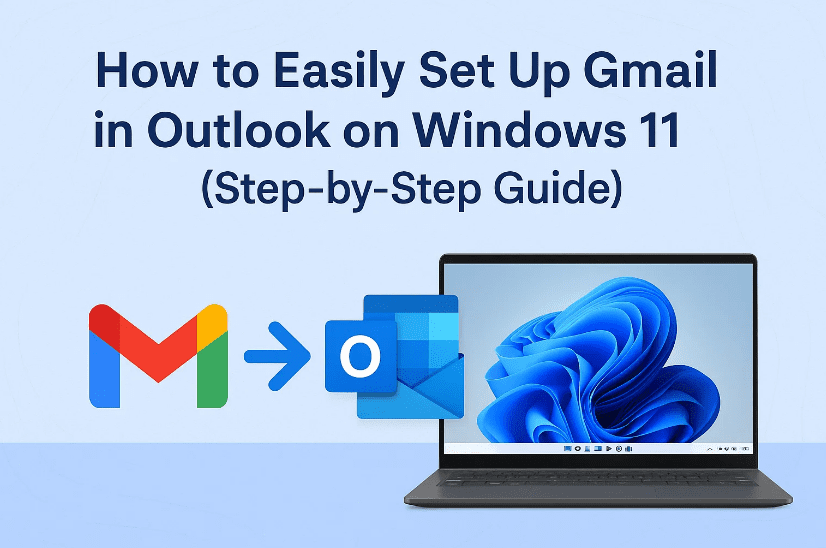
Managing multiple email accounts can quickly become overwhelming if you have to open different tabs or apps every time you want to check messages. That’s why many people prefer to bring everything under one roof—using a desktop email client like Microsoft Outlook.
But here’s the catch: if you want to add Gmail to Outlook, there are some security settings you must adjust first. Without enabling them, Outlook will either throw login errors or refuse to connect entirely.
Don’t worry—I’ll walk you through the entire process of connecting Gmail with Outlook in Windows 11. By the end, you’ll be able to send and receive Gmail emails inside Outlook just like you do in your browser.
1. Why Add Gmail to Outlook?
Before we dive into the steps, let’s pause and understand why you’d want to add Gmail to Outlook in the first place.
- Centralized Inbox: You can check Gmail alongside other accounts (like Yahoo or work emails) in one app.
- Offline Access: Even if your internet drops, emails synced in Outlook remain available offline.
- Advanced Features: Outlook offers filtering, rules, categories, and calendar integration.
- Productivity Boost: Switching between browser tabs wastes time—having everything in Outlook keeps you focused.
Now that we know the “why,” let’s prepare for the “how.”
2. Requirements Before Setup
To avoid hiccups, make sure:
- You have an active Gmail account.
- You are signed into Gmail in your default browser.
- Two-Step Verification (2FA) is enabled in Google.
- Either IMAP or POP is enabled in Gmail settings.
👉 Outlook requires these features for modern authentication. Without them, you may face errors like “Unable to connect to Gmail server” or repeated password prompts.
3. Step 1 – Enable Two-Step Verification in Gmail
This is a must. Gmail doesn’t allow integration with apps like Outlook unless you secure your account first.
- Visit your Google Account Security Settings.
- Scroll down to Signing in to Google.
- Locate 2-Step Verification.
- If it’s off, click to enable.
- Add your phone number, verify it via OTP, and confirm.
Now, 2FA is active. This ensures Outlook can authenticate properly when it requests access.
4. Step 2 – Enable IMAP or POP in Gmail Settings
Next, we need to tell Gmail that third-party apps (like Outlook) are allowed to fetch your emails.
- Open Gmail in your browser.
- Click the ⚙️ gear icon (top-right corner).
- Select See all settings.
- Go to the Forwarding and POP/IMAP tab.
- Scroll down until you find:
- IMAP access → Select Enable IMAP.
- POP download → Select Enable POP (if you prefer POP).
👉 For most users, IMAP is recommended (it syncs across devices). POP is useful only if you want messages downloaded and removed from Gmail’s servers.

5. Step 3 – Save Changes and Confirm Gmail Access
Once you enable IMAP or POP:
- Scroll to the bottom of the Gmail settings page.
- Click Save Changes.
If you skip this, Outlook won’t be able to connect.
6. Step 4 – Add Gmail Account to Outlook
Now let’s move to Outlook:
- Open the Outlook app on your PC.
- Go to File > Add Account.
- Type in your Gmail address.
- Click Continue.
Outlook will now redirect you to a login screen.
7. Step 5 – Log in via Browser Authentication
At this stage, Outlook will prompt you with a browser-based Google login:
- Enter your Gmail credentials.
- Since you enabled 2FA, confirm the login via OTP or Google Prompt.
- Click Allow when Outlook asks for permissions.
This process links your Gmail to Outlook securely—no need for manually typing server addresses unless you want advanced control.
8. Step 6 – Verify IMAP/POP Settings in Outlook
Although modern Outlook usually detects settings automatically, it’s good practice to verify them.
For IMAP (recommended):
- Incoming server:
imap.gmail.com - Port: 993
- Encryption: SSL/TLS
For SMTP (outgoing):
- Server:
smtp.gmail.com - Port: 465 (SSL) or 587 (TLS)
- Authentication: Required (use Gmail credentials).
9. Alternative: POP vs IMAP – Which Should You Use?
A quick comparison:
- IMAP:
- Emails stay on the server.
- Syncs across multiple devices.
- Best for modern usage.
- POP:
- Downloads emails to one device.
- Removes them from the server (depending on settings).
- Useful if you want offline archiving or don’t want server storage used.
👉 Unless you have a specific reason, always choose IMAP.
10. Best Practices for Secure Email Access
Let’s pause here for a few security tips:
- Always keep 2FA enabled on Gmail.
- Avoid disabling security settings like “Allow less secure apps” (Google retired it anyway).
- Use IMAP instead of POP for better sync and modern compatibility.
- Keep Outlook updated via Microsoft 365 updates.
11. Troubleshooting Common Errors
Even with the right steps, issues may appear. Here are some quick fixes:
- Repeated password prompts in Outlook → Make sure 2FA is enabled and you logged in via browser pop-up.
- “Could not connect to Gmail server” → Check if IMAP/POP is enabled and saved in Gmail settings.
- Email sync delays → Verify Outlook’s sync frequency (default is every few minutes).
- App password required → This only applies if you’re using older Outlook versions without modern authentication. For new Outlook, browser login works fine.
12. FAQs on Gmail-Outlook Integration
Q1: Can I use Outlook without enabling 2FA in Gmail?
Not recommended. Modern Outlook requires it for secure login.
Q2: Can I add multiple Gmail accounts to Outlook?
Yes, just repeat the “Add account” steps for each Gmail.
Q3: Will my Gmail labels show up in Outlook?
Yes, Gmail labels appear as folders in Outlook when using IMAP.
Q4: Does this work on Outlook Web or only desktop?
This guide is for Outlook desktop (Windows 11). Gmail can’t be added in Outlook Web—it’s browser-based.
Q5: Can I remove the Gmail account later?
Yes. In Outlook go to File → Account Settings → Remove account.
13. Final Thoughts
Setting up Gmail in Outlook on Windows 11 might sound complicated, but once you break it down step by step, it’s actually straightforward. The key points are:
- Enable Two-Step Verification in Google.
- Enable IMAP (or POP) in Gmail.
- Save changes and log into Outlook using browser-based authentication.
- Verify server settings to ensure smooth sync.
Once configured, Gmail integrates seamlessly with Outlook—allowing you to manage emails, calendars, and tasks all in one place.
Disclaimer: This guide is for educational purposes. Always keep security settings enabled (like 2FA and IMAP encryption) when connecting Gmail to third-party apps to prevent unauthorized access.
Tags
gmail outlook setup, add gmail to outlook, gmail imap settings, gmail pop settings, gmail two step verification, gmail in windows 11, outlook email setup, google account security
Hashtags
#Gmail #Outlook #Windows11 #IMAP #POP #EmailSetup #dtptips