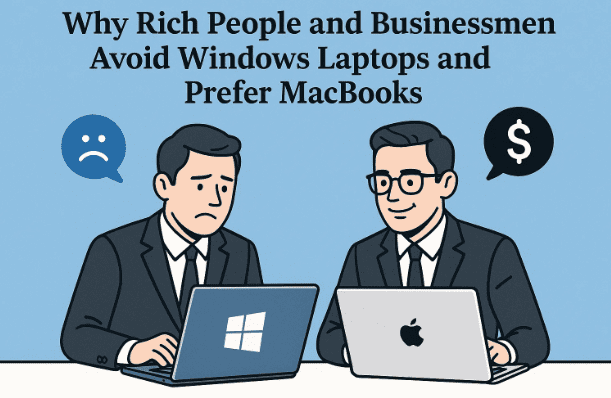
Have you ever noticed that most successful entrepreneurs, CEOs, and wealthy professionals — whether in airports, meetings, or co-working spaces — seem to carry MacBooks instead of Windows laptops?
It’s a common question many people ask: “Why don’t rich people use Windows laptops?”
At first glance, it may look like a matter of trend or luxury branding, but the real reasons go much deeper — involving habit, reliability, design, ecosystem, and simplicity.
In this detailed article, we’ll break down exactly why high-net-worth individuals and business leaders often prefer Apple MacBooks over Windows laptops, and whether that choice truly makes sense in today’s world.
💬 1. The Real Question: Is It About Luxury or Logic?
Let’s start by clearing a common misconception — rich people don’t necessarily use MacBooks just to show off.
Of course, a few might, but for most high-profile business users, the decision is practical, not just fashionable. They value time, reliability, and convenience over customization or gaming performance.
Think about it — a CEO or investor’s daily life revolves around planning, video calls, presentations, reports, and communication. They don’t want to deal with sudden blue screens, driver issues, or antivirus alerts. They want to open the laptop, work smoothly, and close it.
That’s where the MacBook wins — not because it’s shiny, but because it offers less distraction and more focus.
🧠 2. Focus vs. Fixing: Why Businessmen Avoid Troubleshooting
A fundamental difference between rich users and regular users lies in their time value.
They don’t want to spend hours fixing glitches or waiting for updates to finish — they’d rather pay more for something that just works.
Windows laptops, while powerful and versatile, have long carried the reputation of needing regular care:
- Installing and updating antivirus software
- Managing background processes
- Driver updates and compatibility issues
- Troubleshooting system errors
If you’re technically skilled, maintaining Windows can be easy. But if not, it can quickly become a distraction.
A businessman doesn’t want to play “IT technician” — he wants to focus on work, not maintenance.


As the saying goes: “Rich people buy time, not tasks.”
That’s exactly why many avoid Windows altogether.
⚙️ 3. The Legacy Image of Windows: A System That Needs Maintenance
Let’s be honest — Microsoft has made huge progress with Windows 10 and Windows 11. They’re more stable, polished, and secure than ever.
However, the old image of Windows as a buggy, virus-prone, and update-heavy OS still lingers in public perception.
Earlier, Windows systems required frequent reboots, manual driver updates, and third-party antivirus software. Even though that’s not entirely true today, the damage was already done — people built habits around avoiding it.
Those who switched to Apple years ago rarely come back because they’re comfortable with the smooth experience and consistent reliability.
And once someone enters Apple’s world, there’s something even stronger that keeps them there — the ecosystem.
🔋 4. Battery Life and Build Quality: Where Mac Still Wins
One of the biggest practical advantages of MacBooks has always been build quality and battery life.
Even early MacBook models offered 9–10 hours of usage on a single charge, compared to most Windows laptops that barely managed 3–4 hours just a few years ago.
Today, Windows laptops have improved drastically thanks to modern Intel and AMD chips, but the perception gap remains.
Also, there’s the matter of design and materials:
- Many Windows laptops (especially below ₹1 lakh) are built from plastic.
- MacBooks, on the other hand, have an aluminum unibody — sleek, sturdy, and premium.
- The trackpad, keyboard feel, and screen calibration on MacBooks are consistently superior.
As a result, when someone pays a premium, they feel that quality.
That tactile satisfaction matters to people who treat their devices as extensions of their brand or lifestyle.
🌐 5. The Apple Ecosystem Advantage: Seamless Continuity
Here’s the biggest reason rich people rarely switch away from Apple — the ecosystem lock-in.
Everything in Apple’s world connects effortlessly:
- You can start writing an email on your MacBook and finish it on your iPhone.
- Receive a call on your iPhone and answer it directly from your MacBook.
- Copy text on iPad and paste it instantly on MacBook (Universal Clipboard).
- Access the same files from all devices via iCloud without worrying about USB drives.
That kind of real-time synchronization saves time and simplifies life — exactly what business leaders want.
In short, Apple sells convenience, not just computers.
By contrast, the Windows ecosystem still struggles with consistency. While you can sync using OneDrive or Microsoft 365, the seamless handoff between laptop, tablet, and phone simply isn’t as polished as Apple’s ecosystem.
💡 6. Design, Simplicity, and Noise-Free Experience
Another subtle but important factor is simplicity.
MacBooks are quiet, minimal, and distraction-free. They boot up fast, make little noise, and stay cool even under load.
Many older Windows laptops were infamous for their fan noise and heat issues, which made working in quiet environments — like offices or airports — unpleasant.
Though this has improved recently, the Mac’s fanless design (in M1 and M2 models) gives it an edge. It’s silent, elegant, and non-intrusive — something professionals appreciate.
And then there’s the interface.
Windows has evolved, but for new users, it still feels a bit cluttered:
- You have both Settings and Control Panel.
- Advanced configurations hide behind Registry edits.
- There are multiple ways to do the same task.
MacOS, on the other hand, is straightforward — one Settings panel, one approach.
Simplicity isn’t about limitations; it’s about removing friction from daily work.
🧩 7. Why Windows Failed to Build an Integrated Ecosystem
To understand Apple’s success, we must acknowledge Microsoft’s biggest failure: Windows Mobile.
Microsoft once tried to build its own smartphone ecosystem — tightly integrated with PCs and tablets. The devices were innovative and powerful (remember Lumia?), but they failed due to poor app support and lack of developer interest.
Because of this, Windows never achieved full cross-device synergy. Even today, Windows laptops don’t connect seamlessly with Android phones or iPhones. You can sync some things via apps like Your Phone (Link to Windows), but it’s nowhere near Apple’s level of integration.
For businessmen and high-income professionals, this limitation is significant. They want:
- Instant document syncing across devices.
- Continuity between work and home.
- Secure cloud storage that “just works.”
Apple delivers that. Windows, even with Microsoft 365, still feels fragmented.
🔐 8. Security and Virus Concerns: The Old Reputation Sticks
For years, Windows was seen as a magnet for malware and viruses. Even though Windows Defender now offers excellent protection, the reputation still influences buyer psychology.
Business owners and executives, who often handle confidential data, prefer an environment that feels safer by default — and macOS provides that sense of built-in security.
Apple’s system architecture is sandboxed, meaning each app runs in isolation, reducing the chances of system-wide infection.
While no system is 100% secure, the perceived safety of macOS reassures non-technical users who can’t afford downtime or data breaches.
⚖️ 9. Does This Mean Windows Is Bad? Not Really.
Now, it’s important to clarify something — Windows laptops are not inferior.
In fact, modern ultrabooks like the Dell XPS, HP Spectre, and Lenovo ThinkPad X1 are powerful, beautifully designed, and rival MacBooks in performance and quality.
So why does the stereotype persist?
Because habits form faster than reputations change.
Wealthy users adopted MacBooks years ago when Windows was unstable and battery-hungry. Now that Windows has improved, they have no reason to switch back — their work, cloud data, and habits are already deeply tied to the Apple ecosystem.
Meanwhile, tech-savvy professionals, developers, and creators who prefer flexibility still love Windows — because it gives them full control, customizability, and broader compatibility with hardware and software.
As one might say:
“MacBooks are for those who want peace. Windows is for those who love control.”
Both have their audience — it’s just that the rich prioritize peace of mind over personalization.
❓ 10. Frequently Asked Questions (FAQs)
Q1. Do rich people use Windows at all?
Yes, some do — especially professionals in finance, engineering, or enterprise fields where specialized Windows software is required. However, for general business and productivity, MacBooks dominate.
Q2. Is macOS really more stable than Windows?
In most day-to-day usage, yes. macOS offers fewer background conflicts and automatic updates. Windows, while stable, can still occasionally face driver or registry-related bugs.
Q3. Are Macs worth the price?
If you value reliability, battery life, and integration — yes. But if you prefer customization, gaming, or budget flexibility, a Windows laptop is better value.
Q4. Can Windows laptops match MacBook quality?
High-end Windows ultrabooks do, but they often cost nearly as much as a MacBook — and still lack ecosystem advantages.
Q5. Is this trend only in business users?
Mostly, yes. Creators, designers, and entrepreneurs often prefer Macs for the experience. Developers, gamers, and system administrators tend to stick with Windows.
🏁 11. Conclusion
So, why don’t rich people use Windows laptops?
It comes down to efficiency, consistency, and habit.
MacBooks offer a seamless, low-maintenance experience — a blend of design, battery life, ecosystem, and stability that aligns perfectly with the mindset of those who value time more than technical tinkering.
On the other hand, Windows remains a powerhouse for customization, gaming, and enterprise flexibility — but for the elite class who want peace, reliability, and design simplicity, the Apple world remains the comfort zone.
To summarize:
| Factor | Windows Laptop | MacBook |
|---|---|---|
| Ease of Use | Moderate (requires setup) | Very easy (plug-and-play) |
| Maintenance | Frequent updates & drivers | Minimal upkeep |
| Ecosystem | Limited | Fully integrated |
| Battery Life | 4–6 hours (average) | 8–12 hours (average) |
| Build Quality | Varies (plastic/aluminum) | Premium unibody aluminum |
| Security | Improved, but user-managed | Built-in, sandboxed |
| Price | Wide range | Expensive but stable |
| Ideal User | Tech-savvy, gamers, enterprise | Professionals, executives, creatives |
Ultimately, both systems are great — they just cater to different priorities.
Rich people simply choose the one that lets them think less and do more.
Disclaimer:
This article is based on real-world tech behavior patterns and general market observations. Both Windows and macOS have evolved significantly, and the choice depends entirely on personal needs, not social status.
Tags: Windows Laptop, MacBook, Business Laptops, Apple Ecosystem, Windows vs Mac, Productivity Tools, Laptop Comparison, macOS, Microsoft
Hashtags: #MacBook #WindowsLaptop #AppleEcosystem #BusinessTech #TechGuide #Productivity #LaptopComparison #dtptips #Technology