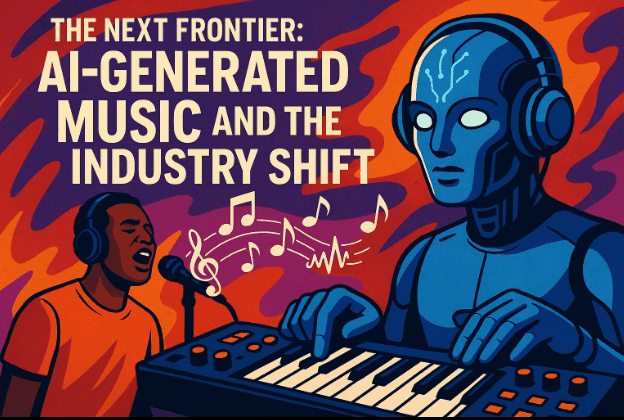
How the game may change for content creators, musicians and platforms alike
What’s changing in AI music
We’re at a moment when generative AI is accelerating far beyond just text or images. Video generation, deep-fakes, voice synthesis – they’re all advancing rapidly. But one area that’s now gaining attention is music generation. Recently, there have been announcements and rumours that OpenAI might be moving more seriously into this space.
In this article I’ll walk you through the background, what’s been reported, how it might work, why it matters (especially if you’re a creator or musician), and what the risks/unknowns are. After reading we’ll look at some practical steps you might take to prepare, whether you just follow the space or want to experiment yourself.
Let’s move to the next step.
Background: AI in music so far
Before we dive into what’s new, it’s worth understanding how AI‐driven music generation has developed so far. This gives us context and helps us ask the right questions.
1 Early efforts
- Back in 2019 the model MuseNet from OpenAI was released. It could generate 4-minute compositions with up to 10 instruments, combining different styles. (OpenAI)
- In 2020 OpenAI introduced Jukebox, which is more ambitious: it generates raw-audio songs (including vocals) in multiple genres, specifying artist, genre, or lyrics. (arXiv)
2.2 What these models could and couldn’t do
It’s important to realise this is still early stage. Here are some strengths and limitations:
| Feature | Strengths | Limitations |
|---|---|---|
| Raw-audio generation (Jukebox) | Generates actual audio including voice, not just MIDI notes. (arXiv) | Very resource‐intensive: one user reports “nine hours to render one minute of audio” using Jukebox. (pgmusic.com) |
| Style conditioning | You can prompt genre, artist style, lyrics. (arXiv) | Musical structure is still weaker than human compositions (e.g., repeating choruses, deep emotional hooks) according to the authors. (arXiv) |
| Accessibility | Some code/data was released open‐source. (arXiv) | Requires specialised hardware and technical know‐how; not yet consumer-friendly in many cases. |
3 Why the interest now is increasing
With computing power rising, diffusion models improving, and generative AI getting more mainstream (text, images, video), the leap into music makes sense. Music is culturally and commercially huge. If AI can reliably generate quality music, it creates new opportunities (and risks) for creators, platforms and the music industry.
That sets the stage. Now let’s examine what’s being reported about a new push by OpenAI.
What the current news says about OpenAI’s move into music
According to recent commentary and articles (some publicly accessible, others from subscription sources) there are three key items of interest: 1) OpenAI is developing a music model, 2) data annotation for that model is underway, 3) integration possibilities with other OpenAI tools (video, ChatGPT) and commercial scenarios.
1 The report
- It is reported that OpenAI is actively developing a “music model” in which engineers collaborate with students to annotate musical scores for training. (This would serve as the training data for the music model.)
- The article states that this model is being explored for use cases like generating music given text or audio prompts – for example: “add guitar accompaniment to an existing vocal track.”
- It is also speculated that this music-model might integrate with other OpenAI products: video generation (for example via the model Sora) and the broader ChatGPT ecosystem.
2 What we do know (not speculation)
- Jukebox and MuseNet are real and publicly documented. (See earlier section.)
- OpenAI has published an announcement about “next-generation audio models in the API” (speech-to-text and text-to-speech) in August 2025. (OpenAI)
- Several community posts suggest that development of a full consumer-ready music model by OpenAI is still unclear or stalled. (Reddit)
3 What’s still unclear
- There is no official public release of a dedicated OpenAI “music generation product” (as of this writing) that competes with e.g. startup music-AI platforms.
- The timeline, pricing, licensing terms (especially around copyright) are not publicly confirmed. The report mentions “internal discussions” and “engineers collaborating with students” but no product launch date.
- Whether the music model will be artist-centric (i.e., designed for musicians making original music) or focused on content-creation for video/social (e.g., background music, videos) remains to be seen.
- How the model will handle copyright/privacy/licensing of training data is a major open question.
4 Why this report matters
- If OpenAI enters the music generation market in a big way, that could shift competitive dynamics (currently some strong startups and tools exist).
- It may accelerate the adoption of AI-generated music in video production, social media, marketing, advertising.
- It raises ethical and industry questions: what happens to musicians, copyright owners, how do we value music as creative work?
So far, we’ve done a good job of laying the groundwork. Let’s move into why this matters and what it means for different stakeholders.
Why this matters – for musicians, creators & platforms
When a major player like OpenAI shifts focus into a domain, it tends to ripple out across the ecosystem. Here are key implications.





1 For musicians and creators
- New tools for composition & ideation: An accessible music-AI model could let musicians generate draft ideas or accompaniment quickly (for example: “Add guitar to my vocal track”).
- Reduced production barrier: For video creators, marketers and social media users, being able to produce background music or full tracks via prompts could lower cost/time.
- Challenge to traditional value: If AI music becomes common, what happens to the value of custom composed music, session musicians, royalty structures?
- Opportunity for novel creativity: Musicians could collaborate with AI as a tool, exploring new styles or blending genres in unexpected ways.
2 For video creators / social media platforms
- Music + video go hand in hand. One of the reports cited the scenario: you generate a dance-style video with Sora, then instant background music via the music AI, share it on social. That chain shortens creation time dramatically.
- Platforms may integrate music-AI to keep users creating more content (and retaining them).
- Advertising and brand use cases: the report mentions that an AI music model could be used by ad agencies to create lyrics and melodies for ads. That means commercial demand is high.
3 For the music industry & copyright holders
- Training data concerns: If the model uses large swathes of copyrighted music (even via “annotation”), the question arises of licensing and remunerating rights-holders.
- Royalty models: If AI-generated music becomes mainstream, how will royalties, publishing rights, and ownership be managed?
- Artist centric vs content-centric: The report noted that some platforms (e.g., a major streaming service working with record labels) claim “artist-first” AI music tools, though skepticism remains. The involvement of big players suggests industry transformation.
4 For OpenAI and the AI ecosystem
- If OpenAI succeeds in building an integrated ecosystem (text → video → music) they could capture major parts of the creative chain. That could accelerate wider adoption of generative AI in media.
- Competitive pressure: other startups and big tech will likely accelerate their efforts in AI music. The blog you provided mentions companies like Suno, and Chinese firms with AI music models.
- Ethical/social implications: As with image and video generation, music generation raises questions about authenticity, creative ownership, potential replacement of human craft, and societal impact.
Now that we’ve looked at “why it matters”, let’s analyse how it could work in practice — what tools or prompts, what integration, what steps a creator might take.
How this could work – voice, prompt, integration
Here we’ll explore the possible workflow, from prompt to output, based on what’s been reported and what we know from earlier music-AI tools.
1 Typical workflow outline
- Set a text or audio prompt
- For example: “Create a 2-minute background track in a mellow acoustic guitar + vocal style.”
- Or: “Take this vocal recording (file) and add guitar accompaniment + drums in a folk-pop style.”
The report cited this scenario explicitly (“user could input a description requesting the AI to add guitar accompaniment to an existing vocal track”).
- Choose style/genre/artist conditioning
- You may specify genre (jazz, hip-hop, pop), instrumentation (piano, guitar, sax), mood (uplifting, ambient), maybe even “artist style” (though legal/licensing may complicate that).
- In earlier tools like Jukebox, you could specify artist and genre. (arXiv)
- Generate audio
- The model then produces the track (either entirely new or building on existing audio).
- Depending on model design, there may be options like “length”, “variations”, “export stems”, etc.
- Review and edit
- Because generated audio may not be perfect (structure, transitions, mixing may need tweaking), creators may take the output into a DAW (digital audio workstation) and refine it.
- For example: adjust mix, cut bad sections, add human performance, etc.
- Use and distribute
- The final track is used in a video, social post, ad, game, etc.
- Consider licensing, copyright, attribution (depending on how the model was trained and the terms).
2 Integration with other tools
- Video + music chain: The report suggests the scenario of video generation via Sora + music generation via the music AI. If you’re able to create video and music almost automatically, your time-to-content shrinks.
- ChatGPT / prompt-lingo: If the music model is integrated with ChatGPT or other assistant tools, you may simply type conversational instructions “Generate upbeat pop beat for a cooking short” or “Add ambient pad under this scene”.
- Commercial APIs: OpenAI (and other firms) may offer APIs where musicians, developers, or services plug in music generation to their workflows (e.g., background music generator for game developers).
3 Practical tips for creators (if you want to experiment)
- Start simple: Test with short prompts and small durations. Earlier models took huge compute and time for even one minute. (pgmusic.com)
- Prompts matter: Be specific about instrumentation, mood, tempo. The more detailed the prompt, the better the direction.
- Post-process the output: Even if the AI generates a full track, treat it as a draft. Clean up transitions, adjust mixing, add your human touch.
- Mind licensing/rights: If you use AI-generated music commercially, research what rights you hold, what the model’s terms are, and whether outputs are “safe” for commercial use.
- Use as co-creator: Think of the AI as collaborator, not full replacement. Use it to spark ideas, remix styles you wouldn’t normally use, explore branching creative paths.
So far we’ve covered “what”, “why” and “how”. Next we need to address the big question: what are the challenges, risks and unknowns in this space?
Challenges, risks & unanswered questions
Whenever a new technology emerges, particularly in creative fields like music, there are major caveats. Here’s a breakdown of important risks and questions that musicians, creators and industry stakeholders should keep in mind.
1 Quality & artistic coherence
- While models like Jukebox demonstrate impressive raw-audio generation, the authors themselves acknowledged significant gaps compared to human-crafted music (e.g., long-term musical structure, thematic development, emotional depth). (arXiv)
- For many professional uses, “good enough” is not enough. A one-minute background loop may be fine for a short video, but not for a full album release.
- The resource cost (compute, time) remains high for high-quality output. One user reported extremely long rendering times. (pgmusic.com)
2 Copyright and licensing
- What music was used to train the model? If vast amounts of copyrighted songs were used without explicit licence, legal issues may arise.
- If you use AI-generated music commercially, will you be required to share royalties? Will the model’s creator require attribution? These terms may vary.
- The line between “in the style of X artist” and “copying X artist” is fuzzy and may raise legal risk.
3 Ethical/creative implications
- Some musicians feel uneasy about AI reducing the perceived value of music as craft. In the text you provided, the writer (a musician themselves) said “‘it’s sad when music is defined as content creation’”.
- If automated music becomes cheap and easy, will there be greater homogenisation of style (everyone using the same tool, bank of sounds) rather than genuine diversity?
- Will human musicians be displaced (session players, composers for short-form content) or will new hybrid roles emerge?
4 Commercial ecosystem & business model risk
- If AI-music models are free or very cheap, how will composers, songwriters and rights-holders earn income?
- Platforms may integrate AI-music generation, reducing demand for traditional music libraries or royalty-earning tracks. That could upset existing business models.
- On the flip side, mis-use is possible: automated music generating copyright-infringing material, deep-fake songs, impersonations of artists without permission.
5 Model transparency & long‐term sustainability
- Will companies publishing such models provide details of training data, licensing, bias, limitations? Without transparency, risks increase.
- Resource usage and environmental cost: high-end generative audio models consume significant compute.
- Will the model become commoditised too quickly (leading to saturation and devaluation of AI-music once novelty wears off)?
6 Unknowns to watch
- Will OpenAI (or other major players) release a fully consumer-friendly music generation tool (with UI, licensing, commercial-friendly output) rather than an experimental research model?
- What will the pricing/licensing structure look like? Subscription, per-track, royalty-free or not?
- Will the model favour “content creation” (short loops, background music) or will it strive for full songs, albums, artistic compositions?
- How will music-AI integrate with other creative chains (video, game audio, VR)?
- Will the industry adapt (music rights organisations, royalties) or lag behind?
It’s good practice to be aware of all these issues if you’re considering using or experimenting with AI music in any serious way.
Q&A: common questions about AI-music generation
Here are some frequently asked questions (and answers) around AI music generation, especially in the context of OpenAI’s potential move.
Q1. Is OpenAI’s music generation model available now?
A1. As of the time of this article, there is no confirmed fully-launched product from OpenAI dedicated solely to music generation (beyond their earlier research models like Jukebox). Reports suggest development is underway, but details (launch date, licensing, UI) are unclear.
Q2. Can I use Jukebox or MuseNet for commercial music production today?
A2. Jukebox and MuseNet are research models published by OpenAI. While the code / model weights are available (in some cases) for experimentation, they are not packaged as turnkey commercial tools with clear licensing for professional production. Users must check the specific license terms. For instance, Jukebox requires considerable technical setup and is resource-intensive. (Upwork)
Q3. If I use AI-generated music, do I need to attribute the AI or pay royalties?
A3. That depends entirely on the service or model you use. If the model’s provider has a commercial license that allows royalty-free use, attribution may not be required. If the model uses copyrighted training data or artist styles, there may be restrictions. Always check the terms.
Q4. Will AI-generated music replace human musicians?
A4. In the near term, it’s more likely to augment human musicians rather than fully replace them—especially for creative, emotional, complex music. However, for short-form content, background tracks, or routine music work, AI could reduce the need for human involvement. Musicians who embrace the technology may gain an edge. The key is to use AI as a tool, not a replacement.
Q5. How can I experiment with music-AI myself?
A5. Here are some suggestions:
- Use open-source models like Jukebox (if you have the compute and technical skills) and explore prompts.
- Look for startup tools or platforms that offer easier UI for music generation (some are being developed).
- Think of AI as an ideation tool: ask it for riffs, chord progressions, background textures – then refine it yourself.
- Always validate the licensing before using outputs commercially.
Q6. What will the music industry look like if AI music becomes mainstream?
A6. Some possible scenarios:
- New revenue models: “AI-generated tracks” category, subscription libraries of AI-generated music.
- Rights organisations adapt to include AI-generation rights, differentiate between human/AI composition.
- Musicians may shift to roles as “AI music curators” or “prompt engineers” (crafting prompts and refining AI output) rather than traditional composition alone.
- Platforms may embed music-AI into their creation workflows (e.g., social media apps offering “generate soundtrack” button).
8 – Conclusion – what to watch and how to prepare
We’re in an exciting period for creative technology. The idea that you may soon type a prompt, generate a video and instantly generate a fitting soundtrack is no longer sci-fi – it’s becoming realistic. If the report about OpenAI moving into music generation is accurate, the disruption to both content creation workflows and the music industry could be significant.
Here’s what to keep an eye on:
- Announcements: Monitor OpenAI’s website or blog for confirmation of a new music generation product.
- Licensing/rights terms: Before using AI-generated music commercially, check terms around ownership, royalties and rights.
- Quality vs human touch: AI may become good, but the human creative spark still matters – mixing, emotion, unique perspective.
- New workflows: Experiment with integrating AI music tools into your process: ideation, draft tracks, remix styles.
- Ethics and fairness: If you’re a musician, think about how your work relates to AI creations; if you’re a creator, consider attribution and respect for underlying rights.
In short: don’t wait for disruption to happen – start exploring, stay informed, and decide how you play in this changing space. The future is coming fast.
Disclaimer: This article is for informational and exploratory purposes only. It does not constitute legal advice regarding licensing, copyright or commercial use of AI-generated music. Before using any AI-generated music in a commercial project, please consult relevant law, licensing agreements and rights-holders.
Tags & Hashtags
#AIMusic #CreativeAI #MusicTechnology #OpenAI #ContentCreation #MusicIndustry #AItools