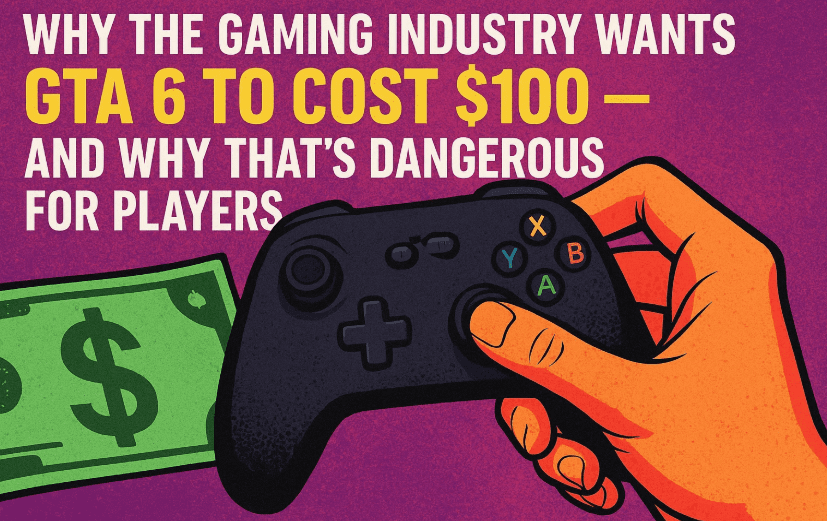
When you think of video-game hype, a few names always come to mind — Halo 3, Grand Theft Auto V, Red Dead Redemption 2. Each defined an era. But now, as anticipation builds for Grand Theft Auto VI, another conversation is taking over: not just when it will release, but how much it might cost.
In an industry already straining under rising prices, microtransactions, and subscription fatigue, talk of a $100 base price has alarmed many gamers. Developers, executives, and analysts are all watching closely — because if Rockstar Games does it successfully, it could reshape how every AAA game is priced in the future.
Let’s break down how we got here, why the idea is even being discussed, and what it could mean for players and the industry.
🕹️ 1. From Halo 3 to GTA 6 — How Hype Defines a Generation
To understand Grand Theft Auto VI’s current moment, you have to remember what Halo 3 meant to 2008.
It wasn’t just a video game — it was a cultural event. Whether or not you owned an Xbox 360, you recognized Master Chief. GameStop stores had murals of Halo 3 across their windows. Midnight launches drew lines around the block.
That level of public excitement has become rare — until now.
For the first time in years, a new title (GTA 6) is generating the same level of global curiosity. But there’s a difference: this time, the conversation isn’t just about graphics or gameplay — it’s about money.
💰 2. Where the $100 Price Rumor Came From
The debate began when Chris Stockmann, design director for the first Saints Row, said in an interview that GTA 6 might be the only game “deserving” of a $100 price tag — and that he “hoped” Rockstar would charge that much.
His statement spread quickly because it reflects what many executives might secretly want:
if GTA 6, the most anticipated game of the decade, can launch at $100 and still break records, other publishers could follow.
However, this sentiment ignores the harsh reality of the average player’s budget. For example, in Canada, a $100 USD game would cost roughly $140 CAD before taxes, or nearly $160 CAD at checkout — for a single title.
That’s more than what many players spend on two games per year.
🧩 3. Why Publishers Want Prices to Rise
Modern AAA development is expensive. Studios spend hundreds of millions on production, motion capture, actors, and global marketing. With budgets that rival Hollywood films, executives argue that higher prices are necessary.









But the real driver isn’t cost — it’s profit optimization.
Big publishers have already found ways to earn more without raising base prices:
- Microtransactions: cosmetics, skins, and boosters inside full-price games.
- Battle passes: seasonal monetization that keeps players spending.
- Deluxe editions: charging extra for early access or digital items.
- Subscription models: monthly passes like Game Pass or EA Play.
The concern is that a $100 base price won’t replace these models — it will add to them.
If GTA 6 succeeds at that price, companies like EA, Ubisoft, and Activision will likely follow suit — normalizing $100 as the “new standard” without removing in-game purchases.
💸 4. The Real Cost of Gaming Today
For most players, the cost of gaming has already increased dramatically even without a price hike.
Let’s look at how the economics break down:
- Base Game: $70 (standard edition)
- Season Pass or DLCs: $40–$60 per year
- Microtransactions / Skins: $20–$100 annually
- Online Subscriptions (PS Plus, Game Pass, etc.): $60–$180 per year
In total, the “true” annual cost for a gamer easily exceeds $200 to $400 USD — and that’s before factoring in hardware upgrades, peripherals, or storage space.
So when the industry hints at $100 games, players see it not as an adjustment for inflation, but as another example of corporate overreach.
🤖 5. The Role of AI and Cut Corners in Modern Game Development
Another uncomfortable truth is that many major studios are simultaneously cutting costs — not raising them.
Reports suggest that companies like EA and Microsoft are investing heavily in generative AI to automate dialogue, textures, or NPC behaviors. While these tools can speed up production, they also lead to layoffs and creative homogenization.
If development becomes cheaper through AI, yet prices rise, the extra revenue goes primarily to shareholders — not to the developers or the game itself.
That’s why many gamers question whether higher prices are really about “quality,” or just profit scaling.
🏙️ 6. GTA’s Legacy of Pushing Technology Forward
To be fair, Grand Theft Auto has always justified its reputation through innovation.
Let’s take a moment to revisit what made each entry revolutionary:
- GTA III (2001): Introduced a 3D open world with day/night cycles and voice-acted characters.
- Vice City (2002): Expanded narrative and aesthetic identity — a love letter to 1980s Miami.
- San Andreas (2004): Three cities, RPG-like character stats, and an enormous map on a PS2.
- GTA IV (2008): Advanced physics (Euphoria engine) and a detailed Liberty City environment.
- GTA V (2013): Seamless three-character system and a persistent online world.
Rockstar Games consistently delivers full, technically impressive releases — a rare trait in an era of incomplete “early-access” titles.
That history explains why GTA 6 has garnered such confidence, and why the industry believes it could “justify” a higher price.
🌇 7. Why GTA 6 Looks Like a True Next-Gen Leap
From everything we’ve seen so far, GTA 6 isn’t just another sequel — it’s a technical showcase.
Analysts and insiders describe features such as:
- Hyper-detailed world design: Vice City rebuilt with dynamic lighting and lifelike reflections.
- Reactive AI: NPCs responding to player actions in new ways.
- Enhanced physics and animation: real-time lighting and motion interpolation for ultra-smooth movement.
- Micro-level detail: environmental objects show dust, fingerprints, and surface wear.
These details might sound minor, but they represent years of engine optimization and artistic labor — the kind of advancement players used to see once per generation.
Still, technological achievement alone doesn’t automatically make a $100 price tag reasonable — especially when other publishers would use it to inflate less ambitious games.
🧠 8. Would Gamers Really Pay $100 for a Game?
History suggests yes — at least for Rockstar.
GTA V became one of the best-selling games in history, earning over $8 billion through its base game and online component.
If Rockstar priced GTA 6 at $100, millions would still buy it on day one.
But that doesn’t mean it’s right.
A small number of publishers dominate the AAA space. If one sets a precedent, consumers lose leverage.
It’s the same pattern we saw when microtransactions and loot boxes became normalized after a few popular titles introduced them.
⚖️ 9. Industry Consequences of a $100 Standard
If $100 games become the norm, several consequences are likely:
- Fewer Game Purchases – Average players might buy 1–2 titles per year instead of several, hurting smaller studios.
- Higher Piracy Rates – Price spikes often drive users toward illegal downloads.
- Widening Gap Between AAA and Indie Games – Indies may gain popularity as affordable alternatives.
- Monetization Pressure Still Remains – Even at $100, expect battle passes and in-game shops to stay.
- Loss of Trust – Players already feel that unfinished games and live services dominate the market.
For most gamers, the issue isn’t paying more for quality — it’s paying more for less content and fewer values delivered.
❓ 10. Frequently Asked Questions (Q&A)
Q1. Why do games cost more now than before?
Development budgets and marketing expenses have grown exponentially, but so have profit expectations. Most increases are business driven, not technical necessity.
Q2. Will GTA 6 actually cost $100?
As of now, Rockstar has not announced pricing. Most analysts expect a standard $70 release, with premium editions costing more.
Q3. Would a $100 price include all content and updates?
Unlikely. Modern games often separate story expansions or online modes into additional purchases even after launch.
Q4. Are there alternatives for budget gamers?
Yes — indie developers and AA studios produce incredible titles for a fraction of the cost. Games like Hollow Knight, Hades, and Baldur’s Gate 3 proved price doesn’t always equal quality.
Q5. When is GTA 6 actually coming out?
Officially announced for 2025, many expect a delay to late 2025 or early 2026 based on Rockstar’s track record.
🏁 11. Conclusion — How Much Is Too Much?
Grand Theft Auto VI will likely define the next decade of open-world gaming just as its predecessors did. Its graphics, AI, and world detail look phenomenal, and Rockstar’s dedication to craftsmanship is undeniable.
But the bigger question is whether the industry should allow its success to be used as justification for higher prices across the board.
Gamers have accepted $70 titles, DLCs, and microtransactions because they’ve had little choice. If $100 becomes standard, it won’t just make gaming more expensive — it will make it less accessible and less creative.
The best way to protect the future of gaming is simple: support developers who deliver quality at fair prices and hold corporations accountable when they don’t.
Because no matter how beautiful GTA 6 looks, its legacy should be about innovation — not inflation.
⚠️ Disclaimer
This article is for informational purposes only. All opinions expressed are based on public statements and industry analysis. Always purchase games through official sources and verify pricing from authorized retailers.
#GTA6 #RockstarGames #VideoGames #GamePrices #GamingIndustry #AAA #Halo3 #GameDevelopment #GameMonetization #OpenWorld #NextGen #PlayerRights