When you think of Rockstar Games, what comes to mind first? For most players, it’s massive maps, fast cars, and stories that keep you hooked. But beneath all the obvious attractions lies Rockstar’s real obsession—immersion.
Immersion isn’t just about pretty graphics or flashy ray-traced reflections. It’s about tricking your brain into believing you’re truly inside the world the developers have built. Miss one small detail, and suddenly the illusion breaks. That’s why some open-world games, though visually stunning at first glance, can feel hollow once you dive deeper.
So, what does Rockstar do differently? Why do their worlds feel alive while others feel like lifeless backdrops? Let’s break it down step by step, moving from the big, obvious systems to the quiet, hidden layers that hold everything together. By the end, you’ll see exactly why GTA 6 isn’t just another sequel—it’s shaping up to be one of the most immersive digital worlds ever created.]
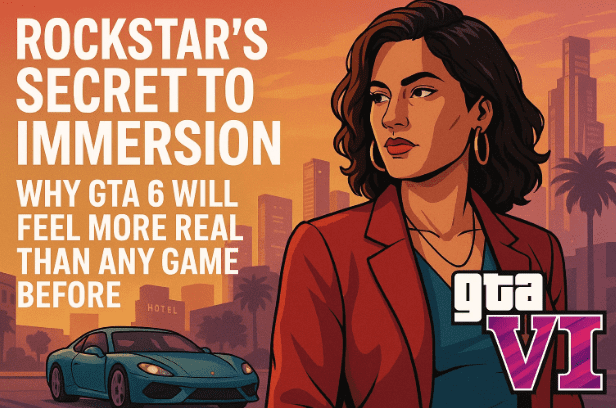
1. What Immersion Really Means in Gaming
Before we jump into GTA 6, let’s define immersion properly. Immersion isn’t just about 4K textures or realistic shadows. It’s about suspending disbelief—when your brain forgets that what you’re seeing is fake.
- Graphics are the icing on the cake.
- Immersion is the recipe, the layers, and the texture that make the cake feel real.
When immersion works, you don’t consciously notice the details. Instead, you feel them. The creak of a wooden floor, the way an NPC shields their eyes from the sun, or the sight of trash blowing across the street—all of these create an emotional reaction.
But immersion is fragile. One glitch, like an NPC walking through a wall, and the illusion shatters instantly. Rockstar knows this better than anyone, which is why their games are full of systems designed to eliminate these “speed bumps.”
2. Why Rockstar Obsesses Over Tiny Details
So why does Rockstar pour years into something as small as mud drying on a boot? The answer lies in how the human brain works.
We’re constantly scanning for contradictions. If a world looks fake, our brain rejects it. If it looks logical and consistent, our brain accepts it—without us even realizing.
This philosophy explains why Rockstar’s worlds feel so alive. They don’t just build cities; they simulate ecosystems where everything reacts in believable ways.
Let’s move to the next layer where this obsession becomes clear: scale and biomes.
3. Scale and Biomes: Making Every Place Feel Unique
Every Rockstar release brings not just bigger maps, but deeper ones. Red Dead Redemption 2 proved this with snow-covered peaks, dusty deserts, and swampy wetlands. Each biome wasn’t just visual variety—it changed how you played the game.












For GTA 6, Rockstar is taking the same philosophy into a fictionalized Florida. The world isn’t just about Vice City—it’s about regions that each feel like their own living organism:
- Swamps and rivers – crawling with gators and wading birds.
- Mount Kalaga trails – perfect for dirt biking and off-road adventures.
- Fishing towns – slower traffic, different accents, and working-class vibes.
- Nightlife districts – neon lights, music, and dense urban crowds.
This is what keeps the world immersive. The map isn’t a copy-paste of buildings; it’s a patchwork quilt of environments, each with its own personality.
4. Weather and Climate: Turning Nature Into Gameplay
Weather is one of Rockstar’s most powerful immersion tools. GTA 5 had basic transitions—sunny, foggy, rainy. Red Dead 2 made weather felt: storms soaked your clothes, fog rolled through valleys, and mud turned to puddles.
Now, GTA 6 sets the stage with Florida’s extreme climate:
- Humidity and haze make the air feel thick.
- Hurricanes create tension as cities brace with sandbags and warnings.
- Flooded streets force rerouting, changing how you play.
- Heat and sunburn affect NPCs and even the protagonists.
Imagine this: a thunderstorm rolls in. An NPC opens an umbrella, you bump into them, they stumble into a puddle, and water splashes everywhere. You don’t consciously think about the physics—it just feels real.
That’s Rockstar’s mastery. The world reacts in ways you don’t expect, but that always make sense.
5. Physics and Animation: The Glue of Realism
If weather sets the stage, physics and animation bring the performance. Most games rely on pre-scripted animations. Rockstar blends physics-driven systems with animation, meaning no two moments look the same.
- In Red Dead 2, a bullet could drop an enemy instantly, or send them stumbling.
- Horses slipped, struggled, and reacted like living animals.
- Characters moved with weight—Arthur’s boots sank into mud and snow.
GTA 6 builds on this foundation: hair sways naturally, clothes shift, and every stumble feels unpredictable. It’s these unscripted, chaotic moments that make the world feel alive.
6. NPC Behaviors and Memory Systems
Pedestrians in GTA 5 already followed traffic laws and reacted to chaos. Red Dead 2 advanced this with daily routines and memory systems—people remembered if you caused trouble.
Now, GTA 6 expands even further:
- Crowds are denser and more diverse. No more copy-paste pedestrians.
- Behaviors fit the environment. Construction workers act differently from beachgoers.
- Reputation systems mean NPCs may recognize you based on past actions.
This makes every interaction unpredictable. A bar fight might scatter some NPCs, while others pull out phones to record it. Suddenly, you’re not just playing—you’re part of a living society.
7. Environmental Storytelling Through Design
Rockstar treats environments as more than backgrounds. Every building, alley, and sign tells a story.
In Red Dead 2, you could read history from abandoned cabins and mining towns. In GTA 6, the details are modern:
- Graffiti-covered walls in Vice City.
- Fishing gear piled in coastal villages.
- Stray trash moving in the wind.
These details don’t need dialogue. They simply exist, reminding you that the world had a life long before you arrived.
8. Lighting, Atmosphere, and Emotional Impact
Lighting is the final touch that sells the illusion. Rockstar uses it not just to illuminate scenes, but to set moods:
- Warm lamp light feels safe.
- Harsh fluorescent lights feel sterile.
- Neon purples and pinks set a dangerous nightlife tone.
The day-night cycle adds even more depth: reflections shimmer differently in the sun than they do at night under neon. Lighting makes the world feel dynamic—alive in ways you don’t even consciously notice.
9. The Hidden Technology Behind Immersion
Finally, none of this would be possible without the tech under the hood. Rockstar’s patents reveal systems most players will never directly see:
- Procedural interior generation – making every store or office feel unique.
- Advanced rendering pipelines – eliminating pop-in and keeping performance stable.
- Machine learning motion capture – producing lifelike hand and finger movements.
These systems ensure that immersion doesn’t break, even in massive worlds running on consoles.
10. What GTA 6 Teaches Us About the Future of Gaming
GTA 6 is more than just a game release. It’s a demonstration of where open-world immersion is heading. Rockstar isn’t chasing bigger maps or shinier cars—it’s building digital worlds where everything reacts naturally.
That’s the future: not just games you play, but worlds you live inside of.
11. Frequently Asked Questions (FAQs)
Q1: Is immersion only about graphics?
No. Graphics help, but immersion comes from systems working together—NPC behavior, weather, physics, and world design.
Q2: Will GTA 6 run smoothly on consoles with all these systems?
Rockstar has developed patents for rendering and streaming that balance performance with detail, ensuring the illusion holds even on PS5 and Xbox Series X.
Q3: How is GTA 6 different from GTA 5 in terms of immersion?
GTA 6 takes the lessons from Red Dead 2—like dynamic weather, NPC routines, and environmental storytelling—and applies them to a modern urban setting.
Q4: Why do Rockstar games feel more alive than other open-world games?
Because Rockstar invests in small details that most studios skip. From puddle physics to NPC memory, every system is designed to support immersion.
12. Conclusion
So far, we’ve peeled back the layers of Rockstar’s design philosophy. From weather and physics to NPC routines and hidden rendering systems, every detail stacks into a believable whole.
That’s the secret of immersion. It’s not the flashy graphics you notice—it’s the details you don’t. The world simply feels logical, alive, and unforgettable.
With GTA 6, Rockstar isn’t just raising the bar for open-world games. They’re redefining what it means to live inside a digital world.
Disclaimer
This article is based on official Rockstar information, patents, and publicly available trailers/screenshots as of 2025. Features discussed here may change before the game’s final release.
Tags
GTA 6, Rockstar Games, immersion in gaming, open-world design, NPC behavior, game physics, video game technology, Red Dead Redemption 2, Vice City
Hashtags
#GTA6 #RockstarGames #GamingImmersion #OpenWorldGames #ViceCity #RedDeadRedemption2 #GameDesign