When Nintendo first released the original Switch back in 2017, it completely reshaped how we think about gaming. A single console that could transform from handheld to TV mode was a gamer’s dream. Fast forward to 2025, and we finally have its true successor — the Nintendo Switch 2.
But here’s the big question: what’s actually different this time?
Is it just another mid-cycle upgrade, or has Nintendo finally rebuilt the Switch experience from the ground up?
In this article, we’ll take a deep dive into every major difference — from hardware and display to Joy-Con design, audio, dock features, and even accessibility. So grab your controller, get comfortable, and let’s explore what really sets the Switch 2 apart from its predecessor.
🧩 1. Design and Build: A Familiar Shape with Smarter Engineering
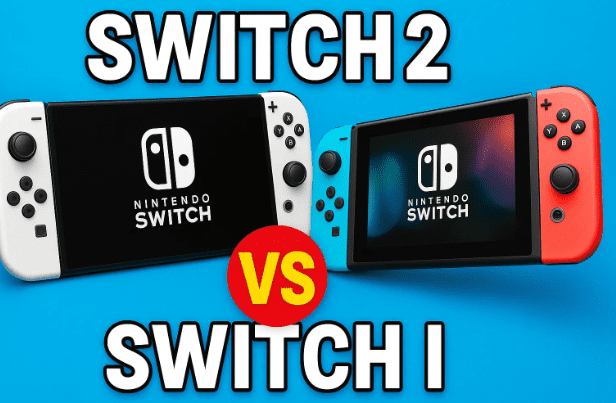
At first glance, the Switch 2 might look quite similar to the original. It’s still a rectangular hybrid console with detachable controllers and a central display. But once you start using it, the refinements become obvious.
Built-in Microphone and Audio Processor
Nintendo has finally added a built-in microphone on the upper edge of the console — something the original Switch never had. This microphone isn’t just for voice chat; it’s paired with a new audio processing chip that can remove background noise automatically. Early demos suggest it’s strong enough to eliminate the hum of a vacuum cleaner nearby.
This feature ties directly into one of Switch 2’s biggest software additions — Game Chat, which allows seamless in-game communication without external accessories or phone apps. (We’ll explore this more later.)
Dual USB-C Ports for Easier Charging
One of the original Switch’s most inconvenient design quirks was its single USB-C port located at the bottom. It made charging while playing in tabletop mode almost impossible.
The Switch 2 solves this elegantly by adding a second USB-C port on the top. Now, you can charge in handheld mode or while docked without awkward setups. It’s a small change, but one that instantly improves daily usability.
Refined Kickstand for Tabletop Gaming
Nintendo clearly listened to user feedback. The tiny kickstand from the original model — which often wobbled or snapped off — has been replaced with a full-width, dual-hinged kickstand.
This new version stretches across the back of the console, offering far better stability and adjustable viewing angles. Whether you’re on a train, flight, or desk, tabletop mode now feels practical rather than fragile.
🌈 2. Display and Visual Quality — Goodbye OLED, Hello HDR
Now let’s move to one of the most visually striking upgrades: the display.






While the Switch 2 doesn’t use OLED technology like the Switch OLED Model, it introduces High Dynamic Range (HDR) support. HDR significantly expands the contrast between light and dark areas, making colors look more vivid and realistic.
The difference is noticeable. Even without OLED’s deep blacks, the HDR screen of the Switch 2 delivers improved clarity and depth, especially in outdoor or bright environments. Games appear sharper and more detailed — it feels like a true generational jump in visual fidelity.
Larger Screen and Higher Resolution
Screen size jumps from 6.2 inches on the Switch 1 to 7.9 inches on the Switch 2 — a massive upgrade for handheld gaming. Along with this comes a new 1080p resolution (up from 720p).
That means portable gaming now looks crisper, text is easier to read, and small UI details pop beautifully. When docked, the console can even output up to 4K (upscaled) at 60 fps.
Some games will also support higher frame rates — up to 120 fps in performance mode — though most will lock at 60 fps for stability. Nintendo is finally catching up to modern display standards while keeping gameplay fluid.
🔊 3. Audio Improvements — Louder, Smarter, More Immersive
Audio quality was one of the weaker points of the original Switch. The Switch 2 addresses that with upgraded stereo speakers and 3D audio support.
In supported titles, you’ll feel sound moving around you — footsteps approaching, ambient rain shifting direction, or voices circling as if you’re inside the game world. It’s the kind of spatial audio effect previously limited to high-end headphones or consoles.
If you’ve ever watched 8D audio videos, imagine that but built directly into your handheld device.
⚙️ 4. Performance, Storage, and Battery Life
So far, we’ve looked at design and sound. Now let’s tackle the internals — performance, storage, and battery capacity — the backbone of any modern console.
Faster Storage and Quicker Load Times
The original Switch shipped with only 32 GB of internal storage — barely enough for today’s game sizes. The Switch 2 now includes 256 GB, which is a massive improvement, though still modest compared to other consoles.
The new SSD-based architecture enables faster read/write speeds, drastically reducing load times. You’ll notice smoother transitions between levels and fewer “Loading…” screens.
Of course, expandable microSD storage remains available for heavy users.
Battery: Bigger Capacity, Shorter Life
Nintendo increased battery capacity from 4,310 mAh to 5,220 mAh, but here’s the twist — despite the bigger battery, actual playtime is lower due to higher power demands.
Expect around 2 to 6 hours of gameplay, compared to the original’s 4.5 to 9 hours. That’s the trade-off for a larger screen, HDR visuals, and faster hardware.
A portable power bank might become your new best friend.
🧲 5. Joy-Con Evolution — Magnets, Mice, and More
If there’s one area where Nintendo always experiments, it’s controller design. The Switch 2 Joy-Cons introduce some of the boldest changes yet.
Magnetic Connection System
Gone are the old physical rails that slid into place. The new Joy-Cons use magnetic connectors. Early tests show these magnets are incredibly strong — you could lift the console by one Joy-Con without it detaching.
To release them, you’ll now use trigger-style release buttons instead of small side circles. It feels smoother, more ergonomic, and less fiddly.
Larger Analog Sticks and Better Button Design
Everything’s slightly bigger this time — from analog sticks to bumpers. The SR and SL buttons (used in sideways mode) are longer and easier to press, making multiplayer games like Mario Party far more comfortable.
The bumper buttons have also been extended for a firmer grip, while indicator lights now sit on the colored outer section, so you can instantly see which player number you are without tilting the controller.
Joy-Con as a Mouse
Here’s one of the quirkiest but most intriguing features: Joy-Cons can now act as mice.
When attached with the wrist strap accessory, small “mouse feet” underneath allow you to glide them across a surface.
This unlocks creative gameplay possibilities — especially in games like Mario Maker or puzzle titles that use touch controls even on TV mode.
Weight and Comfort
Each Joy-Con is slightly heavier now — around 2.3 oz (left) and 2.4 oz (right) — but the improved grip makes them feel sturdier. The new GameCube-inspired handles on the Pro Controller are thinner at the base, giving your fingers more room.
Nintendo has also removed the visible seam between the grips and the main body, resulting in a more premium, solid feel.
HD Rumble 2 and Internal Sensors
Remember HD Rumble from the first Switch? It’s back — but better.
HD Rumble 2 uses side-to-side magnetic vibrations instead of a spinning weight, offering smoother and more precise feedback.
The gyroscope and accelerometer sensors remain for motion control, though the IR camera from the right Joy-Con has been dropped (a logical choice since few games used it).
And yes, Nintendo promises the new analog sticks are quieter — though only time will tell if they finally fix the infamous drift problem.
🎧 6. Pro Controller Enhancements
The Pro Controller for the Switch 2 also receives meaningful updates.
It now features:
- A 3.5 mm audio jack for headsets and microphones.
- Two new programmable back buttons labeled GL and GR.
You can assign these to any input and save profiles per game and per user. For competitive players or accessibility needs, that flexibility is invaluable.
🧱 7. The Dock — Smaller, Cooler, Smarter
Nintendo has reworked the dock both inside and out.
Integrated Ethernet Port
No more dongles! The Switch 2 dock includes a built-in Ethernet port, eliminating lag for online play — something competitive gamers begged for since 2017.
4K Upscaling and Cooling Fan
Even when a game isn’t designed for native 4K, the dock can upscale output to 4K 60 fps on compatible TVs. Combined with HDR, even older titles look cleaner and sharper.
To prevent overheating (a common complaint on the original Switch), the dock now contains its own cooling fan. That means longer docked sessions without performance throttling.
Fewer Ports, But Better Layout
The Switch 2 dock removes one of the old rear USB ports, but compensates with the console’s top USB-C port, which remains accessible even while docked. You still get two USB ports on the side, perfect for controllers or accessories.
Overall, the dock feels more streamlined — functional minimalism done right.
💻 8. Software and User Interface
When you first power on the Switch 2, it still feels comfortably familiar — the signature clean layout returns — but with subtle, meaningful upgrades.
Faster eShop and Rounded Icons
The eShop finally loads quickly. The original Switch 1 eShop was notorious for sluggish performance and poor responsiveness. On Switch 2, navigation is snappy, images load instantly, and downloads begin within seconds.
The home-screen icons now feature rounded corners instead of sharp squares, giving the interface a more modern aesthetic.
Expanded Profile Customization
You can now choose from 258 user profile icons, up from 147 on the Switch 1.
Themes, backgrounds, and accessibility options tie neatly into this visual refresh — making the console feel much more personal.
🗣️ 9. New Game Chat and Game Share Features
Here’s where the Switch 2 truly steps into the online era.
Built-In Game Chat
For the first time, Nintendo introduces integrated Game Chat directly on the console — no more phone apps or external software. You can host video chats with up to 12 participants, with four screens shared simultaneously.
Even better, Nintendo is offering Game Chat free until March 31, 2026, encouraging early adopters to try it out.
Game Share
Another standout addition is Game Share — a revival of the old Nintendo DS “Download Play” spirit.
With Game Share, one player can share parts of a supported game with up to three others. It’s perfect for quick multiplayer sessions without everyone owning the full copy.
Cross-compatibility works between Switch 2 and Switch 1, though only Switch 2 users can combine it with voice chat.
It’s nostalgic yet forward-looking — a great nod to Nintendo’s multiplayer heritage.
♿ 10. Accessibility — Finally Taking It Seriously
The original Switch was charming but sorely lacking in accessibility options. Thankfully, the Switch 2 changes that with a dedicated Accessibility menu loaded with new features.
Here’s what you’ll find:
- Adjustable text size and bold fonts for better readability.
- High-contrast, grayscale, and dark mode options.
- Full button remapping, allowing complete controller customization.
- Orientation rotation, so games expecting sideways grip can be held vertically.
- A built-in screen reader for on-screen text and menus.
- Speech-to-text and text-to-speech support inside Game Chat.
These features bring Nintendo closer to industry standards set by Microsoft’s Xbox Accessibility Toolkit and PlayStation’s accessibility profiles. It’s a major step forward for inclusivity in gaming.
⚖️ 11. Weight and Dimensions Comparison
| Feature | Switch 1 | Switch 2 |
|---|---|---|
| Console Weight | 0.88 lb | 1.1 lb |
| Dock Weight | 0.72 lb | 0.84 lb |
| Joy-Con (L) | 1.7 oz | 2.3 oz |
| Joy-Con (R) | 1.8 oz | 2.4 oz |
| Screen Size | 6.2 in LCD 720p | 7.9 in HDR 1080p |
| Storage Capacity | 32 GB | 256 GB |
| Battery Life | 4.5 – 9 hrs | 2 – 6 hrs |
While it’s heavier overall, the balance and improved ergonomics make it feel more solid in hand. The slightly larger footprint accommodates the bigger display and cooling system.
💬 12. Quick Recap — Key Improvements at a Glance
Before we wrap up, let’s recap the highlights:
- Built-in microphone with advanced noise cancellation.
- Dual USB-C ports for flexible charging.
- HDR 7.9-inch display with 1080p resolution.
- Magnetic Joy-Cons with larger sticks and improved buttons.
- HD Rumble 2 and mouse functionality.
- Pro Controller with audio jack + back buttons.
- 256 GB storage and faster load times.
- Game Chat & Game Share for seamless multiplayer.
- Improved dock with Ethernet and 4K upscaling.
- Comprehensive accessibility settings.
Together, these upgrades make the Switch 2 a true generational leap — not just a visual refresh.
❓ 13. Frequently Asked Questions
Q 1: Is the Switch 2 backward compatible with Switch 1 games?
Yes, it supports both digital and physical Switch 1 titles, so your existing library works right out of the box.
Q 2: Does the Switch 2 have OLED?
No, it uses a standard HDR LCD panel. However, its dynamic-range boost compensates impressively for color depth.
Q 3: Can I use old Joy-Cons with the Switch 2?
Yes, though the new magnetic ones include extra features like mouse control and improved rumble.
Q 4: Will all accessories work with the new dock?
Most will, but check official compatibility on Nintendo’s website.
Q 5: How much does it cost?
The standard Switch 2 is expected to retail around $449 USD, with bundle variations depending on storage and region.
Q 6: Does the Switch 2 support 4K gaming?
Yes — through upscaling in dock mode. Native 4K games are still limited, but the improvement is clearly visible on modern TVs.
🏁 14. Final Verdict — A True Next Step for Hybrid Gaming
So, is the Switch 2 worth upgrading to?
Absolutely — especially if you play handheld or value modern features like HDR, faster loading, and integrated voice chat.
The Switch 1 still holds up for casual players, but the Switch 2 feels like a refined, future-proof console designed for the next decade of portable gaming.
It’s faster, cleaner, more immersive, and finally competitive with modern hardware expectations — while keeping that unmistakable Nintendo charm intact.
If the original Switch was a revolution, the Switch 2 is its elegant evolution — confident, connected, and cleverly improved in all the right places.
⚠️ Disclaimer
All hardware specifications and feature details are based on early 2025 information. Final retail units may vary slightly by region or firmware. Always refer to Nintendo’s official Switch website for the latest updates and compatibility notes. The author is not responsible for discrepancies between beta and retail hardware.
#NintendoSwitch2 #SwitchComparison #GamingNews #HybridConsole #NintendoFans #JoyCon #Switch2Features #GameChat #HDRGaming #PortableConsole