The global technology landscape has always been built on partnerships, rivalries, and constant innovation. Some alliances seemed so strong that they felt unshakable — until now. Imagine one of the most powerful marriages in tech history suddenly collapsing, not because of a scandal or a failed merger, but because one partner simply decided it no longer needs the other.
That’s exactly what we’re witnessing today. China, the world’s second-largest economy, is pulling away from Intel, one of Silicon Valley’s most iconic companies. And this isn’t just a small separation — it’s a decisive move that could reshape the entire global semiconductor industry.
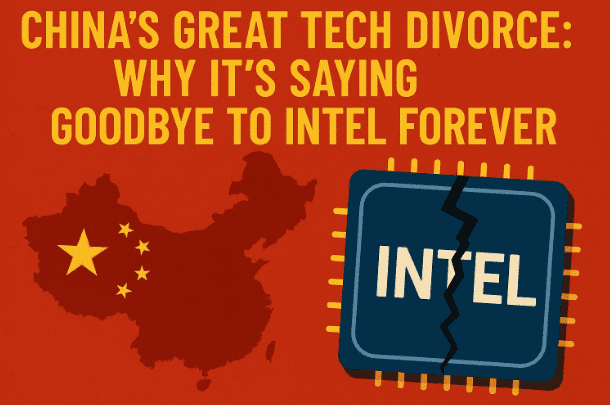
This isn’t just about chips. It’s about power, control, and the very foundations of the digital future. Let’s dive into the story behind this seismic shift.
📖 Table of Contents
- From Allies to Rivals: The History of U.S.–China Tech Cooperation
- The Symbiotic Relationship That Powered Globalization
- When Harmony Turned to Friction: The Tech War
- Made in China 2025: The Push for Independence
- The Silent Breakthrough: Why China Doesn’t Need Intel Anymore
- The Rise of RISC-V: Open-Source Chips for a New Era
- Global Implications: Supply Chains, Innovation, and Fragmentation
- Questions and Answers: What This Means for You
- The Future of Computing: Multipolar or Divided?
- Conclusion: The Silent Revolution Reshaping the World
1. From Allies to Rivals: The History of U.S.–China Tech Cooperation
For decades, the United States and China maintained a complex but mutually beneficial relationship in technology. U.S. companies like Intel designed some of the world’s most advanced processors, while China, with its massive population and rising tech sector, became both a customer and a competitor.
China’s consumer electronics industry boomed with Intel processors inside PCs, servers, and smartphones. Meanwhile, Intel enjoyed immense profits by selling millions of chips to Chinese manufacturers. It looked like a partnership that could last forever.
But beneath the surface, cracks were already forming.
2. The Symbiotic Relationship That Powered Globalization
To understand the breakup, we first need to appreciate just how tightly the U.S. and Chinese tech industries were woven together.
- The U.S. contribution: Cutting-edge chip design, research, and global brand dominance.
- China’s contribution: A gigantic consumer base, low-cost manufacturing, and government-backed investment in tech growth.
This relationship fueled not just profits but also globalization itself. Companies like Intel, AMD, Qualcomm, and ARM thrived by selling intellectual property, while Chinese companies like Huawei, Lenovo, and Xiaomi thrived by manufacturing devices for the global market.
It was a classic case of “you design, we build.” But things began to change.
3. When Harmony Turned to Friction: The Tech War
The first real cracks appeared with the U.S.–China trade war in the late 2010s. Washington placed restrictions on exports of advanced chips to Chinese firms. Huawei, once a rising smartphone giant, was blacklisted.
Intel and other U.S. chipmakers suddenly found themselves in the middle of geopolitics. They could no longer sell their most advanced products freely. For China, this wasn’t just an inconvenience — it was a wake-up call.








Relying on a foreign power for something as critical as semiconductors meant being permanently vulnerable.
4. Made in China 2025: The Push for Independence
In response, Beijing doubled down on its Made in China 2025 initiative. The strategy was clear:
- Build domestic semiconductor fabs (factories).
- Invest in local design firms like SMIC (Semiconductor Manufacturing International Corporation) and HiSilicon (Huawei’s chip arm).
- Develop domestic EDA software (Electronic Design Automation) to reduce reliance on Western tools.
- Train a new generation of engineers to close the talent gap.
At first, skeptics dismissed this as over-ambitious. After all, Intel had a decades-long head start, and chip manufacturing is one of the most technically demanding industries in the world. But something surprising happened — China started catching up fast.
5. The Silent Breakthrough: Why China Doesn’t Need Intel Anymore
So, what exactly changed?
The hidden story lies in speed. While Intel struggled with delays in moving to smaller process nodes (10nm, 7nm, etc.), Chinese firms made rapid progress despite sanctions. Within a decade, domestic Chinese processors began matching — and in some cases surpassing — the performance of imported chips.
Even more importantly, China realized it didn’t need to chase Intel forever. Instead of competing directly on x86 architecture, it started investing in alternative chip designs. That’s where the game-changing moment arrives.
6. The Rise of RISC-V: Open-Source Chips for a New Era
The “divorce” between Intel and China was made possible by a new player: RISC-V.
- What is RISC-V?
RISC-V is an open-source Instruction Set Architecture (ISA). Unlike Intel’s x86 or ARM’s architecture, which require expensive licensing, RISC-V is free for anyone to use, modify, and build upon. - Why does it matter?
Because now Chinese firms don’t need Intel’s permission — or its patents — to design world-class chips. They can innovate on their own terms.
Chinese companies are already producing RISC-V based processors for:
- IoT devices (smart sensors, wearables).
- Telecommunications equipment.
- Artificial Intelligence accelerators.
- High-performance computing.
By combining RISC-V with massive state-backed funding and domestic manufacturing, China has unlocked a path to independence.
This is more than just a technical shift. It’s a philosophical one: a move from proprietary, Western-controlled standards to an open-source future where no single country dominates.
7. Global Implications: Supply Chains, Innovation, and Fragmentation
This breakup is not just a problem for Intel. It’s a turning point for the entire semiconductor industry and even for global geopolitics. Let’s unpack the consequences:
🌍 Supply Chains Splitting in Two
We may see a bifurcated tech world:
- The West (U.S., Europe, allies) continues relying on Intel, AMD, and ARM.
- China (and possibly other countries aligning with it) builds around RISC-V and domestic ecosystems.
💡 Innovation Opportunities
Open-source chip design could accelerate creativity worldwide. Startups and research labs that couldn’t afford Intel or ARM licenses can now build custom chips.
⚠️ Risks of Fragmentation
But there’s also a downside. If two incompatible ecosystems emerge, interoperability becomes harder. Imagine software, hardware, and apps working in one world but not the other. This could slow down global innovation.
8. Questions and Answers: What This Means for You
Let’s pause for a moment and address some common questions readers might have.
Q1: Does this mean Intel will lose all of its Chinese market?
Not immediately. Intel still has contracts, legacy systems, and certain advantages. But over time, as China’s domestic chips improve, its dependence will decline sharply.
Q2: What is RISC-V’s biggest advantage over Intel’s x86?
Flexibility and openness. RISC-V allows customization for specific industries (like AI or 5G), whereas x86 is tightly controlled and costly to license.
Q3: Will this affect the devices I buy as a consumer?
Yes, indirectly. In a few years, you might find your smartphone, laptop, or even car powered by chips designed entirely in China, without Intel inside.
Q4: Could this lead to a “Tech Cold War”?
That’s a real risk. With supply chains splitting, both sides may push to dominate their own ecosystems, reducing cooperation and raising costs globally.
Q5: Should Western companies adopt RISC-V too?
Many already are experimenting with it. Even giants like Google and Qualcomm have shown interest. Ignoring it could be a mistake.
9. The Future of Computing: Multipolar or Divided?
We are standing at a crossroads.
- One path leads to a multipolar tech world, where open standards like RISC-V democratize innovation and reduce monopolies.
- The other path leads to fragmentation, where East and West develop incompatible systems, slowing global progress and fueling rivalry.
Which future we get will depend not just on China and Intel, but also on how governments, corporations, and open-source communities respond.
10. Conclusion: The Silent Revolution Reshaping the World
The “Intel divorce” is more than a business story. It’s the beginning of a silent revolution. By embracing RISC-V and self-reliance, China has declared its independence from Silicon Valley’s legacy dominance.
For Intel, the challenge is existential. Adapt to the new open-source reality — or risk fading into irrelevance.
For the rest of us, the stakes are global. From smartphones to satellites, from AI to defense, the chips inside our devices shape the balance of power in the 21st century.
This isn’t just about technology. It’s about who controls tomorrow.
Tags
Intel, China, semiconductors, RISC-V, chip war, technology independence, Made in China 2025, global supply chains, AI chips, geopolitics
Hashtags
#Intel #China #Semiconductors #RISC-V #TechWar #GlobalTrade #AI #ChipIndustry #Geopolitics #Technology
⚠️ Disclaimer: This article is for informational purposes only. It reflects ongoing trends and publicly available analysis in the semiconductor industry. It does not provide financial advice or endorse any political position.
Would you like me to also create a timeline-style infographic (showing Intel–China relations from cooperation → trade war → RISC-V adoption) to make this article more visually engaging?